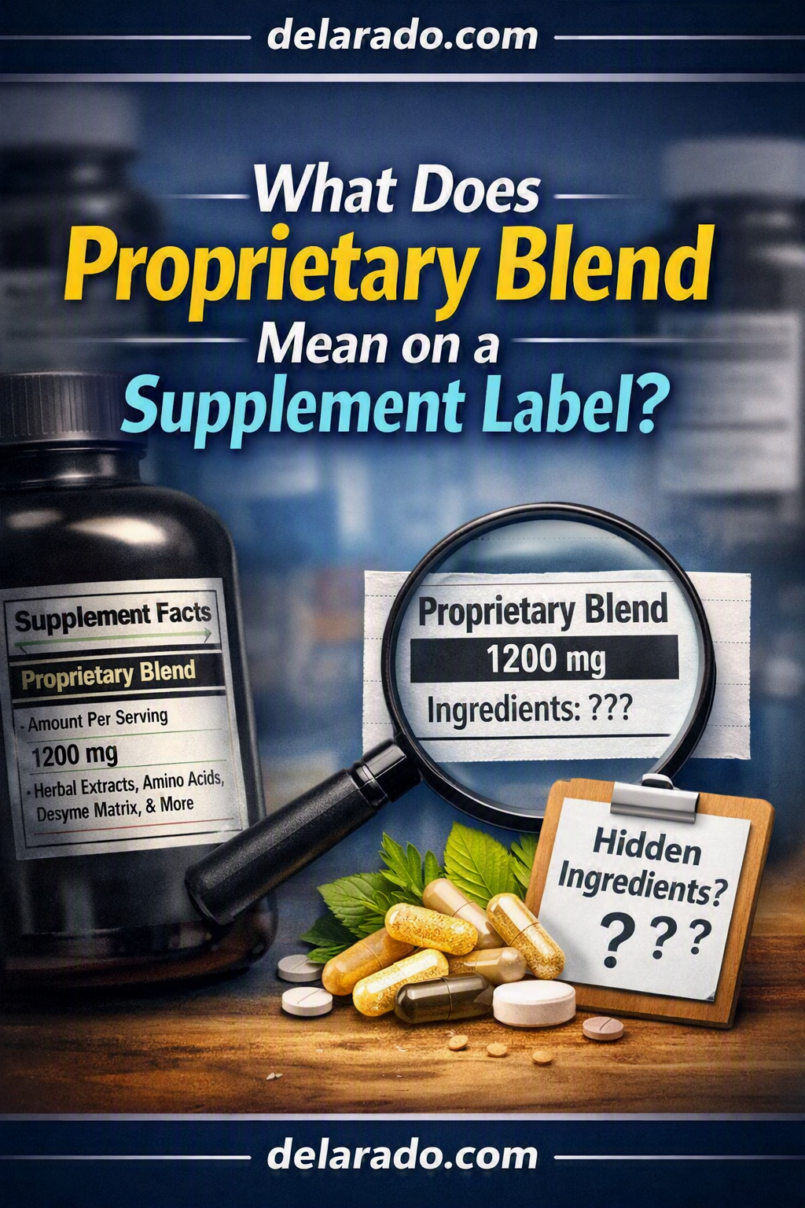
A proprietary blend is a mixture of dietary ingredients grouped together under one name on a Supplement Facts label. The label typically shows the total weight of the entire blend, but it may not show the exact amount of each individual ingredient inside that blend.
For example, a pre-workout, greens powder, sleep supplement, energy product, or herbal formula may list an “Energy Matrix,” “Performance Complex,” “Focus Blend,” or “Proprietary Formula.” You may see all of the ingredients named, but not know how much caffeine, creatine, herbal extract, amino acid, or stimulant is included.
Quick answer: A proprietary blend can make it harder to assess dose, compare a product with research, avoid duplicate ingredients, and identify what may be causing side effects. When possible, choose supplements that list the exact amount of every active ingredient.
What Is a Proprietary Blend?
A proprietary blend is a group of dietary ingredients combined into one formula and listed under a shared name. The blend may be given a technical, branded, or marketing-focused name, such as:
- Proprietary Blend
- Energy Matrix
- Focus Complex
- Performance Formula
- Recovery Blend
- Thermogenic Blend
- Sleep Support Complex
- Herbal Wellness Matrix
- Superfood Blend
- Advanced Nutrient System
Instead of listing the individual amount of every ingredient, the label may list only the combined weight of the full blend.
Energy and Focus Matrix — 1,500 mg
Green tea extract, guarana seed extract, L-theanine, taurine, ginseng root extract, caffeine.
In this example, the label tells you that the entire blend weighs 1,500 milligrams. However, it does not tell you how much green tea extract, guarana, L-theanine, taurine, ginseng, or caffeine is included.
This makes it difficult to determine the exact dose of any one ingredient.
What Does a Proprietary Blend Look Like on a Supplement Label?
A proprietary blend is usually listed within the Supplement Facts panel. It may appear as a bolded heading followed by a total quantity and a list of ingredients underneath.
Example of a Proprietary Blend Label
Serving Size: 1 Scoop
Performance Complex: 3,000 mg
Creatine monohydrate, beta-alanine, citrulline malate, taurine, beetroot extract.
The product tells you the full blend weighs 3,000 mg, but you cannot see the individual amount of creatine, beta-alanine, citrulline malate, taurine, or beetroot extract.
The same label may include other ingredients elsewhere, such as flavors, sweeteners, capsule materials, colors, or preservatives. Always read both the Supplement Facts panel and the Other Ingredients list.
Why Do Supplement Companies Use Proprietary Blends?
Companies may use proprietary blends to protect what they consider a unique formula. If the exact amount of every ingredient were listed, competitors could more easily copy the product’s formula.
Some companies also use proprietary blends for convenience when combining many ingredients in one product. However, a blend can also make a formula look more complex or impressive without clearly showing whether each ingredient is present in a meaningful amount.
Common Reasons Companies Use Blends
- To protect a formula from being copied.
- To combine many ingredients under one product-specific name.
- To simplify the visual appearance of a long ingredient list.
- To market a unique “complex,” “matrix,” or “system.”
- To avoid disclosing the exact dose of individual ingredients.
Protecting a formula may be a legitimate business reason, but it does not change the practical limitation for consumers: you cannot fully assess individual ingredient doses from the label.
What Must a Proprietary Blend Label Show?
On a properly labeled supplement, a proprietary blend should identify the blend, state the total quantity of the blend per serving, and list the dietary ingredients included in it.
The label may not need to show the exact amount of each individual ingredient in the blend. This is the defining feature of a proprietary blend.
A Proprietary Blend Label Typically Shows:
- The name of the blend, formula, matrix, complex, or proprietary system.
- The combined total weight of the blend per serving.
- The ingredients included in the blend.
- Ingredients generally listed from the greatest to the smallest amount by weight.
- The supplement serving size.
- Directions and warning statements.
- Other ingredients outside the blend, such as sweeteners, capsule materials, or flavorings.
Even when ingredients are listed in order by weight, the order is only a clue. It does not tell you the exact amount of each ingredient.
What Can Ingredient Order Tell You?
Ingredients within a proprietary blend are generally listed in order from the greatest amount by weight to the smallest amount by weight. This can provide a limited clue about the formula.
Focus Blend — 1,000 mg
L-theanine, lion’s mane mushroom extract, ginkgo biloba extract, caffeine.
Based on the listed order, L-theanine is likely present in a greater amount by weight than lion’s mane, which is likely present in a greater amount than ginkgo biloba, which is likely present in a greater amount than caffeine.
However, the label does not reveal the actual dose. For example, you do not know whether the caffeine amount is 20 mg, 100 mg, 200 mg, or another amount.
Why Ingredient Order Is Not Enough
- You do not know the exact dose of any ingredient.
- You cannot confirm whether a key ingredient is present in a studied amount.
- You cannot reliably calculate total daily intake from multiple products.
- You may not know how much caffeine, stimulant, herb, or amino acid you are taking.
- You cannot easily compare one proprietary blend with another.
What a Proprietary Blend Cannot Tell You
A proprietary blend may list all the ingredients, but it leaves important questions unanswered. The total blend weight does not tell you how much of each ingredient is included.
| What the Label May Tell You | What the Label May Not Tell You |
|---|---|
| The total weight of the full blend. | The exact amount of each individual ingredient. |
| The names of ingredients in the blend. | Whether an ingredient is present in a meaningful amount. |
| The ingredient order by weight. | The precise dose of a stimulant, herb, amino acid, or other compound. |
| The recommended serving size. | Whether the formula matches a dose used in available research. |
| The product’s marketing category, such as energy or sleep. | Whether the product is suitable for your medical history or medications. |
This uncertainty is why transparent, fully disclosed formulas are often easier for consumers to evaluate.
Potential Risks of Proprietary Blends
A proprietary blend is not automatically unsafe. However, hidden individual doses can create practical safety and decision-making problems.
1. You May Not Know the Dose of a Key Ingredient
Some ingredients have potential side effects, medication interactions, or dose-related concerns. Without the individual amount, it is difficult to know how much you are taking.
2. You Cannot Easily Compare the Formula With Research
Research on an ingredient often uses a specific dose. If a label hides the dose, you cannot tell whether the product contains an amount similar to what has been studied.
3. Ingredient Overlap Is Harder to Identify
You may be using multiple products that contain the same ingredients, such as caffeine, green tea extract, ginseng, magnesium, melatonin, or other compounds. A proprietary blend makes it harder to calculate your total intake.
4. Stimulants May Be Difficult to Track
Energy and pre-workout products may contain caffeine or stimulant-containing botanical ingredients. If the product does not disclose individual amounts, it can be difficult to monitor your total stimulant intake from coffee, tea, energy drinks, pre-workouts, fat burners, and other products.
5. Side Effects Can Be Harder to Trace
If you develop nausea, headaches, digestive upset, jitteriness, sleep changes, skin reactions, or other symptoms, it may be difficult to identify which ingredient and dose contributed to the reaction.
6. A Formula Can Look More Impressive Than It Is
A long ingredient list can make a product appear comprehensive. However, a large number of ingredients does not prove that each one is present in a meaningful amount or that the product is more effective.
Common Supplements That May Use Proprietary Blends
Proprietary blends can appear in many types of products, especially formulas that combine multiple ingredients.
- Pre-workout powders
- Energy supplements
- Fat burners and weight-loss products
- Greens powders
- Superfood powders
- Sleep-support formulas
- Stress-support blends
- Focus and nootropic products
- Testosterone or hormone-support products
- Immune-support formulas
- Herbal wellness blends
- Digestive-support formulas
- Muscle-building and recovery products
- Sexual-performance supplements
Extra caution is appropriate with products marketed for rapid weight loss, extreme energy, bodybuilding, sexual performance, hormone support, or “detoxification.”
How to Read a Proprietary Blend Label
If you are considering a supplement with a proprietary blend, use the following checklist.
- Find the serving size. Confirm how many capsules, gummies, scoops, or tablets equal one serving.
- Find the blend name. Look for “proprietary blend,” “complex,” “matrix,” “formula,” or a branded ingredient group.
- Check the total blend weight. Note the total milligrams or grams provided per serving.
- Read every ingredient listed in the blend. Watch for vitamins, minerals, herbs, stimulants, amino acids, caffeine, and ingredients you already use elsewhere.
- Review ingredient order. Earlier ingredients are generally present in greater amounts by weight than later ones, but the exact amount remains unknown.
- Look for hidden stimulant sources. Check for caffeine, guarana, green tea extract, yerba mate, kola nut, or other stimulant-containing ingredients.
- Check other ingredients. Review sweeteners, flavors, capsule materials, allergens, and additives.
- Read warnings and directions. Do not exceed the recommended serving.
- Compare against your other products. Consider coffee, energy drinks, multivitamins, powders, gummies, medications, and other supplements.
- Consider a more transparent alternative. If the dose matters and cannot be verified, choose a product that lists exact amounts.
Better Alternatives to Proprietary Blends
When possible, choose supplements with transparent labels. A transparent formula lists every active ingredient and the exact amount per serving.
What to Look For Instead
- Single-ingredient supplements with a clear dose.
- Multi-ingredient products that list the amount of each ingredient.
- Clear serving size and directions.
- Visible warnings and safety information.
- Transparent manufacturer contact details.
- Lot numbers and expiration dates.
- Third-party testing or certification when available.
- Realistic claims instead of guaranteed results.
Why Transparent Labels Are Easier to Use
Knowing exact doses makes it easier to:
- Compare products.
- Assess potential ingredient overlap.
- Review possible medication interactions.
- Identify whether an ingredient amount fits your goal.
- Track side effects.
- Discuss the product with a doctor, pharmacist, or registered dietitian.
Who Should Be Extra Careful With Proprietary Blends?
Anyone can benefit from reading proprietary blend labels carefully, but extra caution is especially important for people who have a higher risk of interactions or side effects.
- People who take prescription medications.
- People who use over-the-counter medications regularly.
- Pregnant people.
- People who are breastfeeding.
- People trying to become pregnant.
- Children and teenagers.
- Older adults taking multiple medications.
- People with heart conditions or blood-pressure concerns.
- People with anxiety, sleep problems, or caffeine sensitivity.
- People with diabetes, kidney conditions, liver conditions, or thyroid concerns.
- People preparing for surgery or a medical procedure.
- Competitive athletes subject to banned-substance testing.
Speak with a doctor, pharmacist, or registered dietitian before using a proprietary blend if you have health concerns, take medication, or cannot identify the individual doses of ingredients that may affect you.
Common Proprietary Blend Mistakes to Avoid
- Assuming a proprietary blend is automatically unsafe or automatically high quality.
- Believing the total blend weight is the amount of the headline ingredient.
- Assuming every ingredient is present in an effective amount.
- Ignoring ingredient order within the blend.
- Overlooking caffeine and stimulant-containing ingredients.
- Combining several products with hidden ingredient amounts.
- Taking more than the labeled serving.
- Using a blend without checking medication interactions.
- Trusting dramatic marketing claims instead of reading the Supplement Facts panel.
- Using products that make it difficult to identify the source of side effects.
- Assuming “natural” herbal blends are risk-free.
- Choosing a complex blend when a transparent single-ingredient product would better fit the goal.
Top 10 Questions About Proprietary Blends
1. What does proprietary blend mean on a supplement label?
A proprietary blend is a group of dietary ingredients combined under one name. The label usually lists the total amount of the full blend, but it may not list the exact amount of each ingredient inside it.
2. Are proprietary blends legal?
Yes. Supplement labels can use proprietary blends when they follow applicable labeling requirements, including identifying the blend, listing its total weight, and naming the ingredients included in the blend.
3. Does a proprietary blend show every ingredient?
It should list the dietary ingredients included in the blend, but it may not show the exact amount of each ingredient. The total blend weight is listed instead.
4. Are ingredients in a proprietary blend listed in order?
Ingredients are generally listed in descending order by weight, from greatest to smallest. However, this only provides a general clue and does not reveal the exact dose of each ingredient.
5. Is a proprietary blend always bad?
Not necessarily. A proprietary blend is not automatically unsafe or ineffective. However, it provides less dose transparency, which can make it harder to assess safety, compare products, avoid overlap, and identify the cause of side effects.
6. Why do companies use proprietary blends?
Companies may use them to protect a unique formula from being copied, combine many ingredients under one name, or avoid revealing the exact dose of each individual ingredient.
7. Can proprietary blends hide caffeine?
They can make the exact amount of caffeine harder to identify. Some blends include caffeine or stimulant-containing ingredients such as guarana, green tea extract, yerba mate, or kola nut without clearly showing the individual amount of each.
8. How can I tell if a proprietary blend contains enough of an ingredient?
You often cannot tell from the label alone because the individual dose is not disclosed. A transparent product that lists exact amounts is easier to compare and evaluate.
9. Should I avoid proprietary blends if I take medication?
You should be especially careful. Hidden individual doses can make medication interaction screening more difficult. Ask a doctor or pharmacist before using a proprietary blend if you take medication or have a health condition.
10. What is better than a proprietary blend?
A fully disclosed formula is usually easier to evaluate. Look for products that clearly list every active ingredient and its exact amount per serving.
Final Takeaway
A proprietary blend is a supplement formula that lists a total combined amount for a group of ingredients without revealing each individual dose. While these blends may be used to protect formulas, they make it harder for consumers to assess ingredient amounts, compare products, avoid overlap, monitor stimulant intake, and evaluate possible side effects.
Whenever possible, choose supplements with transparent labels that show the exact amount of every active ingredient. If a proprietary blend contains stimulants, herbs, high-dose nutrients, or ingredients that may interact with your medications, pause and ask a pharmacist, doctor, or registered dietitian before using it.