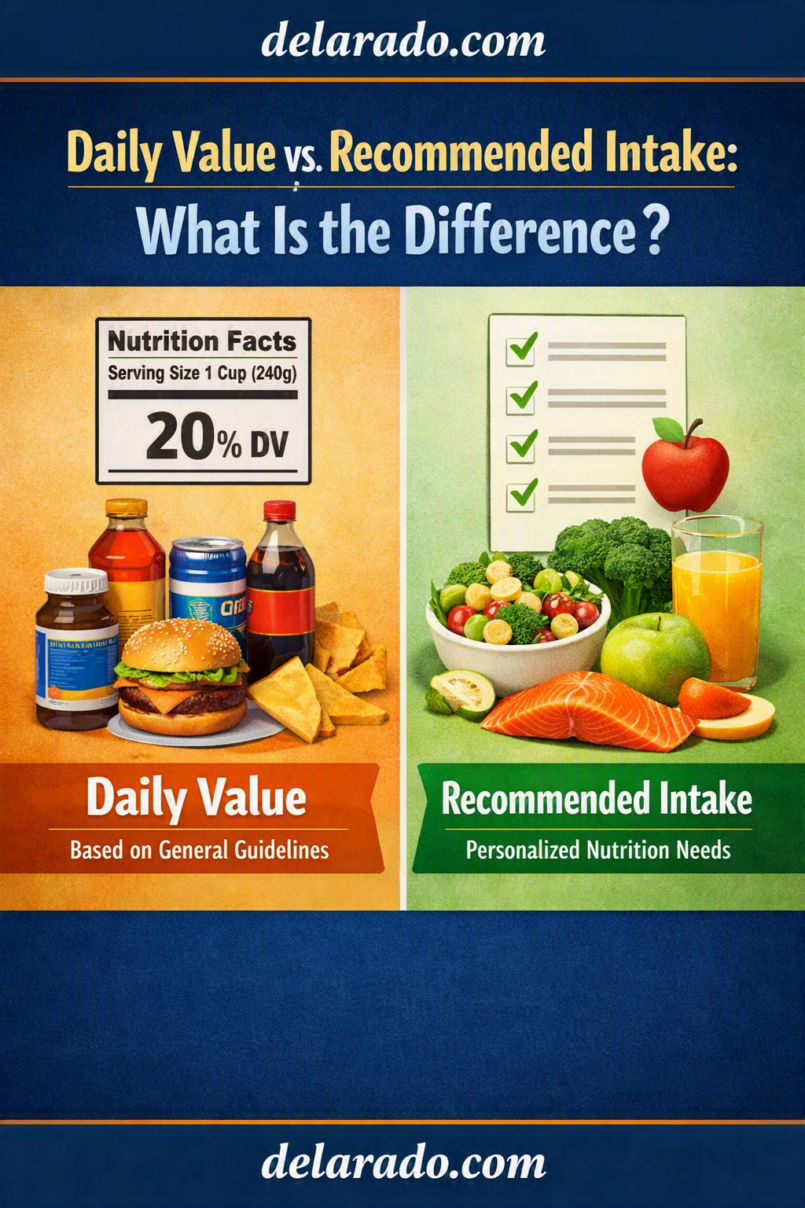
Daily Value and recommended intake are related, but they are not the same thing. A Daily Value, or DV, is a general reference number used on food and supplement labels to help consumers understand how much of a nutrient one serving provides. A recommended intake is a nutrition target designed for specific groups of people based on factors such as age, sex, pregnancy, breastfeeding, and life stage.
In simple terms, the Daily Value helps you read labels, while recommended intake values help guide nutrition planning for individuals and population groups. Understanding the difference can help you use Nutrition Facts and Supplement Facts labels more confidently and avoid assuming that one percentage applies equally to everyone.
Quick answer: Daily Value is a standardized label reference. Recommended intake is a more individualized nutrition guideline that varies by age, sex, life stage, and other health factors.
Daily Value vs. Recommended Intake at a Glance
| Term | Main Purpose | Who It Is Designed For | Where You See It |
|---|---|---|---|
| Daily Value (DV) | Helps consumers understand nutrient amounts on packaged food and supplement labels. | A broad reference for people ages 4 and older. | Nutrition Facts and Supplement Facts labels. |
| Percent Daily Value (%DV) | Shows how much one serving contributes to the Daily Value. | A broad reference for label readers. | Nutrition Facts and Supplement Facts labels. |
| Recommended Dietary Allowance (RDA) | Helps plan nutrient intake for most healthy people in a specific group. | Specific age, sex, and life-stage groups. | Nutrition guidance, clinical discussions, and professional resources. |
| Adequate Intake (AI) | Provides an intake goal when there is not enough evidence to establish an RDA. | Specific age, sex, and life-stage groups. | Nutrition guidance and professional resources. |
| Estimated Average Requirement (EAR) | Estimates the amount needed by about half of healthy people in a group. | Specific age, sex, and life-stage groups. | Nutrition research and population planning. |
| Tolerable Upper Intake Level (UL) | Identifies the highest average daily intake unlikely to pose risk for most people. | Specific age and life-stage groups. | Nutrition safety guidance and professional resources. |
The main takeaway is that a Daily Value is designed for clear label reading, while recommended intake values are designed to help assess and plan nutrient intake more precisely.
What Is Daily Value?
Daily Value, commonly shortened to DV, is a reference amount used on food and dietary supplement labels. It helps consumers compare products and understand how much of a nutrient is contained in one serving.
For example, a package may show that one serving provides a certain amount of calcium, vitamin C, fiber, sodium, or another nutrient. The label may then show the Percent Daily Value to explain how that amount fits into a general daily reference.
Daily Values are standardized for labeling. In most cases, there is one Daily Value for a nutrient for people ages 4 and older. This makes labels easier to read, but it also means the number is not tailored to every individual.
What Daily Value Is Used For
- Comparing similar packaged foods.
- Comparing vitamin and mineral supplements.
- Identifying nutrients that are present in low or high amounts per serving.
- Understanding what a serving contributes to a general daily intake.
- Checking for overlap across supplements, powders, fortified foods, gummies, and drinks.
Daily Value is a helpful label tool, but it is not a personalized prescription for how much of every nutrient you should take.
What Is Percent Daily Value (%DV)?
Percent Daily Value, shown as %DV, tells you what percentage of the Daily Value is provided by one serving of a food or supplement.
Vitamin C: 90 mg — 100% DV
This means one serving provides 100% of the general Daily Value used for vitamin C on the label.
As a general label-reading guide:
- 5% DV or less is generally considered low.
- 20% DV or more is generally considered high.
A high %DV does not automatically mean a product is better, necessary, safer, or more effective. It simply tells you that one serving contains a higher amount of that nutrient relative to the Daily Value.
What Is Recommended Intake?
Recommended intake is a broad phrase used to describe nutrient intake targets developed to help people meet nutritional needs. These recommendations are part of a larger system commonly called Dietary Reference Intakes, or DRIs.
Unlike a Daily Value, recommended intake values can vary based on:
- Age
- Sex
- Pregnancy
- Breastfeeding
- Life stage
- Health status
- Individual nutritional needs
Different terms within the Dietary Reference Intake system have different purposes. The most common are Recommended Dietary Allowance, Adequate Intake, Estimated Average Requirement, and Tolerable Upper Intake Level.
What Is a Recommended Dietary Allowance (RDA)?
A Recommended Dietary Allowance, or RDA, is the average daily intake level of a nutrient that is expected to meet the needs of nearly all healthy people in a specific age, sex, and life-stage group.
For many nutrients, the RDA is used as a practical target for usual intake. It is more specific than a Daily Value because different groups have different needs.
Why RDAs Vary
The RDA for a nutrient may differ between:
- Children and adults
- Men and women
- Older and younger adults
- Pregnant and non-pregnant people
- Breastfeeding and non-breastfeeding people
This is why a supplement label showing 100% DV does not necessarily mean it provides exactly the amount recommended for every individual person.
What Is an Adequate Intake (AI)?
An Adequate Intake, or AI, is used when there is not enough scientific evidence to establish an RDA for a nutrient. It is based on observed or estimated intake levels believed to support nutritional adequacy in healthy people.
An AI can be used as a practical intake goal when an RDA is not available. Like RDAs, AIs can vary by age, sex, and life stage.
The important difference is that an RDA is based on stronger evidence about the amount needed by most healthy people, while an AI is used when the evidence is not sufficient to calculate an RDA.
What Is an Estimated Average Requirement (EAR)?
An Estimated Average Requirement, or EAR, is an intake level estimated to meet the nutrient needs of about half of healthy people in a particular age, sex, and life-stage group.
The EAR is mainly useful for nutrition research, assessing nutrient intakes in groups of people, and helping establish the RDA. It is not generally the best individual target because it is designed to meet the needs of only about half of people in a group.
In simple terms:
- An EAR may meet the needs of about half of people in a group.
- An RDA is set higher to meet the needs of nearly all healthy people in that group.
What Is a Tolerable Upper Intake Level (UL)?
A Tolerable Upper Intake Level, or UL, is the highest average daily intake level that is unlikely to cause adverse health effects for most people in a specific group.
A UL is not a recommended goal. It is a safety limit. Regularly consuming more than the UL may increase the risk of harmful effects for some nutrients.
Why the UL Matters for Supplements
Supplements can make it easier to consume high amounts of certain vitamins and minerals. Ingredient overlap can occur when someone uses several products at the same time, such as:
- A multivitamin
- An individual vitamin or mineral supplement
- A greens powder
- An immune-support drink or gummy
- A meal-replacement shake
- A protein powder with added nutrients
- Fortified foods and beverages
The UL is one reason high-dose supplements should be used carefully. More is not always better, and a product with a high %DV is not automatically appropriate for daily use.
Why Daily Value and Recommended Intake Are Different
Daily Value and recommended intake values have different jobs. A label needs a simple, standardized system that helps shoppers compare products quickly. Individual nutrition planning requires more detail because nutrient needs differ between people.
| Daily Value | Recommended Intake |
|---|---|
| Used primarily on packaged food and supplement labels. | Used for nutrition planning and assessing nutrient needs. |
| Usually one number per nutrient for people ages 4 and older. | Often changes by age, sex, pregnancy, breastfeeding, and life stage. |
| Designed to make labels easier to compare. | Designed to better reflect differences in nutrient requirements. |
| Shown as a percentage per serving. | Usually expressed as a daily intake amount for a defined population group. |
| Helpful for label reading but not individualized. | More useful for personalized nutrition discussions. |
Daily Values often match or exceed the recommended intake for many people, but they do not always match every person’s RDA or AI. This is why it is important not to treat %DV as a personal requirement or a medical recommendation.
How to Use Daily Value and Recommended Intake
Use Daily Value and recommended intake information for different purposes.
Use Daily Value to Read Labels
- Compare two similar products.
- See whether one serving is relatively low or high in a nutrient.
- Identify products with added vitamins and minerals.
- Spot possible ingredient overlap across supplements.
- Understand what a serving contributes to a general daily intake.
Use Recommended Intake for Nutrition Planning
- Discuss nutrient needs with a doctor, pharmacist, or registered dietitian.
- Consider life-stage needs, such as pregnancy or older adulthood.
- Assess dietary patterns and possible nutrient gaps.
- Review lab-confirmed deficiencies.
- Make individualized decisions about supplements.
For most people, the best approach is food first: build a varied eating pattern and use supplements only when there is a clear reason to do so.
Daily Value and Dietary Supplement Labels
Daily Value is especially useful on Supplement Facts labels because it can help you see whether a product provides a small, moderate, or high amount of a vitamin or mineral.
How to Read a Supplement Facts Label
- Check the serving size. The %DV applies to one full serving, which may be more than one capsule, gummy, tablet, or scoop.
- Find the ingredient amount. Review the amount in milligrams, micrograms, grams, or other units.
- Read the %DV. See how much one serving contributes to the general Daily Value.
- Check other products. Look for the same nutrient in multivitamins, powders, drinks, fortified foods, and individual supplements.
- Review warnings and directions. Follow label instructions unless a qualified professional has advised otherwise.
- Consider your personal needs. A high %DV may be unnecessary, helpful, or inappropriate depending on your situation.
Why Some Ingredients Do Not Have a %DV
Not every ingredient has an established Daily Value. Herbs, amino acids, probiotics, digestive enzymes, creatine, collagen, caffeine, and many specialty ingredients may be listed as “Daily Value Not Established.”
When no %DV is available, focus on the actual dose, serving size, product quality, directions, safety warnings, medication interactions, and whether there is a clear reason to use the ingredient.
Practical Examples: DV vs. Recommended Intake
Example 1: A Multivitamin With 100% DV
Vitamin C: 90 mg — 100% DV
This means one serving provides the full Daily Value used on the label for vitamin C. It does not automatically mean that everyone should take the product, that more vitamin C is better, or that the product replaces a varied diet.
Example 2: A High-Dose Vitamin Product
Vitamin B12: 1,000 mcg — 41,667% DV
A very high %DV tells you that the product provides far more than the general Daily Value. It does not tell you whether that amount is needed for your situation. Consider the reason for use, other products you take, and advice from a qualified healthcare professional.
Example 3: A Nutrient With Different Needs by Life Stage
A Daily Value gives one general number for label reading, while a recommended intake may differ by age, sex, pregnancy, or breastfeeding status. This is why a supplement label cannot replace personalized nutrition guidance.
Example 4: An Ingredient Without a Daily Value
Creatine Monohydrate: 5 g — Daily Value Not Established
Creatine does not have an established Daily Value on labels. Instead of relying on a percentage, review the amount per serving, directions, other ingredients, possible side effects, product quality, and your reason for using it.
Common Mistakes to Avoid
- Assuming Daily Value and recommended intake are the same thing.
- Thinking 100% DV is the perfect amount for every person.
- Assuming a higher %DV always means a better supplement.
- Confusing a UL with a recommended intake goal.
- Using an EAR as a personal nutrient target.
- Ignoring serving size before reviewing %DV.
- Combining multiple products without checking for overlapping nutrients.
- Taking high-dose vitamins or minerals without a clear reason.
- Ignoring medication interactions and warning statements.
- Using supplements instead of addressing food, sleep, hydration, or medical concerns.
- Assuming “Daily Value Not Established” means an ingredient is safe or effective.
Top 10 Questions About Daily Value and Recommended Intake
1. Is Daily Value the same as the recommended daily intake?
No. Daily Value is a standardized label reference used on foods and supplements. Recommended intake values, such as the RDA or AI, are designed for specific age, sex, and life-stage groups.
2. What does 100% Daily Value mean on a supplement?
It means one serving provides 100% of the general Daily Value used on the label for that nutrient. It does not mean that amount is right, necessary, or ideal for every person.
3. What is the difference between DV and RDA?
DV is a broad reference used for product labels. RDA is a recommended average daily intake intended to meet the needs of nearly all healthy people in a specific age, sex, and life-stage group.
4. What is the difference between RDA and AI?
An RDA is established when enough evidence exists to determine the nutrient amount needed by most healthy people. An AI is used when the evidence is not sufficient to establish an RDA, but there is enough information to estimate an adequate intake level.
5. What is the difference between RDA and EAR?
An EAR is estimated to meet the nutrient needs of about half of healthy people in a group. An RDA is set higher and is intended to meet the needs of nearly all healthy people in that group.
6. What does UL mean in nutrition?
UL means Tolerable Upper Intake Level. It is the highest average daily amount unlikely to pose a risk for most people. It is a safety limit, not a recommended daily target.
7. Does %DV account for my age, sex, or pregnancy status?
No. %DV is based on a general label reference. It does not account for individual factors such as age, sex, pregnancy, breastfeeding, health conditions, medication use, or lab results.
8. Can I add the %DV amounts from different supplements?
You can use %DV as a quick comparison tool, but you should also add the actual amounts of repeated nutrients from all products you use. Check serving sizes carefully.
9. Why do some supplements say “Daily Value Not Established”?
Some ingredients, including many herbs, probiotics, amino acids, enzymes, and specialty compounds, do not have an established Daily Value for labeling purposes.
10. Should I take a supplement that provides more than 100% DV?
Not automatically. A high %DV may be appropriate in some situations, but it may also be unnecessary or unsuitable. Consider the nutrient, dose, your other products, your health situation, and professional guidance.
Final Takeaway
Daily Value is a label-reading tool. Recommended intake is a broader set of nutrition guidelines that takes age, sex, life stage, and other factors into account. Both can be useful, but they serve different purposes.
Use %DV to compare products and spot nutrient overlap. Use individualized nutrition guidance when making decisions about deficiencies, high-dose supplements, pregnancy, medication interactions, health conditions, or long-term supplement use.