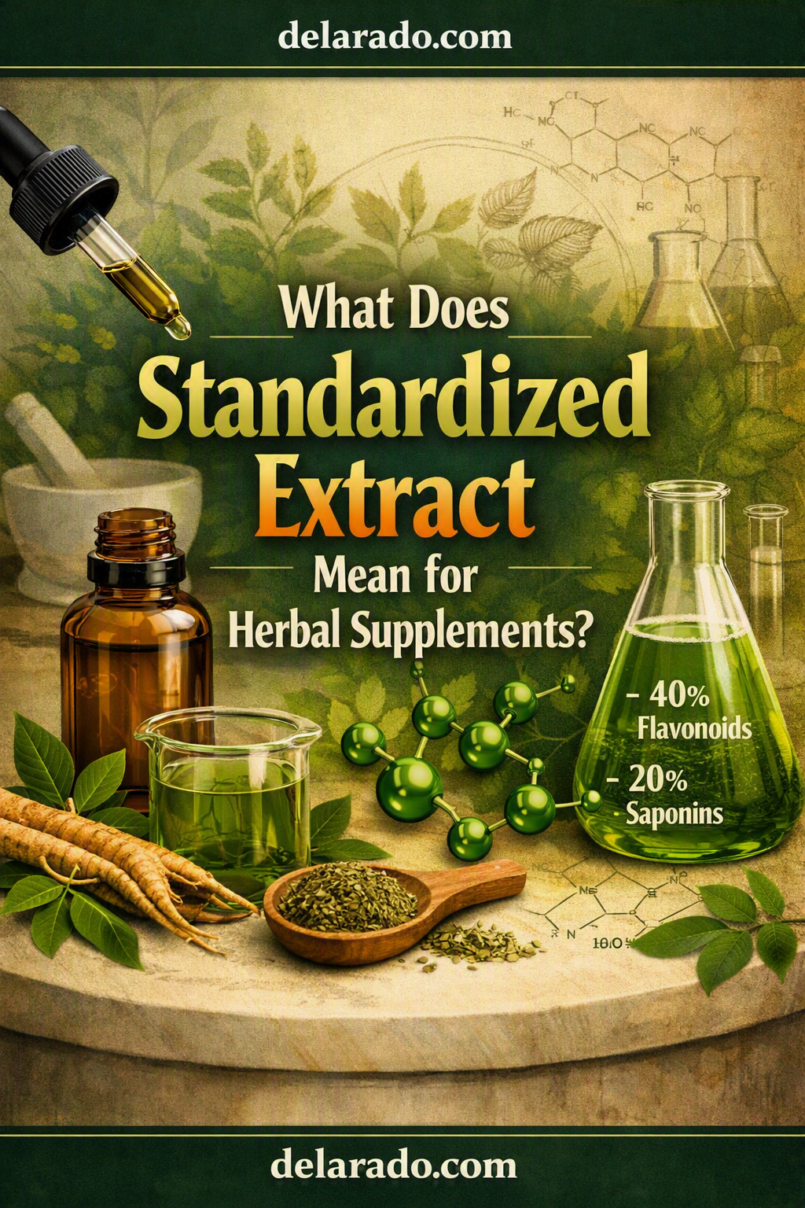
What Does Standardized Extract Mean for Herbal Supplements?
A standardized extract is an herbal ingredient processed and measured to provide a stated amount or percentage of one or more naturally occurring compounds. On a supplement label, this may look like “standardized to 5% withanolides,” “standardized to 95% curcuminoids,” or “standardized to 24% flavone glycosides.”
In practical terms, standardization is intended to make one batch of an herbal extract more chemically consistent with another batch. However, the word “standardized” does not automatically prove that a product is high quality, effective, safe, clinically tested, or appropriate for every person.
Quick answer: A standardized extract tells you that an herbal product is intended to contain a consistent amount of a specified compound or group of compounds. Always check the herb, plant part, extract amount, standardization percentage, actual milligrams of the compound, directions, warnings, medication interactions, and product quality.
What Is a Standardized Herbal Extract?
A standardized herbal extract is a concentrated plant preparation that has been measured or adjusted to provide a consistent level of one or more selected plant compounds.
Plants naturally vary. Their chemical makeup can change because of differences in species, plant part, soil, climate, growing conditions, harvest time, storage, processing, and extraction method. Standardization is intended to reduce some of this batch-to-batch variation.
A label may identify a standardized extract in several ways:
- “Standardized to 5% withanolides”
- “Standardized to 95% curcuminoids”
- “Standardized to 24% flavone glycosides”
- “Contains 20% saponins”
- “Provides 50 mg of polyphenols”
- “Standardized extract providing 10 mg of a named plant compound”
The label may provide the percentage of a compound, the milligrams of a compound, or both. The most useful labels clearly identify the plant, plant part, extract amount, standardization target, and amount per serving.
How Are Herbal Extracts Made?
Herbal extracts are made by using a liquid or other extraction process to draw selected compounds out of plant material. The finished extract may then be dried into a powder, added to capsules, mixed into gummies, used in liquids, or blended into other supplement formulas.
Plant Materials May Include:
- Roots
- Leaves
- Flowers
- Seeds
- Bark
- Fruit
- Stems
- Rhizomes
- Whole plant material
Common Extraction Methods May Use:
- Water
- Alcohol
- Water and alcohol combinations
- Glycerin
- Oil
- Other specialized extraction processes
Different extraction methods can pull different compounds from the same plant. This is one reason two supplements made from the same herb may not be interchangeable.
Why Are Herbal Extracts Standardized?
Standardization is intended to help a manufacturer produce a more consistent product. If a company targets a specific plant compound or group of compounds, it can test batches and adjust the extract to meet a stated specification.
Potential Benefits of Standardization
- May improve batch-to-batch consistency.
- May help consumers compare products with a similar standardization target.
- May make it easier to identify the amount of a selected compound.
- May help researchers describe the herbal material used in a study.
- May provide more detail than a label that says only “herbal extract.”
However, standardization does not guarantee that the selected compound is the only important compound in the herb. Many plants contain numerous compounds that may work together, and scientific understanding of these interactions can be incomplete.
What Are Marker Compounds?
A marker compound is a chemical component used to identify, measure, or standardize an herbal ingredient. It may be chosen because it is naturally present in the plant, easy to measure, associated with the plant’s identity, or believed to relate to the intended use of the extract.
For example, an herbal extract may be standardized to a percentage of:
- Withanolides
- Curcuminoids
- Ginsenosides
- Flavonoids
- Polyphenols
- Saponins
- Rosavins
- Ginkgolides
- Valerenic acids
- Other plant-specific compounds
A marker compound can be useful for verifying that an extract meets a stated specification. But a marker compound is not always the only compound responsible for an herb’s effects.
Marker Compounds vs. Active Compounds
It is important not to assume that every standardized compound is a proven “active ingredient.” In herbal products, the compound used for standardization may be a marker used for consistency rather than the only compound responsible for the herb’s biological effects.
| Term | What It Means | Important Limitation |
|---|---|---|
| Marker Compound | A compound measured to identify or standardize an herbal ingredient. | It may not be the only compound that matters for the herb’s effects. |
| Active Compound | A compound believed to contribute to a biological effect. | Herbal activity may involve multiple compounds rather than one isolated ingredient. |
| Standardized Extract | An extract adjusted or measured to contain a defined amount of selected compound(s). | Standardization alone does not prove safety, effectiveness, or clinical relevance. |
For many herbs, the full plant chemistry is complex. A label that highlights one compound may provide useful information, but it should not be treated as a complete explanation of how the herb works.
How to Read a Standardized Extract Label
A clear herbal supplement label should help you identify what plant is used, what part of the plant is used, how much extract is included, and what the extract is standardized to contain.
Look for These Details
- Common plant name: Such as turmeric, ashwagandha, ginseng, or ginkgo.
- Scientific name: A Latin botanical name can help identify the specific plant species.
- Plant part: Root, leaf, seed, bark, flower, fruit, rhizome, or whole herb.
- Extract amount: The total amount of the extract per serving, often listed in milligrams.
- Standardization percentage: The percentage of the named compound or compound group.
- Actual standardized compound amount: The number of milligrams provided, if listed.
- Serving size: The number of capsules, gummies, tablets, drops, or scoops that equal one serving.
- Other ingredients: Capsule materials, sweeteners, allergens, flavors, and additives.
- Directions and warnings: Instructions, cautions, storage details, and use restrictions.
- Quality information: Expiration date, lot number, manufacturer details, and third-party testing when available.
Example Label
Ashwagandha Root Extract: 600 mg
Standardized to: 5% withanolides
Serving Size: 2 Capsules
This label tells you that one serving contains 600 mg of ashwagandha root extract and that the extract is intended to contain 5% withanolides.
How to Calculate the Amount of a Standardized Compound
If the label gives the extract amount and the standardization percentage, you can estimate the amount of the standardized compound.
Extract amount × standardization percentage = estimated amount of the standardized compound
Example 1: Ashwagandha Extract
600 mg extract × 5% withanolides = 30 mg withanolides
Example 2: Turmeric Extract
500 mg extract × 95% curcuminoids = 475 mg curcuminoids
Example 3: A Lower-Percentage Extract
250 mg extract × 20% compound group = 50 mg of the listed compound group
This calculation can help you compare similar standardized extracts. However, it does not prove that one product will work better or be safer than another. The herb, plant part, extraction method, formula, quality, intended use, and your individual health situation still matter.
What Do Herbal Extract Ratios Mean?
Some herbal supplements use an extract ratio, such as 4:1, 10:1, 20:1, or another ratio. An extract ratio is intended to describe the relationship between the starting plant material and the final extract.
Herbal Extract 10:1
This may indicate that 10 parts of starting plant material were used to produce 1 part of finished extract.
Extract ratios can be helpful, but they do not automatically indicate strength, quality, effectiveness, or equivalence between products.
Why Extract Ratios Can Be Misleading
- Different plants contain different natural concentrations of compounds.
- Different plant parts can produce different extracts.
- Different extraction methods can pull different compounds from the plant.
- The ratio does not always reveal the amount of a standardized compound.
- A higher ratio does not automatically mean a better or stronger product.
- The final extract may include carriers or processing ingredients.
A 10:1 extract is not automatically “twice as strong” as a 5:1 extract. To make a useful comparison, look at the herb, plant part, extract amount, standardization information, intended use, and label transparency.
Standardized Extract vs. Whole Herb
A standardized extract and a whole-herb product are not necessarily the same. Both can contain plant-derived material, but they may differ in concentration, chemical profile, preparation, dose, and intended use.
| Standardized Extract | Whole Herb or Whole Plant Powder |
|---|---|
| Concentrated plant preparation. | Usually dried and ground plant material. |
| May be measured or adjusted to a stated compound percentage. | May contain the plant’s broader natural mix of compounds. |
| Often listed in milligrams with a standardization target. | Often listed as a weight of plant powder or plant material. |
| May offer more batch-to-batch consistency for a selected compound. | May vary more naturally between harvests and batches. |
| Does not automatically mean more effective or safer. | Does not automatically mean gentler, safer, or less potent. |
Neither form is automatically better for every purpose. The most appropriate choice depends on the specific herb, formulation, intended use, dose, evidence, safety profile, and your health situation.
Does “Standardized” Mean High Quality?
No. The word “standardized” can be useful, but it is not a guarantee of quality, purity, safety, effectiveness, or consistent manufacturing practices.
A standardized extract may still have important unanswered questions, including:
- Is the plant species accurately identified?
- Is the stated plant part actually used?
- Is the extract amount appropriate for the intended use?
- Is the stated standardization percentage accurate?
- Was the product tested for contaminants?
- Does the product contain undeclared ingredients?
- Does the formula contain other herbs, stimulants, or additives?
- Can the product interact with medications?
- Is there credible information supporting its intended use?
Better Quality Signals to Look For
- Clear herb name, scientific name, and plant part.
- Exact extract amount per serving.
- Clearly stated standardization percentage or compound amount.
- Transparent list of all other ingredients.
- Lot number and expiration date.
- Sealed, undamaged packaging.
- Manufacturer contact details.
- Third-party testing or certification when available.
- Realistic claims and visible warnings.
Herbal Supplement Safety, Side Effects, and Interactions
Herbal supplements can affect the body. A standardized extract can provide a more consistent level of a plant compound, but it can also deliver a concentrated dose. “Natural” and “standardized” do not mean risk-free.
Potential Safety Concerns
- Medication interactions.
- Digestive upset, headaches, sleep changes, or skin reactions.
- Changes in blood pressure, blood sugar, heart rate, or mood.
- Increased bleeding risk with certain ingredients.
- Effects on liver enzymes or how the body processes medications.
- Allergic reactions.
- Ingredient overlap from multiple herbal blends.
- Contamination, mislabeling, or poor-quality products.
Talk to a Qualified Healthcare Professional First If You:
- Take prescription medication.
- Use over-the-counter medication regularly.
- Are pregnant, breastfeeding, or trying to become pregnant.
- Are giving an herbal supplement to a child or teenager.
- Have kidney, liver, heart, endocrine, autoimmune, digestive, or bleeding-related conditions.
- Have diabetes, high blood pressure, seizures, anxiety, depression, or thyroid concerns.
- Are preparing for surgery, dental work, or medical testing.
- Use blood thinners, diabetes medication, blood-pressure medication, seizure medication, mood medication, or immune-related medication.
Stop using a supplement and seek medical advice if you suspect a side effect. Seek urgent medical care for serious symptoms such as trouble breathing, swelling of the face or throat, chest pain, fainting, severe rash, confusion, seizures, or unusual bleeding.
How to Choose a Standardized Herbal Supplement More Wisely
Choose herbal supplements based on a specific purpose, transparent labeling, safety considerations, and realistic expectations. Avoid buying a product simply because it is trending, called natural, or marketed as a quick solution.
- Define your goal. Know why you are considering the herb.
- Check the specific herb. Confirm the common name, scientific name, and plant part.
- Read the extract details. Look for the total extract amount and the standardization percentage.
- Calculate the standardized compound amount if needed. Multiply extract amount by the stated percentage.
- Check for transparent labeling. Avoid vague formulas that hide doses behind proprietary blends.
- Review other ingredients. Check for allergens, sweeteners, caffeine, stimulants, fillers, and added herbs.
- Review warnings and medication interactions. Ask a pharmacist or doctor if you take medication.
- Choose reputable sources. Look for company details, lot numbers, expiration dates, sealed packaging, and quality testing when available.
- Start one product at a time. This makes it easier to track possible benefits and side effects.
- Reassess regularly. Continue only if the product has a clear purpose and acceptable safety profile.
Common Mistakes to Avoid
- Assuming “standardized” means clinically proven.
- Assuming “standardized” means safe for everyone.
- Thinking the standardized compound is always the only active part of an herb.
- Comparing products only by extract ratio.
- Assuming a higher extract ratio is always stronger or better.
- Ignoring the actual milligrams of the extract per serving.
- Ignoring serving size and directions.
- Taking multiple herbal blends without checking for ingredient overlap.
- Using herbal supplements without checking medication interactions.
- Starting several herbal products at once.
- Trusting exaggerated detox, energy, weight-loss, hormone, or cure claims.
- Using a product with unclear plant identity, plant part, or dose.
Top 10 Questions About Standardized Herbal Extracts
1. What does standardized extract mean on an herbal supplement label?
It means the herbal extract is intended to contain a stated amount or percentage of one or more selected plant compounds. Standardization is used to improve chemical consistency between batches.
2. Is a standardized herbal extract better than a whole-herb supplement?
Not automatically. A standardized extract may provide more consistency for a selected compound, while a whole-herb product may contain a broader natural mix of plant compounds. The better option depends on the herb, intended use, dose, quality, safety, and individual needs.
3. What does “standardized to 5%” mean?
It means the extract is intended to contain 5% of a named compound or compound group. For example, 600 mg of an extract standardized to 5% would provide an estimated 30 mg of that standardized compound.
4. Does a higher standardization percentage mean a better supplement?
No. A higher percentage only means the extract contains more of the specified compound relative to the extract weight. It does not automatically mean the product is more effective, safer, higher quality, or more appropriate for your situation.
5. What is a marker compound?
A marker compound is a plant chemical measured to identify or standardize an herbal ingredient. It may be used for consistency, but it is not always the only compound responsible for the herb’s effects.
6. What does a 10:1 herbal extract ratio mean?
A 10:1 ratio may indicate that 10 parts of starting plant material were used to make 1 part of finished extract. It does not automatically tell you how strong, effective, or comparable the extract is to another product.
7. Can standardized herbal extracts interact with medications?
Yes. Herbal extracts can affect the body and may interact with prescription or over-the-counter medicines. Speak with a doctor or pharmacist before use if you take medication or have a medical condition.
8. Does standardized mean the product is tested for contaminants?
Not necessarily. Standardization refers to the stated level of selected plant compounds. It does not automatically confirm testing for contaminants, identity, purity, heavy metals, microbes, or undeclared ingredients.
9. How can I compare two standardized herbal extracts?
Compare the plant species, plant part, extract amount, standardization percentage, actual standardized compound amount, serving size, other ingredients, warnings, quality information, and the reason you are considering each product.
10. Should I take a standardized herbal extract every day?
That depends on the herb, dose, intended purpose, medication use, health history, and safety information. Do not assume daily use is appropriate simply because a product is sold over the counter. Ask a qualified healthcare professional if you are uncertain.
Final Takeaway
A standardized herbal extract is designed to provide a consistent amount of a selected plant compound or compound group. This can make an herbal label more informative, but it does not guarantee that the supplement is high quality, clinically proven, safe, or right for every person.
Read beyond the word “standardized.” Check the herb, plant part, extract amount, standardization percentage, actual compound amount, serving size, other ingredients, warnings, medication interactions, expiration date, and manufacturer information. If you take medication, are pregnant or breastfeeding, have a health condition, or are unsure about a product, talk with a doctor, pharmacist, or registered dietitian before starting it.