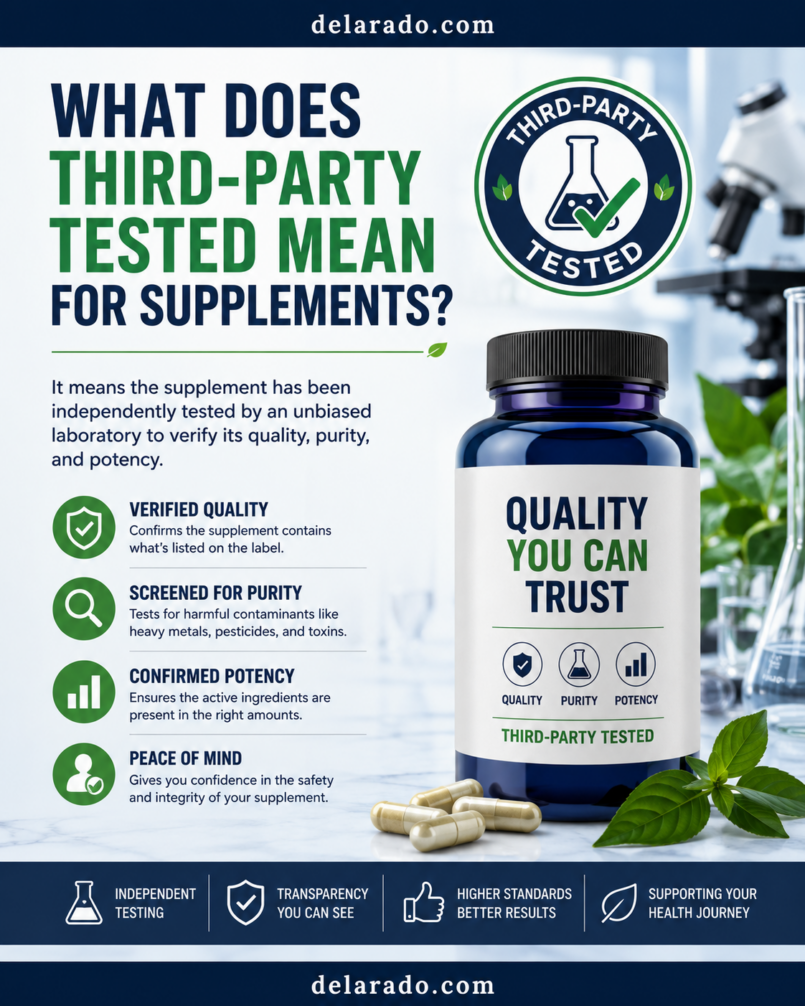
What Does Third-Party Tested Mean for Supplements?
Third-party tested means that a supplement has been evaluated by a laboratory, certification organization, or testing company that is separate from the brand that makes or sells the product. The purpose is to provide an independent check of selected quality factors, such as whether a product contains listed ingredients, whether it contains certain contaminants, or whether it meets a specific program’s standards.
Third-party testing can be a useful quality signal when choosing vitamins, minerals, protein powders, probiotics, herbal products, creatine, greens powders, pre-workouts, and other dietary supplements. However, it does not automatically prove that a product will work for your goal, is safe for every person, or is free from every possible risk.
Quick answer: Third-party tested usually means an independent organization checked certain aspects of a supplement. Always find out who did the testing, what was tested, whether the specific finished product was certified, and what the certification does and does not cover.
What Does Third-Party Tested Mean?
Third-party tested means an independent organization reviewed or tested a supplement instead of relying only on the manufacturer’s own internal quality checks.
The third party may be an independent laboratory, certification organization, or quality-assurance program. Depending on the program, testing may examine ingredients, ingredient amounts, contaminants, manufacturing practices, label accuracy, banned substances, or other factors.
For example, a third-party program may test whether:
- The supplement contains the ingredients listed on the label.
- The listed ingredients are present in the stated amounts.
- The product contains certain contaminants above established limits.
- The finished product contains selected undeclared substances.
- The product is manufactured under a reviewed quality program.
- A sports supplement is screened for selected banned substances.
Testing standards can vary widely. “Third-party tested” is not a single universal standard, so the details behind the claim matter.
Why Third-Party Testing Matters for Supplements
Dietary supplements are regulated differently from prescription medications. A supplement product generally does not go through the same premarket approval process used for prescription drugs. Manufacturers are responsible for ensuring their products meet applicable requirements for quality, labeling, and safety.
Because supplements can vary in ingredient accuracy and product quality, independent testing may give consumers added confidence that a product has been evaluated beyond the company’s own claims.
Potential Benefits of Third-Party Testing
- May help confirm that listed ingredients are present.
- May help verify that ingredient amounts match label claims.
- May screen for selected contaminants.
- May identify certain undeclared ingredients.
- May review product labels and manufacturing practices.
- May provide additional protection for athletes concerned about banned substances.
- May make it easier to compare quality-focused supplement brands.
Third-party testing is especially helpful when a product contains many ingredients, concentrated botanical extracts, protein powders, performance ingredients, or substances that may be relevant to drug testing.
Third-Party Testing vs. Third-Party Certification
The phrases “third-party tested” and “third-party certified” are often used interchangeably, but they can mean different things.
| Term | What It Usually Means | What to Check |
|---|---|---|
| Third-Party Tested | An outside laboratory or organization tested one or more aspects of a product. | Who tested it, what was tested, how often testing occurs, and whether the finished product was tested. |
| Third-Party Certified | A recognized certification organization reviewed a product against a defined program or standard. | Whether the seal applies to the specific product, product line, manufacturing facility, or a single batch. |
| GMP Registered or GMP Certified Facility | A manufacturing site may have been evaluated for certain manufacturing practices. | Whether the claim applies to the facility only or to the specific finished product. |
| Certificate of Analysis | A document reporting test results for a raw ingredient or product batch. | Whether it is current, specific to the product and lot, and from a credible independent source. |
A product can be tested without being certified. A brand may also advertise that it uses a certified manufacturing facility even when a specific product does not have independent certification. Read claims carefully.
What Can Third-Party Testing Check?
The scope of testing depends on the testing organization and program. A high-quality program may involve more than testing one sample in a lab.
1. Identity Testing
Identity testing helps confirm whether an ingredient is what the label says it is. This may be particularly important for herbs, botanicals, amino acids, vitamins, minerals, and specialty compounds.
2. Potency or Label Claim Testing
Potency testing may check whether the amount of a vitamin, mineral, protein, creatine, probiotic, herb, or other listed ingredient matches the amount stated on the label.
3. Contaminant Testing
Programs may test for selected contaminants, such as certain heavy metals, microbes, pesticides, herbicides, solvents, or other substances. The exact contaminants and limits depend on the program.
4. Undeclared Ingredient Screening
Some programs test for selected ingredients that are not listed on the label. This may be especially relevant for products marketed for weight loss, energy, bodybuilding, sexual performance, or athletic performance.
5. Banned Substance Testing
Sports certification programs may screen for selected substances prohibited in athletic competition. This can be particularly important for competitive athletes, military personnel, and people subject to drug-testing rules.
6. Manufacturing and Label Review
Some certification programs review manufacturing practices, product labels, ingredient documentation, and facility procedures in addition to laboratory testing.
What Third-Party Testing Does Not Guarantee
Third-party testing can be valuable, but it has important limits. A certification seal or testing claim should not be treated as a guarantee of effectiveness, personal safety, or medical suitability.
Third-Party Testing Does Not Automatically Prove:
- The supplement will work for your specific goal.
- The product is appropriate for your age, health condition, or medication use.
- The product has no possible side effects.
- The supplement cannot interact with prescription or over-the-counter medicines.
- The supplement is suitable during pregnancy or breastfeeding.
- The product is safe at every dose or for long-term use.
- The product is free from every possible contaminant or undeclared ingredient.
- The product is right for athletes under every sport organization’s rules.
- The product replaces food, sleep, exercise, medical care, or prescribed medication.
- The product is clinically proven to treat, prevent, diagnose, or cure a disease.
Third-party testing is one quality signal, not a complete safety decision.
How Third-Party Supplement Programs Work
Certification programs vary, but many involve a combination of product review, laboratory testing, documentation review, and manufacturing assessment.
A Program May Include:
- Review of the ingredient list and Supplement Facts label.
- Evaluation of whether label claims match product documentation.
- Testing of finished products, ingredients, or both.
- Screening for selected contaminants or undeclared substances.
- Review of manufacturing processes and quality systems.
- Review of packaging, warnings, and other label details.
- Ongoing product testing, auditing, or surveillance.
- Permission to use a certification mark only if program requirements are met.
Programs differ in how often they test, which product lots they test, which substances they screen for, and whether they conduct manufacturing audits. A meaningful seal should be tied to a recognizable program with clear public standards.
Common Third-Party Seals and Programs
Several organizations offer supplement-related testing, certification, or quality-verification programs. The scope of each program can differ, so it is important to review the specific claim rather than assuming all seals mean the same thing.
| Program or Organization | Common Focus | What Consumers Should Check |
|---|---|---|
| NSF | Product certification, label claim review, contaminant screening, and sport-focused certification programs. | Look for the specific NSF mark and confirm it applies to the product, not only the manufacturer or facility. |
| USP | Quality verification programs for selected products, including ingredient identity, potency, purity, and manufacturing quality. | Look for the USP Verified Mark on the exact product and review the program details. |
| Informed Sport | Testing focused on reducing the risk of banned substances for athletes. | Confirm the specific product and batch are listed in the program’s database when applicable. |
| Informed Choice | Sports supplement testing and quality-assurance programs. | Check the specific product certification and the scope of its sport-testing claim. |
| BSCG | Banned-substance testing and certification programs for sports-focused products. | Review whether the finished product is certified and what testing the program includes. |
| ConsumerLab | Independent product testing and reporting on selected dietary supplements. | Check whether the exact product and version were tested and what results were reported. |
A seal from a recognized organization can be useful, but the scope matters. For example, a sport certification may focus on banned-substance risk, while another certification may focus more heavily on label accuracy, contaminants, or manufacturing practices.
Third-Party Testing for Athletes and Drug-Tested Professionals
Competitive athletes, military personnel, first responders, and others subject to drug-testing rules should be especially cautious with supplements. Some products may contain substances that create a positive test result, including substances that are not clearly disclosed on the label.
Sports-focused third-party certification may reduce risk by screening products for selected banned substances. However, it cannot eliminate all risk because testing programs have limits, sports organizations have different prohibited-substance lists, and supplement formulas can change.
If You Are Subject to Drug Testing:
- Choose a product with sport-specific third-party certification when possible.
- Confirm the certification applies to the exact product, flavor, formula, and batch when applicable.
- Review the prohibited-substance rules of your sport, employer, or organization.
- Avoid products with proprietary blends that hide individual doses.
- Use extra caution with pre-workouts, fat burners, muscle builders, testosterone products, sexual-performance products, and extreme energy formulas.
- Keep product labels, lot numbers, receipts, and documentation.
No supplement certification can guarantee that an athlete will never have a positive test result. Certification is a risk-reduction tool, not a zero-risk promise.
How to Verify a Third-Party Tested Claim
Do not rely only on a product’s front-label statement. Some claims are vague, and a product may use language that sounds like certification without showing who performed the testing or what was tested.
Use This Verification Checklist
- Find the organization’s name. A credible claim should identify the testing laboratory or certification program.
- Look for a recognizable seal. Check whether the seal is printed on the actual product label.
- Visit the organization’s database. Many certification programs provide searchable listings of certified products.
- Match the exact product. Confirm brand, product name, flavor, formula, serving size, and product type when possible.
- Check whether the product or facility is certified. A certified manufacturing facility is not always the same as a certified finished product.
- Review the certification scope. Find out whether the program checks ingredients, potency, contaminants, banned substances, manufacturing practices, or only selected elements.
- Check the lot number and expiration date. Keep these details in case you need to verify a batch or report a concern.
- Be cautious with vague wording. Claims such as “lab tested,” “quality tested,” or “clinically tested” may not explain who tested the product or what was evaluated.
How to Read a Supplement Label Alongside Testing Claims
Third-party testing should support good label reading, not replace it. You still need to understand what the supplement contains and whether it is appropriate for you.
Review These Parts of Every Label
- Serving size: Confirm how many capsules, gummies, tablets, scoops, or packets equal one serving.
- Amount per serving: Review the exact amount of each vitamin, mineral, herb, amino acid, protein, or other ingredient.
- Percent Daily Value: Use %DV to identify low or high amounts of nutrients with established Daily Values.
- Proprietary blends: Be cautious when the label hides individual ingredient amounts.
- Other ingredients: Check for allergens, sweeteners, caffeine, gelatin, flavorings, and additives.
- Warnings: Read pregnancy, medication, age, storage, and maximum-use cautions.
- Expiration date and lot number: Avoid expired or damaged products and keep batch details.
- Manufacturer information: Look for a legitimate company identity and accessible contact details.
A third-party seal does not make a hidden proprietary blend easier to evaluate. When possible, choose transparent products that list the exact amount of every active ingredient.
Supplement Quality Checklist
Use this checklist when evaluating a supplement, whether or not it has a third-party testing claim.
- Choose a supplement for a specific reason.
- Read the entire Supplement Facts panel.
- Confirm the serving size and actual ingredient amounts.
- Check for duplicate nutrients or ingredients across all products you use.
- Look for transparent formulas instead of hidden proprietary blends.
- Review directions, warnings, and potential medication interactions.
- Choose a product with clear manufacturer information and intact packaging.
- Look for credible third-party certification when available.
- Verify that a seal applies to the exact finished product.
- Start one new supplement at a time and monitor your response.
- Stop using a product and seek guidance if side effects occur.
Safety Risks Third-Party Testing Cannot Eliminate
Even a quality-tested supplement can be the wrong choice for a person. Safety depends on more than label accuracy and contaminant testing.
Potential Risks Still Include:
- Medication interactions.
- High-dose vitamin or mineral intake.
- Overlapping ingredients from multiple products.
- Herbal side effects.
- Stimulant-related sleep, anxiety, blood-pressure, or heart-rate effects.
- Allergic reactions.
- Use during pregnancy or breastfeeding without qualified guidance.
- Use before surgery or medical procedures.
- Use in children without appropriate professional advice.
- Using supplements instead of seeking care for persistent symptoms.
Ask a Qualified Healthcare Professional Before Use If You:
- Take prescription medications.
- Use over-the-counter medicines regularly.
- Are pregnant, breastfeeding, or planning pregnancy.
- Have kidney, liver, heart, endocrine, autoimmune, digestive, or bleeding-related conditions.
- Have diabetes, high blood pressure, seizures, anxiety, depression, or thyroid concerns.
- Are preparing for surgery, dental work, or medical testing.
- Are considering high-dose vitamins, minerals, herbal extracts, energy products, or weight-loss products.
Common Mistakes to Avoid
- Assuming “third-party tested” means the supplement is proven to work.
- Assuming a certification seal means the product is safe for everyone.
- Not checking which organization performed the testing.
- Not verifying whether the exact product is listed in a certification database.
- Confusing a certified facility with a certified finished product.
- Assuming all third-party seals have the same standards.
- Ignoring serving size, ingredient amounts, warnings, and other ingredients.
- Using products with hidden proprietary blends.
- Combining multiple supplements without checking ingredient overlap.
- Taking a quality-tested product with medication without checking for interactions.
- Using expired products or products with broken seals.
- Relying on supplements instead of balanced eating, sleep, hydration, or medical care.
Top 10 Questions About Third-Party Tested Supplements
1. What does third-party tested mean for supplements?
It means an independent laboratory or organization, separate from the supplement brand, tested or evaluated selected aspects of the product. Testing may involve ingredients, label accuracy, contaminants, manufacturing practices, or banned substances, depending on the program.
2. Is third-party tested the same as third-party certified?
Not always. Third-party testing may refer to one or more laboratory tests. Third-party certification usually means a product has met a defined program’s requirements and may carry that organization’s certification seal.
3. Does third-party tested mean a supplement is safe?
No. It can provide added confidence about selected quality factors, but it does not guarantee the product is safe for everyone. Supplements can still cause side effects, interact with medications, or be inappropriate for certain health conditions.
4. Does third-party testing prove that a supplement works?
No. Third-party testing generally focuses on quality, label accuracy, contaminants, or banned substances. It does not prove that the supplement will provide a specific health, weight-loss, energy, muscle-building, or performance result.
5. What does a third-party program usually test for?
Depending on the program, testing may check ingredient identity, potency, label accuracy, selected contaminants, microbes, heavy metals, pesticides, undeclared ingredients, or banned substances.
6. What are common third-party supplement certifications?
Common programs include NSF, USP, Informed Sport, Informed Choice, BSCG, and ConsumerLab. Their standards and scopes differ, so check what each specific program verifies.
7. How do I verify that a supplement is really third-party certified?
Look for the certifying organization’s name and seal on the product, then search the organization’s official product database. Confirm that the exact product, formula, flavor, and batch are covered when applicable.
8. Is a GMP-certified facility the same as a third-party certified supplement?
No. A GMP-related claim may apply to the manufacturing facility or its processes. It does not necessarily mean that the specific finished supplement product has been independently tested and certified.
9. Do athletes need third-party tested supplements?
Athletes and others subject to drug testing should strongly consider sport-specific third-party certification because it can reduce the risk of selected banned substances. However, it cannot guarantee zero risk.
10. Should I only buy supplements that are third-party tested?
Third-party testing is a valuable quality signal, especially for higher-risk products, but it is only one part of a smart decision. Also check the ingredient list, serving size, dose, warnings, medication interactions, expiration date, product transparency, and whether you have a clear reason to take the supplement.
Final Takeaway
Third-party tested means that an independent organization has evaluated selected aspects of a supplement. It can add confidence that a product’s ingredients, label claims, contaminants, or banned-substance risk have been reviewed, depending on the program.
Still, a testing claim is not a guarantee that a supplement is effective, appropriate for your health situation, free of all risks, or safe to combine with medication. Choose transparent products, verify certification claims, read the full label, avoid unnecessary high doses and hidden proprietary blends, and speak with a doctor, pharmacist, or registered dietitian when you are unsure.