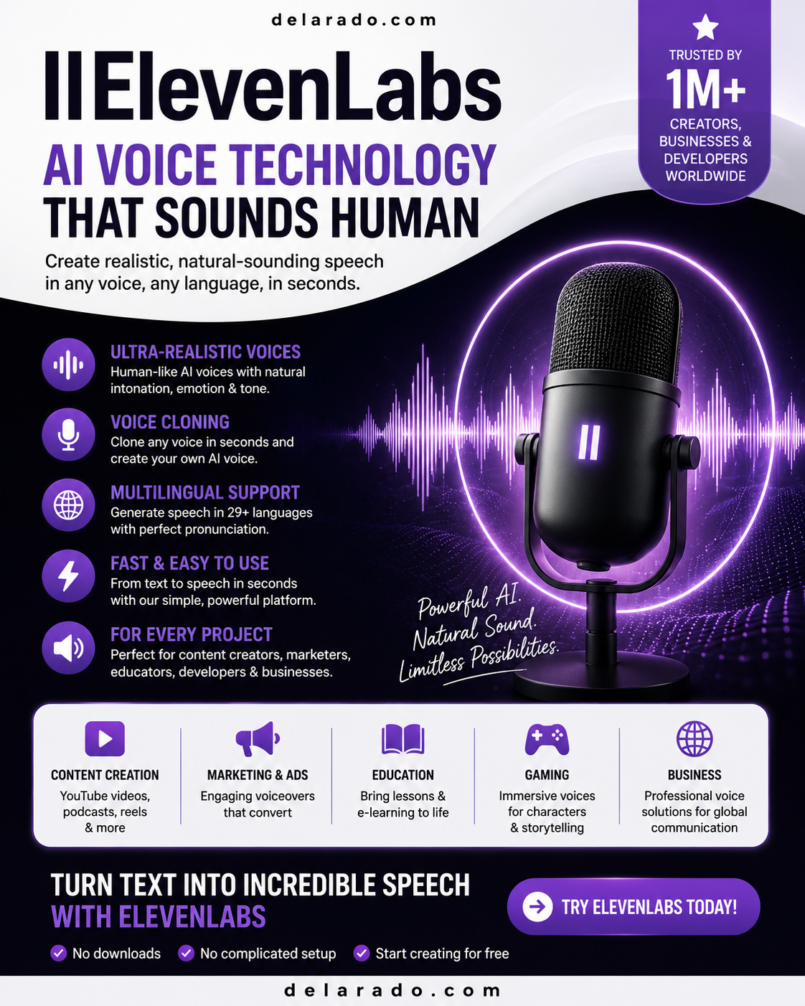
Quick verdict: ElevenLabs is a powerful AI audio platform for creators, marketers, publishers, developers, and businesses that need realistic voiceovers, multilingual dubbing, synthetic voices, audio tools, or conversational voice experiences. It is particularly compelling when audio quality, speed, and scalable content production matter more than recording every project manually.
It is not automatically the best choice for every user. People who only need a few basic voiceovers each month may find a free or lower-cost text-to-speech tool sufficient, while high-volume teams should carefully estimate credit use before committing to a plan. The best value comes from using ElevenLabs as part of a repeatable content, localization, publishing, customer-service, or software workflow.
What Is ElevenLabs?
ElevenLabs is an AI audio platform built around natural-sounding speech generation and voice technology. Its tools can turn written scripts into spoken audio, create or clone permitted voices, transcribe speech, translate and dub content, generate audio effects, and support voice-enabled applications.
In simple terms, it helps users produce audio without needing to record every line in a studio. A creator can write a video script, select a voice, adjust the delivery, generate the narration, edit the audio, and use it in a finished project. A business can also use voice technology in customer-support workflows, phone systems, apps, or interactive voice agents.
ElevenLabs is broader than a basic “text-to-speech reader.” It can support short social-media clips, long-form narration, product demos, training materials, podcasts, audiobooks, multilingual video localization, games, software products, and customer-facing voice experiences.
What Is the Purpose of ElevenLabs?
The main purpose of ElevenLabs is to make high-quality audio production faster, more flexible, and more accessible. Instead of hiring voice talent for every draft, recording multiple takes, editing audio manually, or rebuilding content for different languages, users can generate and revise audio from a written script.
For many users, the core value is not simply creating an AI voice. The real value is reducing the time between an idea and a publishable audio asset. A marketer can create several advertisement variations, a course creator can narrate lessons, and a publisher can convert written material into audio more efficiently than with a fully manual workflow.
Problems ElevenLabs Can Help Solve
- Producing voiceovers without owning recording equipment or booking a studio
- Testing multiple narration styles before publishing a video or advertisement
- Creating consistent voiceovers across a large content library
- Repurposing blog posts, guides, scripts, and eBooks into audio formats
- Localizing educational, marketing, or entertainment content for new markets
- Building voice-based product features through an API
- Creating more accessible content for people who prefer listening to reading
- Reducing repetitive audio-production work for teams and agencies
Who Is ElevenLabs For?
ElevenLabs is designed for individuals and organizations that need spoken content at a level of quality that feels more polished than traditional robotic text-to-speech. It can work for beginners because the browser-based creation tools are straightforward, but it also has API and enterprise-oriented capabilities for advanced users.
Target Audience
- Content creators: YouTubers, podcasters, TikTok creators, streamers, and social-media marketers who need voiceovers quickly.
- Affiliate marketers: Publishers creating product explainers, comparison videos, short-form clips, narrated blog content, and lead-generation assets.
- Course creators and educators: People producing lessons, tutorials, language-learning materials, training modules, and narrated presentations.
- Authors and publishers: Writers turning articles, books, newsletters, and digital guides into accessible audio experiences.
- Agencies: Marketing, video, social-media, localization, and production agencies serving multiple clients.
- Developers: Builders who want to add speech, transcription, dubbing, or voice interactions to an app, game, website, or workflow.
- Small businesses: Local service businesses and online companies that want scalable voice content, automated call handling, or clearer customer communication.
- Accessibility-focused organizations: Teams creating more usable audio experiences for audiences that benefit from spoken content.
Who May Not Need It?
- Users who only need occasional, very simple robotic narration
- Businesses that require a human actor for highly regulated, sensitive, celebrity-led, or emotionally complex productions
- Anyone intending to clone, imitate, misrepresent, or monetize another person’s voice without clear permission
- Creators without a clear use case or publishing workflow, since unused credits and features can reduce value
Benefits of ElevenLabs
1. Faster Content Production
ElevenLabs can shorten the path from script to narration. Rather than recording and editing every revision, users can update text, regenerate selected sections, and move toward final production faster. This is useful for creators who publish consistently or agencies managing multiple client projects.
2. More Natural Voice Delivery
The platform is known for voices that aim to sound expressive, fluid, and human-like. The practical advantage is better listener retention when compared with flat, overly mechanical narration. Quality still depends on the script, voice selection, punctuation, settings, and final editing.
3. Scalable Multilingual Content
Audio localization can be difficult when it requires separate writers, translators, voice actors, editors, and production schedules. ElevenLabs can help streamline portions of that workflow, allowing teams to test expansion into other languages and markets more efficiently.
4. Flexible Voice Options
Users can select voices from a library, create custom voice styles from prompts, or use permitted voice-cloning options. This flexibility lets a brand develop a recognizable narration style rather than changing voices from project to project.
5. Multiple Tools in One Ecosystem
ElevenLabs can be used for more than text-to-speech. Depending on the plan and available product features, users may access speech-to-text, voice cloning, dubbing, voice changing, audio isolation, sound generation, agents, and developer tools. Centralizing these tasks can simplify a production stack.
6. Useful for Repurposing Content
One well-researched article can become a narrated video, short clips, a podcast segment, an audio lesson, a downloadable audio guide, or an audiobook chapter. Repurposing helps content teams reach people who consume information in different formats.
7. Potential Accessibility Improvements
Adding audio versions of articles, lessons, and digital resources can give audiences another way to engage with information. It should complement, not replace, accessible design practices such as readable layouts, captions, transcripts, descriptive headings, and clear navigation.
ElevenLabs Key Features
Text-to-Speech Generation
Text-to-speech converts written material into spoken audio. Users paste or upload a script, choose a voice, adjust applicable settings, generate audio, review it, and export or use the result in a project. Strong scripts are essential: short sentences, natural punctuation, correct spelling, and clear formatting generally improve output.
Voice Library
A voice library gives users options for different tones, accents, languages, character styles, and narration needs. The best practice is to select a voice that matches the intended audience and content type. For example, a calm educational narration may need a different voice than a high-energy short-form ad.
Voice Design
Voice design allows users to describe a desired voice rather than relying only on prebuilt options. A creator may request characteristics such as warm, authoritative, conversational, youthful, cinematic, energetic, or calm. Always test generated voices carefully before using them in public-facing content.
Voice Cloning
Voice cloning can create a digital voice model from approved voice samples. This can be useful for creators who want consistent narration without recording every script. The critical rule is consent: only clone a voice when the voice owner has explicitly authorized it. Never use voice cloning for impersonation, fraud, deception, or unauthorized commercial activity.
Dubbing and Localization
Dubbing tools can help translate and voice video or audio content for additional language audiences. Before publishing, review translations for terminology, cultural meaning, names, timing, pronunciation, and compliance. Automated localization is a starting point, not a replacement for human quality control in important content.
Speech-to-Text and Transcription
Speech-to-text tools can convert recordings into written transcripts. This can support video captions, podcast notes, searchable archives, meeting summaries, content repurposing, and editing workflows. Transcripts should always be proofread, especially when they contain technical terms, names, numbers, or legal statements.
Audio Editing and Enhancement Tools
Audio-related tools may include voice changing, voice isolation, and generated sound effects. These capabilities can help creators clean up source material, create atmosphere, or develop more immersive videos and interactive media.
Studio and Long-Form Workflows
Long-form projects may require organized chapters, scenes, narration blocks, and revision control. A studio-style workflow is particularly valuable for audiobooks, training libraries, serialized content, and multi-part educational products.
Conversational Voice Agents
Voice agents can be used to create spoken, interactive experiences for customer support, lead qualification, appointment workflows, product guidance, and other business processes. These systems need careful testing, escalation paths, privacy controls, and human oversight.
API and Developer Integration
Developers can use APIs to integrate voice functions into websites, applications, games, internal systems, or automated workflows. Common uses include narrated articles, in-app voice assistants, interactive learning tools, accessibility features, and dynamic product experiences.
How to Use ElevenLabs: Step-by-Step
- Create an account: Start with the available plan that fits the intended testing or production use case.
- Define the goal: Decide whether the project is a video voiceover, audiobook, social clip, podcast intro, translated video, customer-service workflow, or app feature.
- Write the script: Use clear language, short paragraphs, intentional punctuation, and natural phrasing. Read it aloud before generating audio.
- Choose or create a voice: Browse voice options or use a permitted custom voice. Match the voice to the audience and format.
- Generate a short test: Do not generate an entire long project first. Test 30 to 60 seconds to check tone, pacing, pronunciation, and clarity.
- Edit the script: Correct awkward phrasing, add punctuation for pauses, spell out unusual acronyms where needed, and revise names or technical terms.
- Generate the final audio: Create the complete narration only after the test version meets the desired standard.
- Perform quality control: Listen through headphones, check for incorrect pronunciations, confirm factual accuracy, and verify that the voice fits the brand.
- Add supporting elements: Combine narration with video, captions, licensed music, visuals, chapters, transcripts, or calls to action as appropriate.
- Publish responsibly: Follow platform rules, disclose AI use when required or helpful, respect copyright, and use only content and voices you have the right to use.
- Measure results: Track watch time, click-through rate, conversions, sales, listener completion rate, engagement, and production time saved.
Example Workflow for a Product Review Video
Write a helpful review script with an introduction, product benefits, limitations, who it is for, a comparison point, and a transparent call to action. Generate a test narration, pair it with original screen recordings or licensed visuals, add captions, publish the video, and embed it in the related article. This approach creates a stronger user experience than publishing generic AI audio over unrelated stock footage.
How to Make Money With ElevenLabs
ElevenLabs is a tool, not a guaranteed income source. Results depend on a useful offer, ethical marketing, audience demand, content quality, distribution, pricing, sales skill, and consistent execution. The most sustainable approach is to use the platform to improve a service or product that solves a real customer problem.
1. Offer AI Voiceover Services
Create voiceovers for YouTube channels, faceless-video creators, educators, real-estate marketers, local businesses, course creators, and social-media agencies. A clear service package can include script cleanup, voice selection, audio generation, revisions, captions, and delivery in requested formats.
2. Build Short-Form Video Content
Create useful short videos for TikTok, Instagram Reels, YouTube Shorts, Pinterest, or other platforms. Monetization may come from client work, sponsorships, digital products, affiliate links, lead generation, or platform-specific programs where available. Avoid low-value content farms; focus on original commentary, practical demonstrations, and audience trust.
3. Create and Sell Educational Products
Turn written expertise into courses, audio lessons, study guides, language resources, coaching materials, and narrated digital products. The audio should add instructional value, not simply duplicate low-quality text.
4. Repurpose Content for Clients
Offer a content-repurposing service: transform a client’s article, webinar, podcast, or eBook into narrated videos, audiograms, audio articles, social posts, and multilingual clips. This is valuable because many businesses already have content but lack the time to reformat it.
5. Localize Existing Content
Businesses with established videos, training materials, and product demos may need content adapted for new language audiences. Charge for a localization workflow that includes translation review, dubbing, timing checks, subtitles, and final quality assurance.
6. Create Audiobook and Narration Services
Authors and publishers may need audio editions, book trailers, chapter previews, or promotional clips. Confirm distribution requirements before offering AI-narrated audiobooks, since marketplaces and publishers can have separate policies.
7. Develop Voice-Enabled Digital Products
Developers can build specialized tools such as language-learning assistants, interactive story products, voice-powered knowledge bases, guided meditation apps, product explainers, or customer-support systems. Revenue can come from subscriptions, licensing, setup fees, maintenance, or usage-based access.
8. Use It in Affiliate Marketing
Create honest review videos, comparison explainers, tutorials, and use-case demonstrations around products that genuinely fit the audience. Disclose affiliate relationships clearly, avoid false claims, and do not use copied scripts or misleading testimonials. Trust and helpfulness are more valuable than aggressive promotion.
Simple Service Offer Example
“Monthly Video Narration Package”: 12 short voiceovers, script polishing, one approved brand voice, basic audio cleanup, captions, and two revisions per asset. The price should be based on script length, turnaround time, commercial rights, revisions, editing requirements, and the cost of tool usage.
How to Use ElevenLabs Daily
A productive daily workflow is based on planned content, reusable templates, and quality control. Generating audio is fast, but publishing good content still requires research, editing, compliance checks, and distribution.
Daily Workflow for a Creator or Marketer
- Review the content calendar and select one high-priority asset.
- Write or improve a script based on a real search query, customer question, or campaign goal.
- Create a short audio test before producing the entire script.
- Generate the final narration using the approved brand voice.
- Review pronunciation, pacing, facts, links, disclosures, and calls to action.
- Add captions and visual support for video content.
- Publish the asset on the appropriate channel.
- Repurpose the core idea into an article, email, short clip, pin, carousel, or audio post.
- Review analytics and note what improved engagement or conversions.
- Organize scripts, audio files, approvals, and performance data for future reuse.
Daily Workflow for an Agency
- Review client briefs, deadlines, and content approvals.
- Use pre-approved voice profiles and brand guidelines.
- Generate test samples for new campaigns before full production.
- Maintain a revision log to prevent version confusion.
- Bill accurately for script length, production scope, localization, and revisions.
- Store client consent documentation for custom or cloned voices.
Daily Workflow for Developers
- Monitor API usage, latency, errors, cost, and user feedback.
- Test fallback behavior if audio generation or voice interactions fail.
- Review privacy practices and minimize unnecessary storage of voice data.
- Provide human escalation options for customer-facing voice agents.
- Update prompts, knowledge sources, and testing scenarios based on actual user questions.
ElevenLabs Pros and Cons
| Pros | Cons |
|---|---|
| Natural-sounding AI voice generation for many content formats | Higher-quality and higher-volume workflows can require a paid plan |
| Useful for voiceovers, narration, localization, and audio repurposing | Generated audio still needs human review for pacing, names, and pronunciation |
| Offers a broad audio ecosystem beyond basic text-to-speech | Multiple features can create a learning curve for brand-new users |
| Can save time compared with recording every draft manually | Credit use and costs must be monitored in high-volume production |
| Supports creators, businesses, agencies, and developers | Not every project should replace professional human voice talent |
| Voice customization can support consistent branding | Voice cloning requires explicit consent and responsible use |
| API options can support custom voice-enabled software | API implementation requires technical skill, testing, and security planning |
| Can help repurpose written content into audio formats | AI-generated content without original insight may perform poorly with audiences |
ElevenLabs Pricing and Value Considerations
ElevenLabs offers a free option and paid plans, but plan names, feature access, credit allocations, commercial-use permissions, and prices can change. Review the official pricing page and current terms before purchasing or using generated content commercially.
When evaluating cost, do not look only at the monthly subscription price. Estimate the number of scripts, characters, audio minutes, dubbing minutes, voices, team members, revisions, API calls, and commercial projects expected each month. Then compare that cost with the time and money saved from reduced recording, editing, outsourcing, or localization work.
Questions to Ask Before Choosing a Plan
- How many voiceovers or audio minutes are needed each month?
- Is commercial use required?
- Are custom voices or voice cloning needed?
- Will multiple team members need access?
- Is video dubbing or translation part of the workflow?
- Will the tool be used inside an app through an API?
- What happens if usage exceeds the included credits?
- Are there separate requirements for music, beta features, or third-party content?
Important Legal and Ethical Considerations
AI voice technology should be used responsibly. Only upload audio, scripts, recordings, music, video, and voice samples when there is a legal right to use them. Obtain clear, documented permission before cloning any individual’s voice, including a client, employee, contractor, actor, or collaborator.
- Do not imitate a public figure, customer, employee, or private individual without permission.
- Do not use synthetic audio for fraud, deception, fake endorsements, scams, threats, or misinformation.
- Do not claim a synthetic voice is a real person if that would mislead the audience.
- Review commercial-use rights for the selected plan and specific product feature.
- Check the policies of YouTube, podcast platforms, audiobook distributors, ad networks, marketplaces, and social platforms before publishing.
- Use disclosures when required by law, platform rules, contracts, or audience expectations.
- Keep a record of client approvals and voice-consent documentation.
How to Make This Review More SEO-Friendly
Publishing a long article does not guarantee rankings. Search visibility depends on search intent, originality, topical authority, technical performance, links, user satisfaction, competition, and the quality of the page. The strongest review pages add firsthand testing, original screenshots, examples, comparisons, and transparent limitations.
Add These Elements Before Publishing
- Add original screenshots of the dashboard, voice settings, project workflow, or output process.
- Include a short audio sample or original video demonstrating a real use case.
- Add a byline, author bio, publication date, and “last updated” date.
- Describe firsthand testing honestly, including what worked and what required revision.
- Link internally to related posts about AI tools, video marketing, voiceovers, content creation, and affiliate disclosure practices.
- Link externally to official product, pricing, policy, documentation, and support pages where appropriate.
- Use descriptive image alt text, such as “ElevenLabs AI voice generator dashboard for video narration.”
- Optimize images, use a fast WordPress theme, and ensure the page works well on mobile.
- Use a clear table of contents, short paragraphs, and descriptive headings.
- Answer genuine buyer concerns rather than repeating keywords unnaturally.
- Keep pricing, features, and policy statements updated after product changes.
Suggested Internal Links
- Best AI Tools for Content Creators
- How to Create Faceless YouTube Videos Ethically
- AI Voiceover vs Human Voiceover: Which Is Better?
- How to Repurpose Blog Posts Into Video Content
- Affiliate Disclosure Guide for Content Publishers
Suggested Call to Action
Try ElevenLabs and explore the available plans
Final Verdict: Is ElevenLabs Worth Buying?
ElevenLabs is worth considering for creators, marketers, publishers, agencies, and developers who need realistic AI audio and have a genuine plan to use it consistently. Its strongest advantage is the ability to turn scripts and ideas into polished audio assets quickly, while also supporting broader needs such as dubbing, transcription, voice customization, and voice-enabled software.
A paid plan makes the most sense when audio is part of an active commercial workflow and the time saved is greater than the subscription and usage cost. Start with a small, measurable project, test the quality carefully, confirm commercial-use rights, and scale only after the workflow proves useful. For casual users with minimal audio needs, the free option or a simpler tool may be enough.
Top 10 ElevenLabs Buyer Questions and Answers
1. What is ElevenLabs used for?
ElevenLabs is used to create AI-generated speech and audio experiences. Common uses include video voiceovers, narrated articles, audiobooks, podcasts, training materials, multilingual dubbing, customer-service voice agents, and voice features inside software applications.
2. Is ElevenLabs good for YouTube videos?
It can be a strong option for YouTube narration, especially for explainers, tutorials, product reviews, educational videos, shorts, and faceless channels. The final video should still include original research, useful visuals, accurate information, clear editing, and a distinct point of view.
3. Can ElevenLabs be used commercially?
Commercial-use rights depend on the account plan, the feature used, and the current terms. Review the official licensing and plan details before using generated audio in advertisements, monetized videos, client work, products, or other business activities.
4. Can I clone my own voice with ElevenLabs?
Yes, voice-cloning tools can be used for a person’s own voice when the platform’s requirements are met. Only clone a voice when the voice owner has explicitly agreed and the use complies with applicable laws and platform policies.
5. Can I clone someone else’s voice?
Only with clear permission from that person and in compliance with the platform’s policies and applicable law. Using another person’s voice without consent can create serious legal, ethical, and reputational risks.
6. Does ElevenLabs sound like a real human?
Its voices are designed to sound natural and expressive, but results vary by voice, language, script quality, pronunciation, settings, and audio editing. Always create a test sample before producing a large project.
7. Can ElevenLabs make money for me?
It does not create guaranteed income. It can support income-producing work such as voiceover services, client content, digital products, video production, localization, software development, and affiliate content, but results depend on demand, execution, marketing, pricing, and quality.
8. Is ElevenLabs suitable for beginners?
Yes. Beginners can start with text-to-speech and simple voiceover projects. Advanced options such as API integration, voice agents, and sophisticated localization workflows may require more technical knowledge and testing.
9. How do I reduce errors in AI voiceovers?
Use clean scripts, natural punctuation, short paragraphs, phonetic spelling for difficult names where appropriate, test samples, careful listening, and manual edits. Review every final recording before publishing.
10. Is ElevenLabs better than hiring a voice actor?
It depends on the project. ElevenLabs can be faster and more scalable for frequent content, revisions, prototypes, and multilingual testing. A professional human voice actor may still be the better choice for high-profile campaigns, nuanced performances, sensitive projects, or productions requiring a specific artistic interpretation.