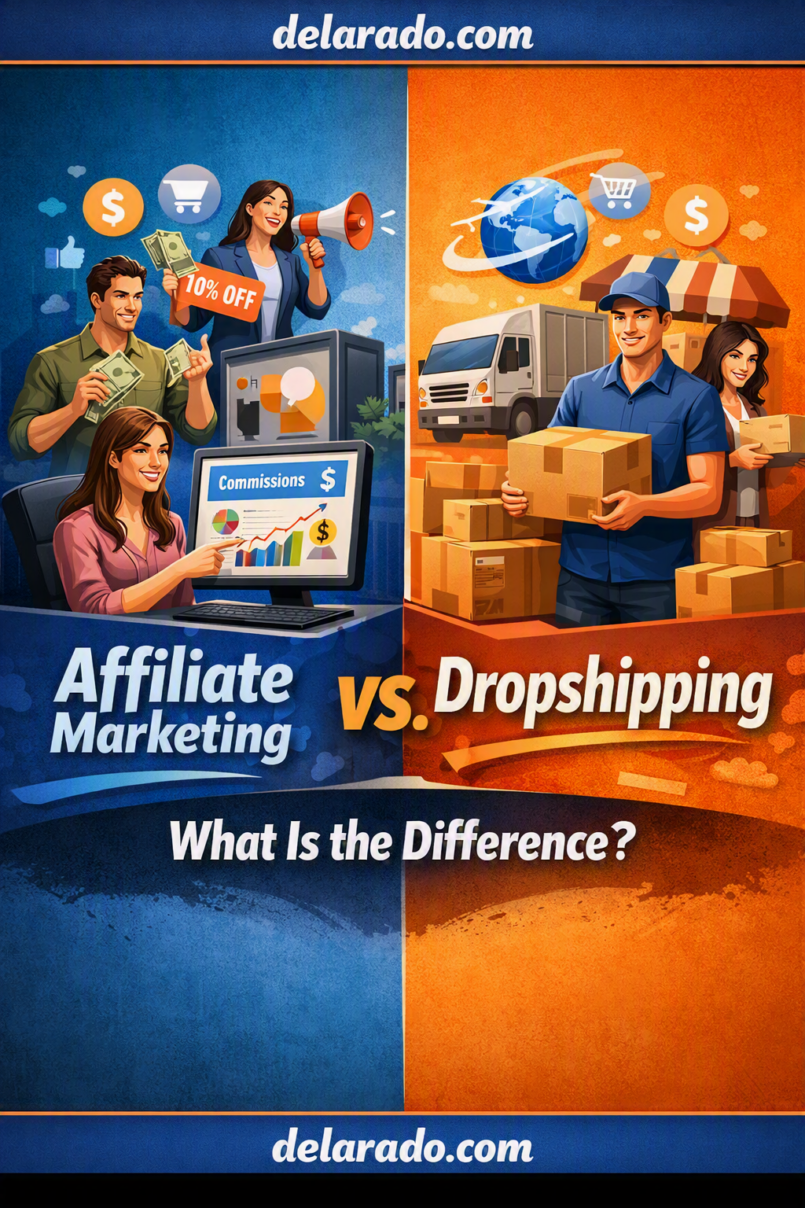
Affiliate marketing and dropshipping both allow you to promote products without holding inventory, but they work very differently. In affiliate marketing, you recommend another company’s product and may earn a commission when a person completes a qualifying action. In dropshipping, you operate the customer-facing store, set prices, collect payment, and arrange for a supplier to ship the product to the customer.
Affiliate marketing is generally simpler to start because the merchant handles product fulfillment, returns, and direct customer service. Dropshipping can offer more control over branding, pricing, and customer experience, but it also creates more responsibility for product quality, support, refunds, shipping, advertising claims, taxes, and legal compliance.
Who Is This Topic For?
This guide is for beginners, creators, bloggers, ecommerce sellers, side-business owners, freelancers, social-media marketers, product researchers, and anyone deciding whether affiliate marketing or dropshipping fits their goals.
This Article Is Helpful If You Want To:
- Understand affiliate marketing
- Understand dropshipping
- Choose between affiliate marketing and ecommerce
- Start an online business with limited inventory
- Promote products through content
- Build an online store
- Learn who handles shipping and returns
- Understand customer-service responsibilities
- Compare startup costs and risks
- Choose a business model that fits your skills
What Is Affiliate Marketing?
Affiliate marketing is a performance-based marketing model. You recommend a merchant’s product or service using a tracked affiliate link. If a person clicks the link and completes a qualifying action, you may earn a commission.
Affiliate Marketing Workflow
Create helpful content → Add a clear affiliate disclosure → Share an approved affiliate link → Visitor clicks the link → Merchant handles purchase and fulfillment → Affiliate may earn a commission for a qualifying action
Affiliate Responsibilities
- Create helpful content
- Build an audience or traffic source
- Use approved affiliate links
- Follow affiliate program rules
- Disclose affiliate relationships clearly
- Use accurate product information
- Avoid misleading claims
- Update old recommendations
Merchant Responsibilities
- Create or source the product
- Set pricing
- Process payment
- Manage inventory
- Ship physical products
- Deliver digital products
- Handle returns and refunds
- Provide customer support
- Manage product quality
- Pay affiliate commissions under program terms
Example
A blogger publishes a guide about choosing WordPress hosting.
The guide includes a clear affiliate disclosure and a tracked link to a hosting company.
A reader clicks the link and buys a hosting plan.
The hosting company handles payment, account setup, customer support, and service delivery.
The blogger may earn a commission if the purchase qualifies under the affiliate program rules.
What Is Dropshipping?
Dropshipping is an ecommerce fulfillment model. You create a store and sell products to customers, but a third-party supplier stores the inventory and ships the order directly to the customer.
Dropshipping Workflow
Customer visits your store → Customer buys a product from your store → You receive payment → You send the order to a supplier → Supplier ships the product to the customer → You manage customer communication and support
Dropshipper Responsibilities
- Choose products and suppliers
- Create the online store
- Set pricing
- Market the store
- Process customer orders
- Communicate delivery expectations
- Handle customer service
- Manage refunds and returns
- Resolve shipping problems
- Manage product claims and descriptions
- Follow tax, privacy, consumer-protection, and advertising requirements
Supplier Responsibilities
- Store inventory
- Pack products
- Ship orders
- Provide product availability information
- Provide tracking information where applicable
- Manage supplier-side inventory and fulfillment processes
Example
You create an online store that sells reusable water bottles.
A customer purchases a bottle from your store for $30.
You send the order to your supplier and pay the supplier’s product and shipping cost.
The supplier ships the bottle directly to the customer.
You remain responsible for the customer’s order experience, including questions, refunds, shipping delays, and product concerns.
Affiliate Marketing vs. Dropshipping
| Factor | Affiliate Marketing | Dropshipping |
|---|---|---|
| What you sell | You recommend another company’s product or service | You sell products through your own store |
| Inventory | You do not manage inventory | Supplier manages inventory, but you depend on supplier accuracy |
| Customer payment | Merchant handles customer payment | You collect payment through your store |
| Shipping | Merchant handles shipping | Supplier ships, but you communicate with the customer |
| Customer support | Merchant usually handles direct product support | You are usually responsible for customer support |
| Returns and refunds | Merchant handles returns and refunds | You manage customer-facing refund and return process |
| Pricing control | Merchant sets pricing | You set retail price, subject to market and supplier costs |
| Profit model | You may earn a commission | You may earn the difference between customer price and supplier costs |
| Brand control | Limited control over merchant brand and experience | More control over store branding and customer journey |
| Startup complexity | Usually lower | Usually higher |
| Product quality risk | Lower direct responsibility, but still affects your reputation | Higher responsibility because customers buy from your store |
| Legal and operational responsibility | Usually focused on disclosures, program rules, and marketing claims | Includes customer, refund, shipping, advertising, tax, privacy, and store obligations |
Key Difference: Customer Relationship
The biggest difference is often who owns the direct customer relationship.
With Affiliate Marketing
The merchant sells directly to the customer. The customer generally pays the merchant, receives the product or service from the merchant, and contacts the merchant for account, delivery, refund, or product support.
With Dropshipping
The customer buys from your store. Even though a supplier ships the product, the customer sees your business as the seller. They may contact you about delivery delays, product issues, refunds, order changes, payment questions, and other concerns.
Example
In affiliate marketing, you may recommend a camera through an affiliate link, but the camera retailer handles the purchase and shipment.
In dropshipping, you sell the camera through your own store. The customer expects your store to answer questions if the camera arrives late, damaged, or different from what was described.
This is why dropshipping generally involves more operational responsibility than affiliate marketing.
Benefits of Affiliate Marketing
Lower Operational Complexity
You do not usually manage inventory, shipping, fulfillment, returns, customer payment processing, or direct product support.
Can Start With Content
You can begin by creating articles, videos, social posts, emails, reviews, tutorials, comparisons, and resource pages around a focused niche.
Useful for Creators and Educators
Affiliate marketing can fit creators who enjoy teaching, reviewing, explaining, comparing, or helping people make better buying decisions.
Can Promote Digital and Physical Products
Affiliate programs may exist for software, subscriptions, online courses, physical products, services, travel, books, tools, hosting, design platforms, and more.
Less Direct Customer-Service Burden
The merchant normally handles product delivery, shipping, account access, returns, refunds, and direct customer service.
Can Be Combined With Other Business Models
You can combine affiliate marketing with consulting, services, digital products, courses, memberships, sponsorships, advertising, or a physical-product store.
Benefits of Dropshipping
More Control Over Branding
You can create your own store name, design, product collections, customer journey, email experience, packaging options where available, and promotional strategy.
More Pricing Control
You set the retail price, although your pricing must account for supplier costs, shipping, payment processing, refunds, taxes, advertising, customer service, and competition.
Potentially Higher Revenue Per Order
Instead of earning a commission, you may earn the difference between the customer price and your supplier and operational costs. This does not guarantee profit.
Builds a Direct Customer Base
Customers buy from your store, allowing you to build your own email list, customer records, repeat-purchase strategy, brand identity, and retention process while following applicable privacy rules.
Can Create Bundles and Offers
You may create product bundles, gift sets, upsells, cross-sells, subscription offers, and promotions, provided pricing and terms are clear and not misleading.
May Support a Long-Term Brand
Over time, a dropshipping store may develop into a more established ecommerce brand, especially if you improve product selection, customer experience, supplier relationships, and fulfillment reliability.
Risks of Affiliate Marketing
Limited Control Over the Merchant
The merchant can change prices, products, commission rates, program rules, tracking methods, refund policies, product availability, and support quality.
Commissions Are Not Guaranteed
A click does not guarantee a sale, and a sale may not result in a payable commission if it is refunded, canceled, rejected, or otherwise ineligible.
Product Problems Can Still Affect Your Reputation
Even though you do not fulfill the product, your audience may lose trust if you recommend poor-quality products or businesses with weak customer support.
Traffic Is Required
You need an audience through content, search traffic, video, social media, email, partnerships, or another approved method before affiliate links can generate meaningful results.
Program Restrictions Apply
Affiliate programs may restrict email marketing, paid advertising, direct linking, social media, coupon codes, brand bidding, link shortening, and other promotional methods.
Disclosure Is Required
You should clearly disclose when you may earn a commission from qualifying purchases.
Risks of Dropshipping
Supplier Problems Become Customer Problems
If a supplier has stock issues, long delivery times, damaged products, inaccurate inventory, poor packaging, or quality concerns, your customer may still expect your store to resolve the issue.
Customer Support Is Your Responsibility
You may need to respond to questions about orders, shipping, tracking, returns, refunds, payment issues, product quality, incorrect items, cancellations, and delivery delays.
Profit Margins Can Be Tight
Your revenue must cover supplier product costs, shipping, payment fees, advertising, refunds, chargebacks, customer support, software fees, taxes, and other operating costs.
Advertising Can Be Expensive
Paid ads may be necessary for some dropshipping models, but ad costs can rise and results are not guaranteed. You should not spend money you cannot afford to lose while testing.
Product Quality Can Be Hard to Control
You may not personally inspect every product before it reaches the customer. Order samples, test suppliers, and use accurate product descriptions when possible.
Shipping Expectations Must Be Clear
Do not promise fast shipping unless you can support that claim. Clearly state delivery estimates, shipping locations, tracking availability, and return terms.
More Legal and Compliance Responsibility
Dropshipping businesses may need to consider consumer protection, product claims, refunds, data privacy, sales tax, shipping policies, payment processing, product safety, advertising, and other obligations.
Startup Cost Comparison
| Cost Area | Affiliate Marketing | Dropshipping |
|---|---|---|
| Website or content platform | May use a website, YouTube, social media, email, or another platform | Usually needs an ecommerce store or storefront |
| Inventory | No inventory purchase required | Supplier holds inventory, but you may still order samples |
| Product development | Merchant develops the product | Supplier sources or manufactures the product |
| Advertising | Can use organic content; paid ads may be restricted | Often uses paid ads, but costs and restrictions vary |
| Customer service | Usually lower direct burden | Higher responsibility for customer-facing support |
| Refunds and chargebacks | Merchant usually handles them | You generally manage customer-facing refund and chargeback issues |
| Software | May need website, email, analytics, and content tools | May need store platform, apps, payment tools, supplier tools, support tools, and analytics |
| Financial risk | Often lower operational risk, but content and time investment remain | Often higher because of refunds, ads, supplier costs, chargebacks, and customer obligations |
Neither business model is free from cost or risk. Affiliate marketing may require more time spent building content and audience trust, while dropshipping can require more operational and customer-service resources.
Profit Comparison
Affiliate Marketing Income
Affiliate income is usually based on commission. You may earn a fixed payment, percentage of a sale, lead payment, recurring commission, or another model defined by the merchant.
Affiliate Commission Formula
\[
\text{Affiliate Commission} = \text{Eligible Sale Amount} \times \text{Commission Rate}
\]
Example
If an eligible product costs $100 and the commission rate is 10%:
\[
100 \times 0.10 = 10
\]
The potential commission is $10, subject to program terms and any refunds or reversals.
Dropshipping Gross Margin
Dropshipping income is based on the difference between what the customer pays and your costs.
Basic Gross Margin Formula
\[
\text{Gross Margin} = \text{Customer Payment} – \text{Product Cost} – \text{Shipping Cost}
\]
Example
If a customer pays $40, the supplier product cost is $18, and shipping costs $6:
\[
40 – 18 – 6 = 16
\]
The gross amount before payment fees, advertising, refunds, taxes, software, customer service, and other expenses is $16.
Important Reminder
Gross margin is not net profit. A store may still lose money after advertising costs, refunds, chargebacks, payment processing, support time, software fees, taxes, and other expenses.
Customer Service Comparison
| Customer Issue | Affiliate Marketing | Dropshipping |
|---|---|---|
| Product delivery problem | Merchant usually handles it | You usually communicate with the customer and coordinate with supplier |
| Refund request | Merchant handles refund process | You manage customer-facing refund process |
| Shipping delay | Merchant handles shipment communication | You are expected to respond to the customer |
| Incorrect item | Merchant handles replacement or refund | You coordinate the resolution with supplier and customer |
| Product quality complaint | Merchant handles direct complaint, but your reputation may be affected | You are responsible for addressing the customer concern |
| Account or login problem | Merchant handles access support | Depends on your store and product setup |
If you prefer content creation, education, reviews, and recommendations over order management and customer support, affiliate marketing may fit better. If you want to build a customer-facing store and manage the full experience, dropshipping may fit better.
Affiliate Marketing: Step-by-Step Start
Step 1: Choose a Niche
Choose a focused topic and audience, such as WordPress tools for beginners, home coffee equipment, productivity tools for freelancers, or hiking gear for new hikers.
Step 2: Create Helpful Content
Create beginner guides, tutorials, reviews, comparisons, buyer checklists, and resource pages that answer real audience questions.
Step 3: Find Relevant Programs
Research affiliate programs that match your niche and review the product, commission model, cookie duration, payout rules, promotion restrictions, and disclosure requirements.
Step 4: Apply to Programs
Apply using accurate information about your website, channel, audience, and promotion methods.
Step 5: Add Clear Disclosures
Tell people when you may earn a commission from a recommendation or affiliate link.
Step 6: Promote Products Naturally
Use affiliate links only where they are relevant to the content. Explain benefits, limitations, pricing considerations, and alternatives.
Step 7: Build Traffic and an Email List
Use articles, videos, social media, Pinterest, communities, and lead magnets to attract and serve the right audience.
Step 8: Track and Update
Track clicks, conversions, questions, engagement, and product fit. Update old content when products, prices, features, or terms change.
Dropshipping: Step-by-Step Start
Step 1: Choose a Product Category
Choose a category where you can understand customer needs, evaluate product quality, create accurate descriptions, and provide support.
Step 2: Research Products and Suppliers
Research supplier reliability, product quality, inventory, shipping times, return policies, communication, fulfillment locations, and product safety considerations.
Step 3: Order Samples
Whenever possible, order and inspect product samples before selling. Check quality, packaging, shipping time, instructions, functionality, and whether the product matches supplier photos and descriptions.
Step 4: Build an Online Store
Create product pages, clear pricing, shipping policies, return policies, privacy policy, terms, support information, checkout, and payment processing.
Step 5: Create Accurate Product Pages
Use accurate product descriptions, realistic delivery estimates, clear product images, size information, material information, compatibility details, and honest claims.
Step 6: Set Up Support and Returns
Prepare a process for customer questions, order changes, shipping delays, damaged products, refunds, returns, cancellations, and payment disputes.
Step 7: Market Responsibly
Create useful product content, SEO pages, social media, email marketing, partnerships, and paid ads where appropriate. Do not make false product, shipping, health, or performance claims.
Step 8: Monitor Orders and Customer Feedback
Review supplier performance, product quality, delivery times, customer satisfaction, refunds, chargebacks, support requests, and repeat purchases.
When Affiliate Marketing May Be Better
- You enjoy content creation, teaching, reviews, or comparisons
- You do not want to manage inventory or fulfillment
- You do not want to handle returns and customer service directly
- You want to start with a lower operational burden
- You have a blog, YouTube channel, newsletter, podcast, or social audience
- You want to recommend products alongside existing content or services
- You are willing to build traffic and trust over time
- You prefer earning commissions over managing an ecommerce store
Example
A website designer creates guides for new business owners, recommends hosting, email platforms, design tools, and website templates, and earns affiliate commissions from qualifying purchases.
When Dropshipping May Be Better
- You want to build your own store and customer brand
- You want more control over pricing and offers
- You are prepared to handle customer support
- You can research and manage suppliers carefully
- You are willing to manage refund and return issues
- You can create accurate product pages and delivery expectations
- You understand the financial risk of advertising, refunds, and chargebacks
- You want to build a direct customer relationship
Example
A home organization brand creates an online store, sells carefully selected storage products, creates bundle offers, manages customer email, handles refunds, and coordinates fulfillment with suppliers.
Can You Do Both?
Yes. Some businesses combine affiliate marketing and ecommerce, but the difference must remain clear to customers.
Example Combination
A hiking website sells its own branded hiking checklist and digital trail planner.
It also recommends third-party hiking boots, backpacks, water filters, and outdoor tools through affiliate links.
Rules for Combining Models
- Clearly disclose affiliate links
- Clearly identify your own products
- Do not present affiliate products as your own inventory
- Do not present dropshipped products as locally stocked if they are not
- Use accurate shipping and delivery information
- Keep refund policies clear
- Do not use fake customer reviews
- Separate product support responsibilities clearly
A mixed model can work when you are transparent about what you sell directly and what you recommend through affiliate relationships.
Programs That Can Help
Affiliate Programs
Company affiliate, partner, referral, creator, and ambassador programs can provide tracked links and potential commissions for qualifying actions. Review each program’s rules before joining.
Affiliate Networks
Affiliate networks can connect publishers with brands and may help manage tracking, applications, reporting, links, and payments. Examples include Impact, CJ, ShareASale, Awin, Rakuten Advertising, and PartnerStack.
WordPress
WordPress can help create affiliate articles, reviews, comparison guides, buyer resources, lead magnets, disclosure pages, and content libraries.
Shopify
Shopify can help build an ecommerce store, create product pages, manage checkout, connect payment methods, organize products, manage orders, and support customer-facing store workflows.
WooCommerce
WooCommerce can help WordPress users create product pages, carts, checkout workflows, payment integrations, customer order records, and ecommerce store features.
Supplier Platforms
Supplier platforms can help dropshippers research products, compare suppliers, review shipping options, connect inventory, and manage order fulfillment. Research suppliers carefully before relying on them.
Email Marketing Platforms
MailerLite, ConvertKit, Brevo, Mailchimp, Klaviyo, and similar tools can help build email lists, send customer updates, deliver lead magnets, create newsletters, and support ecommerce or affiliate workflows.
Canva
Canva can help create product visuals, buyer checklists, social posts, store graphics, email assets, lead magnets, comparison guides, and branded content.
Google Analytics
Google Analytics can help track traffic sources, content engagement, store activity, checkout behavior, email signups, and outbound affiliate-link activity when configured appropriately.
Common Mistakes
Choosing Based Only on “Easy Money” Claims
Neither affiliate marketing nor dropshipping guarantees income. Choose based on your skills, responsibilities, budget, audience, product knowledge, and willingness to provide customer value.
Ignoring Customer Support in Dropshipping
Even if a supplier ships products, customers generally see your store as the seller. Prepare to handle questions, returns, refunds, delays, damaged products, and order problems.
Promoting Poor Affiliate Products
Do not recommend products solely because they pay high commissions. Poor recommendations can damage audience trust.
Using Fake Reviews
Do not create fake customer testimonials, AI-generated reviews, fabricated earnings screenshots, false social proof, or misleading before-and-after results.
Hiding Affiliate Disclosures
Disclose affiliate relationships clearly near recommendations and links. Do not hide them in a footer or separate legal page.
Using Misleading Product Descriptions
Dropshippers should use accurate descriptions, product images, shipping estimates, sizing, materials, compatibility details, and performance claims.
Ignoring Shipping Expectations
Do not promise fast delivery unless you can support it. Clearly explain shipping times, locations, tracking, delays, and return policies.
Using Unapproved Advertising Methods
Affiliate programs and advertising platforms may restrict paid ads, brand bidding, direct linking, coupons, email links, social promotion, and product claims. Review current terms.
Not Ordering Product Samples
For dropshipping, order samples when possible. Check quality, packaging, shipping speed, product details, and whether the item matches supplier claims.
Not Tracking Real Profit
For dropshipping, account for supplier costs, shipping, payment fees, advertising, refunds, chargebacks, support time, software fees, taxes, and other expenses. For affiliate marketing, account for content, website, email, advertising, and business costs.
Not Updating Content or Product Information
Update affiliate recommendations, product pages, prices, shipping estimates, availability, policies, and customer information as conditions change.
Frequently Asked Questions
What is the difference between affiliate marketing and dropshipping?
In affiliate marketing, you recommend another company’s product and may earn a commission from qualifying actions. In dropshipping, customers buy from your store, and a supplier fulfills the product order while you manage the customer-facing business.
Which is easier for beginners: affiliate marketing or dropshipping?
Affiliate marketing is often simpler operationally because the merchant handles payment, fulfillment, returns, and direct customer support. Dropshipping gives more control but creates more responsibility for customer service, suppliers, refunds, shipping, and store operations.
Do I need inventory for affiliate marketing?
No. You recommend another company’s products or services. The merchant handles inventory and fulfillment.
Do I need inventory for dropshipping?
You typically do not hold inventory yourself because the supplier stores and ships products. However, you should consider ordering samples to evaluate quality and delivery.
Who handles customer service in affiliate marketing?
The merchant usually handles customer service, delivery, refunds, product support, and account issues. Your reputation can still be affected by products you recommend.
Who handles customer service in dropshipping?
You generally handle customer-facing support because customers purchased through your store. You may coordinate with suppliers, but customers expect your business to resolve issues.
Can affiliate marketing make more money than dropshipping?
Either model can generate revenue, but neither guarantees profit. Affiliate income depends on commissions and traffic, while dropshipping income depends on margins after product costs, shipping, ads, refunds, fees, support, and other expenses.
Can I do affiliate marketing and dropshipping together?
Yes. You can sell your own products through a store and recommend relevant third-party products through affiliate links. Clearly disclose affiliate relationships and accurately represent which products you sell directly.
What are the biggest risks of dropshipping?
Common risks include supplier reliability, product quality, delivery delays, customer service demands, refund requests, chargebacks, advertising costs, tight margins, tax obligations, and misleading shipping or product claims.
What are the biggest risks of affiliate marketing?
Common risks include low or changing commissions, program restrictions, account approval issues, lack of traffic, weak product fit, hidden disclosures, outdated content, and reputation damage from poor recommendations.
Should I start with affiliate marketing or dropshipping?
Choose affiliate marketing if you prefer content creation, education, reviews, and lower operational responsibility. Consider dropshipping if you want to build a customer-facing store and are prepared to manage product research, supplier relationships, support, refunds, shipping communication, and ecommerce operations.