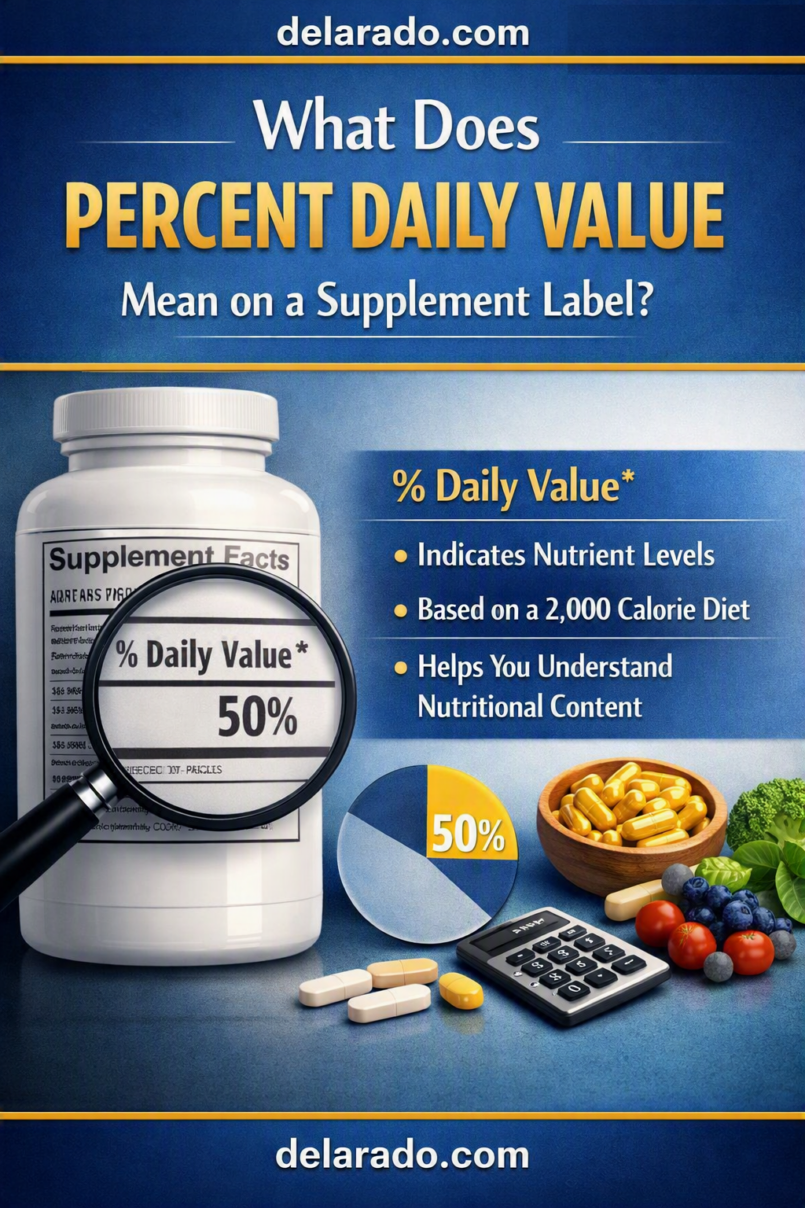
Percent Daily Value, written as %DV, shows how much one serving of a supplement contributes to a general daily reference amount for a nutrient. For example, if a vitamin supplement provides 100% Daily Value of vitamin C, one serving provides the full reference daily amount used on the label for vitamin C.
The %DV can help you compare products, identify whether a supplement contains a relatively low or high amount of a nutrient, and avoid accidentally taking too much when you use several supplements, fortified foods, powders, gummies, or drinks.
Quick answer: %DV does not mean a supplement is automatically right for you. It is a general label reference—not a personalized recommendation. Always check serving size, total dose, other products you use, medications, health conditions, and label warnings.
What Is Percent Daily Value (%DV)?
Percent Daily Value is a percentage shown on Nutrition Facts and Supplement Facts labels. It tells you how much a nutrient in one serving contributes to a general daily reference amount.
For example, if a supplement label says:
Vitamin C: 90 mg — 100% Daily Value
That means one serving of the product provides 100% of the Daily Value used on the label for vitamin C.
The %DV is most commonly listed for nutrients such as vitamins and minerals. It may not be available for many herbal ingredients, amino acids, probiotics, enzymes, blends, or specialty compounds.
Daily Value vs. Percent Daily Value: What Is the Difference?
Daily Value and Percent Daily Value are related, but they are not the same thing.
| Term | What It Means | Example |
|---|---|---|
| Daily Value (DV) | A general daily reference amount used on food and supplement labels. | The Daily Value for a nutrient may be expressed in milligrams or micrograms. |
| Percent Daily Value (%DV) | The percentage of that Daily Value provided by one serving of a product. | A product that provides half of the Daily Value would list 50% DV. |
Think of the Daily Value as the full reference amount and the %DV as the portion supplied by one serving.
How Does %DV Work on a Supplement Label?
On a Supplement Facts label, you will usually see several columns. The most common columns include:
- Serving Size
- Amount Per Serving
- % Daily Value
The serving size is important because every amount and every %DV listed on the label is based on that serving size.
Serving Size: 2 Gummies
Vitamin D: 20 mcg — 100% DV
This means you must take two gummies to receive the listed 20 micrograms and 100% Daily Value. If you take only one gummy, you receive half of the amount shown.
Do not assume one capsule, gummy, tablet, scoop, or softgel equals one serving. Always look at the serving size first.
How Is Percent Daily Value Calculated?
The basic calculation for Percent Daily Value is:
Percent Daily Value = (Amount of nutrient in one serving ÷ Daily Value for that nutrient) × 100
Example Calculation
Imagine a nutrient has a Daily Value of 300 micrograms. A supplement provides 30 micrograms in one serving.
(30 mcg ÷ 300 mcg) × 100 = 10% DV
That supplement would show 10% Daily Value for the nutrient.
You do not need to calculate %DV every time you read a label because it is usually listed for nutrients with established Daily Values. However, understanding the calculation helps you compare products and recognize what the percentage represents.
What Do 5% and 20% Daily Value Mean?
As a general guide, the %DV can help you identify whether one serving of a supplement provides a relatively low or high amount of a nutrient.
- 5% Daily Value or less is generally considered low.
- 20% Daily Value or more is generally considered high.
| %DV Per Serving | General Meaning | How to Think About It |
|---|---|---|
| 0% to 5% | Low | The supplement provides a small amount of that nutrient per serving. |
| 6% to 19% | Moderate | The supplement provides a meaningful but not especially high amount per serving. |
| 20% or more | High | The supplement provides a substantial portion of the general Daily Value in one serving. |
| 100% or more | Full or greater than the reference amount | The product provides the full Daily Value or more in one serving. |
A high %DV does not automatically mean the product is better. It may be useful when there is a specific reason to take that amount, but high-dose supplements can also increase the chance of side effects, nutrient overlap, or unnecessary intake.
Why %DV Is Not a Personalized Recommendation
Daily Values are general label references. They are not customized to your age, sex, body size, activity level, diet, health condition, medication use, pregnancy status, or lab results.
Your individual needs may be different from the general Daily Value depending on factors such as:
- Age
- Pregnancy or breastfeeding
- Health conditions
- Medications
- Dietary restrictions
- Activity level
- Digestive or absorption concerns
- Lab-confirmed nutrient deficiencies
- Advice from a doctor, pharmacist, or registered dietitian
For this reason, a supplement with 100% DV may be unnecessary for one person, appropriate for another person, or unsuitable for someone who already receives the nutrient from multiple products.
Why Do Some Supplement Ingredients Have No %DV?
Not every ingredient has an established Daily Value. When a Daily Value has not been established, labels commonly show a symbol such as an asterisk next to the ingredient and state that the Daily Value has not been established.
Ashwagandha Root Extract: 600 mg — Daily Value Not Established
This does not mean the ingredient is necessarily unsafe or ineffective. It simply means there is no general Daily Value used for labeling that ingredient.
Ingredients that may not have a %DV include:
- Herbs and botanical extracts
- Amino acids
- Probiotics
- Digestive enzymes
- Creatine
- Collagen
- Caffeine
- Specialty compounds
- Many performance or wellness ingredients
When no %DV is listed, you should pay even closer attention to the ingredient amount, serving size, directions, warnings, medication interactions, and the reason you are considering the product.
How to Read %DV on a Supplement Facts Label
Use this step-by-step process to understand the %DV before taking a supplement.
- Read the serving size. Confirm how many capsules, gummies, scoops, or tablets make up one serving.
- Find the nutrient. Look for the specific vitamin or mineral you are evaluating.
- Check the amount per serving. Review the amount in milligrams, micrograms, grams, or another unit.
- Read the %DV. See what portion of the general Daily Value one serving provides.
- Compare it with your other products. Include multivitamins, powders, fortified foods, drinks, and individual supplements.
- Check whether the nutrient has a Daily Value. If it says “Daily Value Not Established,” focus on the actual dose and safety information instead.
- Review warnings and directions. Do not exceed the labeled serving without qualified guidance.
- Consider your personal needs. A high or low %DV is not automatically good or bad for everyone.
Examples of Percent Daily Value on Supplement Labels
Example 1: A Basic Multivitamin
Vitamin C: 90 mg — 100% DV
Vitamin D: 20 mcg — 100% DV
Zinc: 11 mg — 100% DV
This multivitamin provides the full general Daily Value for each listed nutrient in one serving. That does not mean every person needs it, and it does not mean adding separate vitamin C, vitamin D, or zinc supplements is automatically appropriate.
Example 2: A Lower-Dose Supplement
Calcium: 130 mg — 10% DV
This product provides 10% of the Daily Value for calcium per serving. It may add to calcium from foods and other products, but it is not a complete source of the Daily Value by itself.
Example 3: A High-Dose Supplement
Vitamin B12: 1,000 mcg — 41,667% DV
A very high %DV may appear on some products. A large percentage does not automatically mean a product is dangerous or beneficial, but it should prompt you to ask why the dose is so high, whether it fits your situation, and whether a qualified healthcare professional has recommended it.
Example 4: An Ingredient Without a %DV
Creatine Monohydrate: 5 g — Daily Value Not Established
Creatine does not have an established Daily Value on the label, so the important details are the serving size, amount per serving, directions, ingredients, quality, possible side effects, and whether the product is suitable for you.
How to Use %DV to Avoid Taking Too Much
%DV is especially useful when you use several products. A person may take a multivitamin, greens powder, protein shake, energy drink, immune gummy, and an individual vitamin supplement without realizing that several products contain the same nutrients.
Common Sources of Ingredient Overlap
- Multivitamins
- Individual vitamin or mineral supplements
- Greens powders
- Protein powders with added vitamins and minerals
- Meal-replacement shakes
- Immune-support gummies or drinks
- Pre-workouts and energy products
- Fortified foods and beverages
- Hair, skin, and nail products
- Sleep or stress-support blends
Simple Overlap Check
- List every supplement you take, including powders, gummies, teas, and drinks.
- Write down the serving size you actually use.
- List each repeated vitamin, mineral, caffeine source, herb, or other ingredient.
- Add the amounts from all products used in one day.
- Review the totals with a pharmacist, doctor, or registered dietitian if you are unsure.
Do not add up percentages alone when products use different serving sizes. Review the actual amount of the nutrient as well as the %DV.
Using %DV for Common Supplements
Multivitamins
Multivitamins often list a %DV for many vitamins and minerals. Look for nutrients that already appear in your other products so you do not accidentally duplicate them.
Vitamin D Supplements
Check the amount listed in micrograms or International Units, the serving size, and the %DV. Do not assume a higher percentage is automatically better for your needs.
Vitamin B12 Supplements
Some vitamin B12 products have very high %DVs. Focus on the actual amount, your reason for taking it, and whether you have been advised to use that dose.
Calcium and Magnesium Supplements
Check the amount of the mineral per serving, the %DV, the serving size, ingredient form, and overlap with other products. You may need more than one tablet or capsule to get the listed serving.
Iron Supplements
Iron should not be taken casually. Check the amount, %DV, directions, and warnings, and speak with a qualified healthcare professional if you are unsure whether you need it.
Greens Powders and Meal-Replacement Products
These products may include added vitamins and minerals with high %DVs. Check the full label because they can overlap with multivitamins, individual nutrients, and fortified foods.
Herbal Supplements
Many herbal products do not have a %DV. Read the exact amount of the herb, the plant part or extract form, warnings, directions, and possible medication interaction cautions.
Common Percent Daily Value Mistakes to Avoid
- Assuming 100% DV means the supplement is necessary for everyone.
- Assuming a higher %DV always means a better product.
- Ignoring the serving size before reading the %DV.
- Taking more than the labeled serving without qualified guidance.
- Combining multiple products without checking for duplicate nutrients.
- Looking only at %DV and ignoring the actual amount per serving.
- Assuming “Daily Value Not Established” means an ingredient is safe or effective.
- Using high-dose products because the label makes them seem stronger or more advanced.
- Ignoring medication interactions and warning statements.
- Using supplements instead of addressing food, sleep, hydration, or medical concerns.
- Continuing a supplement indefinitely without checking whether it has a clear purpose.
Top 10 Questions About Percent Daily Value on Supplement Labels
1. What does 100% Daily Value mean on a supplement label?
It means one serving of the product provides 100% of the general Daily Value used on the label for that nutrient. It does not mean every person needs that amount or that more is better.
2. Is 200% Daily Value too much?
Not automatically. Whether an amount is appropriate depends on the nutrient, the total amount you get from food and other products, your health needs, medications, and whether a qualified professional has recommended it.
3. What does 5% Daily Value mean?
Five percent Daily Value means one serving provides 5% of the general Daily Value for that nutrient. As a general label guide, 5% Daily Value or less is considered low.
4. What does 20% Daily Value mean?
Twenty percent Daily Value means one serving provides 20% of the general Daily Value for that nutrient. As a general guide, 20% Daily Value or more is considered high.
5. Why do some supplements have no Percent Daily Value?
Some ingredients do not have an established Daily Value. This is common with herbs, probiotics, amino acids, enzymes, creatine, collagen, caffeine, and many specialty ingredients.
6. Is %DV based on my personal needs?
No. %DV is based on a general reference amount used for labeling. Your personal needs may differ based on age, diet, medical conditions, medication use, pregnancy, breastfeeding, activity level, and lab results.
7. Should I add %DV percentages from different supplements?
You can use %DV as a quick comparison tool, but you should also add the actual amounts of repeated nutrients from all products. Serving sizes and food sources can make a percentage-only approach incomplete.
8. Does a high %DV mean a supplement works better?
No. A higher %DV only means the product contains more of a nutrient relative to the Daily Value. It does not prove that the product is more effective, necessary, higher quality, or safer.
9. Can I take a multivitamin with other supplements that have high %DV percentages?
Possibly, but check for overlap first. A multivitamin, greens powder, immune product, protein powder, and individual vitamin supplement may all contain the same nutrients. Ask a pharmacist or healthcare professional if you are unsure.
10. When should I ask a healthcare professional about %DV?
Ask before using a high-dose supplement, combining several products, taking iron or other concentrated nutrients, using herbal products, taking prescription medication, managing a health condition, preparing for surgery, or if you are pregnant or breastfeeding.
Final Takeaway
Percent Daily Value is a practical label tool that shows how much a nutrient in one serving contributes to a general daily reference amount. It can help you compare supplements and identify low or high nutrient amounts, but it does not replace individualized nutrition or medical advice.
Read %DV together with the serving size, actual ingredient amount, directions, warnings, other ingredients, and every other product you use. When you are unsure about a high-dose product, duplicate nutrients, medication interactions, or a health condition, speak with a pharmacist, doctor, or registered dietitian before starting.