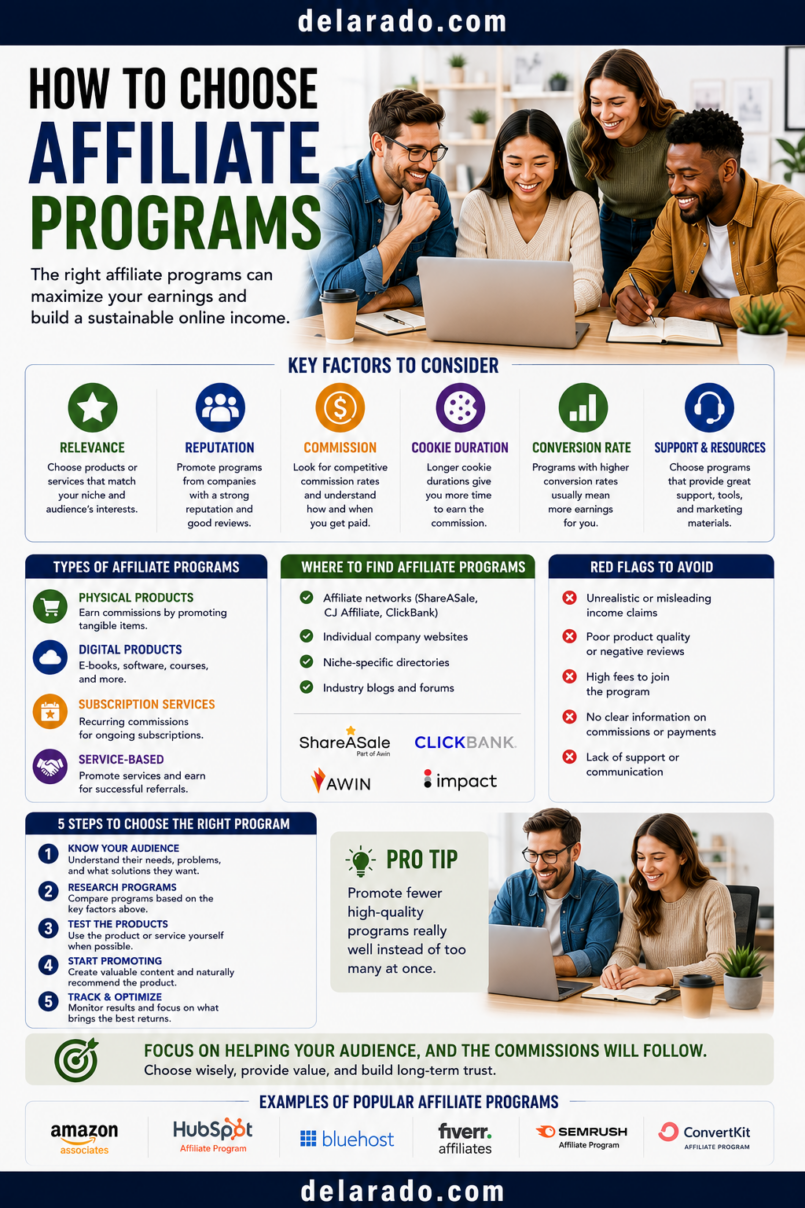
To choose affiliate programs, start with your audience’s needs—not the commission rate. The best program is one that offers a legitimate product or service relevant to your niche, has clear terms, provides reasonable support, allows your intended marketing methods, and gives you enough information to recommend the product honestly.
A high commission does not automatically make a program a good choice. If the product is poor, too expensive, unsuitable for your audience, difficult to explain, or restricted by program rules, promoting it can damage trust and create more problems than it solves.
Who Is This Topic For?
This guide is for affiliate marketing beginners, bloggers, YouTubers, creators, newsletter writers, niche website owners, social-media marketers, consultants, and anyone deciding which affiliate programs to join.
This Article Is Helpful If You Want To:
- Find affiliate programs for your niche
- Choose products to recommend
- Understand affiliate program terms
- Compare commission structures
- Review affiliate program rules
- Avoid poor-quality products
- Create honest affiliate content
- Promote products through a blog or YouTube
- Use affiliate links in email or social media
- Build a long-term affiliate strategy
What Is an Affiliate Program?
An affiliate program is a partnership system run by a company or affiliate network. It allows approved affiliates to promote a product or service using unique tracking links. If a customer completes a qualifying action, the affiliate may receive a commission.
Affiliate Program Components
| Component | What It Means |
|---|---|
| Merchant | The company offering the product or service |
| Affiliate | The approved person or business promoting the product |
| Affiliate link | A unique tracked link used to attribute referrals |
| Commission | Potential payment for an eligible customer action |
| Conversion | The action that qualifies for payment, such as a sale, lead, or trial |
| Cookie duration | The tracking period in which a referral may be credited |
| Payout threshold | The minimum amount required before the program sends payment |
| Program terms | The rules covering promotion methods, payments, disclosures, and account requirements |
Simple Example
A website owner writes a guide about choosing email marketing software for a small business.
They join an affiliate program for a platform they believe may fit part of their audience.
They create a useful comparison article, disclose the affiliate relationship, and include an approved tracking link.
If a reader completes a qualifying purchase or trial, the affiliate may earn a commission under the program’s rules.
The recommendation should still be helpful if the reader chooses another product or does not make a purchase.
Why Program Choice Matters
Protects Audience Trust
The products you recommend affect your reputation. A poor-quality recommendation can make readers, viewers, subscribers, or customers less likely to trust future content.
Helps You Create Better Content
Programs with clear product information, useful documentation, reasonable support, and a legitimate product make it easier to create accurate reviews, tutorials, comparisons, and buyer guides.
Reduces Compliance Problems
Understanding program rules helps you avoid prohibited practices such as unauthorized paid ads, trademark bidding, coupon promotion, email links, social-media activity, link cloaking, or misleading claims.
Improves Product Relevance
A suitable program gives you products that match your audience’s problems, budget, knowledge level, and goals.
Supports More Sustainable Content
Choosing programs connected to a focused niche lets you create a useful library of guides, comparisons, reviews, tutorials, alternatives, checklists, and resource pages.
Can Reduce Customer Complaints
When products are clearly explained and relevant, people are less likely to feel misled by your recommendations.
Benefits of Choosing Carefully
More Relevant Recommendations
You can recommend products that genuinely fit the audience rather than placing random links in every article or video.
Better Conversion Potential
Relevant products may perform better because the audience is already looking for a solution to a related problem.
Clearer Content Positioning
A focused set of programs can help you create better content categories, such as beginner guides, product comparisons, tool tutorials, setup instructions, and buyer checklists.
Stronger Long-Term Reputation
Transparent, accurate, useful recommendations can help you build credibility over time.
Fewer Program Violations
Reviewing terms before joining can help you avoid using links in prohibited ways or making unsupported claims that could lead to account suspension.
Better Audience Insights
Affiliate link clicks, customer questions, and product interest can help you understand what your audience is trying to solve.
Risks and Limitations
High Commissions Can Be Misleading
A high payout may be attractive, but it does not mean the product is useful, trustworthy, affordable, or appropriate for your audience.
Programs Can Change Their Terms
Commission rates, cookie durations, payment schedules, approved products, marketing restrictions, account requirements, and payout rules can change.
Products May Change
Product prices, features, availability, support quality, ownership, policies, and reputation can change after you publish a recommendation.
Not Every Product Fits Every Audience
A product may be useful for advanced users but not beginners, suitable for large teams but not freelancers, or affordable for one audience but not another.
Approval Is Not Guaranteed
Affiliate programs may reject applications based on content, traffic source, location, niche, audience, website quality, promotional methods, or other requirements.
Tracking Is Not Perfect
Commissions can be affected by cookie restrictions, device changes, customer behavior, refunds, cancellations, coupon use, fraud review, browser settings, and attribution rules.
Some Programs Restrict Promotions
Programs may prohibit direct-linking, paid ads, email campaigns, brand bidding, coupon-code sites, social media, link shortening, or certain forms of content.
Start With Your Audience
The first question is not “Which program pays the most?” It is “What does my audience need help with?”
Audience Questions
- Who is the audience?
- What problem are they trying to solve?
- What is their experience level?
- What is their budget?
- What features matter most?
- What mistakes do they want to avoid?
- What questions do they ask before buying?
- What alternatives might they consider?
- What products are not a good fit for them?
Example Audience
Beginner bloggers and small-business owners who want to build a WordPress website but need simple explanations about hosting, domains, themes, plugins, email marketing, backups, and content planning.
Possible Program Categories for That Audience
- Web hosting
- Domain registration
- WordPress themes
- Website backup tools
- Email marketing platforms
- Graphic design tools
- SEO tools
- Course platforms
- Website templates
Start with audience needs, then research products. Do not force your audience into a product category because it happens to offer a commission.
Step-by-Step Process
Step 1: List Products Your Audience Uses
Make a list of products, tools, services, or resources your audience already uses, researches, compares, or asks about.
Sources for Product Ideas
- Customer questions
- Search queries
- Comments on your content
- Support requests
- Product reviews
- Community discussions
- Competitor comparison articles
- Tools you use personally
- Products clients ask about
- Frequently asked questions
Example Product List
Web hosting, WordPress themes, email marketing tools, website backup plugins, content planning tools, graphic design tools, SEO tools, and digital-product platforms.
Start with products that solve specific recurring problems.
Step 2: Research the Product Before the Program
Evaluate the product itself before you apply to its affiliate program. A commission is not a reason to recommend something you would not feel comfortable explaining to your audience.
Product Research Checklist
- What problem does the product solve?
- Who is the product for?
- Who is it not for?
- What are the main features?
- What are its limitations?
- What does it cost?
- What support is available?
- Is pricing transparent?
- Is the product current and actively maintained?
- Are there clear alternatives?
- Would you recommend it without a commission?
Example Product Assessment
This email marketing platform may be a useful option for a beginner who wants simple forms, email sequences, and a basic landing page. It may not be the best option for a large company that needs advanced CRM workflows, complex integrations, or enterprise reporting.
Explain product fit and limitations honestly. A useful recommendation includes situations where the product is not the right choice.
Step 3: Find the Affiliate Program
Once you identify a product you might recommend, look for the company’s affiliate, partner, referral, creator, ambassador, or publisher program.
Where to Find Programs
- Company website footer
- Partner page
- Affiliate page
- Creator program page
- Referral program page
- Affiliate network listing
- Merchant dashboard
- Company support center
Search Examples
[Company Name] affiliate program
[Company Name] partner program
[Company Name] creator program
[Company Name] referral program
Do not assume a company offers an affiliate program. Some companies may offer referrals, reseller arrangements, creator partnerships, or no promotional program at all.
Step 4: Review Commission Structure
Review how the program pays affiliates, but do not make a decision based on commission rate alone.
Common Commission Models
| Commission Type | How It Works | Example |
|---|---|---|
| Percentage of sale | You earn a percentage of an eligible purchase | 10% of a qualifying sale |
| Fixed payment | You earn a set amount for each eligible action | $20 for a qualifying trial signup |
| Recurring commission | You may earn recurring payments while a referred customer remains eligible | 20% of an active monthly subscription |
| Pay per lead | You earn when someone completes an approved lead action | A visitor submits a quote request |
| Tiered commission | Commission changes based on volume or performance | Higher rate after a certain number of referrals |
Questions to Ask
- What action qualifies for a commission?
- Is the commission fixed, percentage-based, or recurring?
- Are commissions paid on renewals?
- Are commissions reversed after refunds?
- Are certain products excluded?
- Are new customers required?
- Is there a maximum commission amount?
- How long is the tracking period?
A lower commission for a product your audience truly needs may be more sustainable than a higher commission for a product that is unsuitable or difficult to recommend honestly.
Step 5: Review Cookie Duration
Cookie duration is the time period during which an affiliate referral may be credited after a person clicks your link. The exact process varies by program and may be affected by customer behavior, browser settings, device changes, privacy controls, coupon codes, and other attribution rules.
Example
A program may credit a qualifying purchase if it happens within a certain number of days after someone clicks your link, subject to the program’s rules.
Cookie Duration Questions
- How long is the tracking window?
- Does another affiliate link override the referral?
- Does a coupon code affect attribution?
- Does the program track across devices?
- What happens if a customer clears browser cookies?
- Does the program use first-click or last-click attribution?
- Does the customer need to be new?
Do not make content decisions based only on cookie duration. Product quality, audience fit, trust, and program rules matter more.
Step 6: Check Payment Details
Before joining a program, understand how and when you may be paid.
Review These Details
- Minimum payout threshold
- Payment schedule
- Payment method
- Available countries
- Currency
- Tax form requirements
- Refund or reversal delay
- Payment processing fees
- Account verification requirements
- Inactive account rules
Example Questions
Does the program pay monthly, quarterly, or after a specific threshold?
Does it pay through bank transfer, PayPal, another platform, or a network account?
Are commissions delayed until after a refund period?
Do not assume you will receive a commission immediately after a sale. Many programs validate transactions and account for refunds, cancellations, fraud reviews, and payout thresholds.
Step 7: Check Promotion Rules
Every affiliate program has promotional rules. Read them before creating content, buying ads, adding links to email, using social media, or creating discount campaigns.
Common Restrictions
- No paid search advertising
- No bidding on trademarked brand terms
- No direct linking from ads
- No coupon site promotion
- No email marketing links
- No link shortening or cloaking
- No social-media promotion
- No browser extensions
- No cashback or incentive offers
- No misleading claims
- No fake reviews
- No unauthorized discounts
- No automated traffic
- No spam
Important Questions
- Can I use affiliate links in blog posts?
- Can I include them in YouTube descriptions?
- Can I use them in email newsletters?
- Can I post them on social media?
- Can I use paid ads?
- Can I mention the brand in ad copy?
- Can I use coupons or discount codes?
- Can I use a link shortener?
- Can I create a product comparison page?
Never assume one program’s rules apply to another. Read the current agreement for each program.
Step 8: Review Brand Reputation
Your reputation is connected to the products you promote. Research the company’s support, pricing, product quality, policies, and customer experience before recommending it.
Research Areas
- Product documentation
- Pricing transparency
- Refund policy
- Customer support information
- Product updates
- Public customer feedback
- Security and privacy information where relevant
- Business contact details
- Subscription cancellation process
- Product limitations
Warning Signs
- Unclear pricing
- Hidden recurring charges
- Unrealistic income promises
- Unclear refund process
- Fake-looking testimonials
- Limited support information
- Misleading claims
- Frequent unresolved complaints
- Inconsistent product information
- Pressure-based sales tactics
Do not promote a product if you cannot confidently explain what it does, what it costs, who it helps, and what limitations it has.
Step 9: Check Content Opportunities
A good affiliate program should fit naturally into useful content. Before joining, make sure you can create helpful content that does more than repeat the merchant’s sales page.
Content Opportunity Questions
- Can I create a beginner guide around this product category?
- Can I create a comparison with alternatives?
- Can I make a useful tutorial?
- Can I explain who the product is for?
- Can I explain who should avoid it?
- Can I create a checklist or buyer guide?
- Can I answer common questions?
- Can I update the content when the product changes?
Example Content Ideas: Email Marketing Tool
- How to Start an Email List for a Small Business
- What Should Beginners Compare Before Choosing an Email Platform?
- How to Create a Lead Magnet Landing Page
- How to Send a Welcome Email Sequence
- Free Email Marketing Tools vs. Paid Plans
- How to Choose an Email Platform for a Course Creator
- Email Marketing Tool Alternatives for Beginners
If your only content idea is “Buy this product,” the program may not support a sustainable content strategy.
Step 10: Apply to a Small Number of Programs
Beginners do not need to join dozens of programs. Start with a small number of relevant products you can explain well and create content around.
Good Beginner Approach
- Choose one core product category
- Find two or three relevant products
- Research them carefully
- Apply to appropriate programs
- Create helpful content before adding many links
- Track audience questions and feedback
- Add new programs only when they fit the niche
Example
A beginner WordPress website may begin with one hosting program, one email platform, one design tool, and one backup tool—rather than adding affiliate links to dozens of unrelated products.
A smaller number of high-quality, well-explained recommendations is often more useful than a large list of random products.
Step 11: Add Clear Disclosures
Disclose affiliate relationships clearly near your recommendation or link. People should understand that you may earn a commission before they rely on the recommendation or click through.
Disclosure Examples
- Disclosure: This article contains affiliate links. If you purchase through a qualifying link, I may earn a commission at no additional cost to you.
- Some links below are affiliate links, which means I may earn a commission if you make a qualifying purchase.
- This video includes affiliate links. I may earn a commission if you purchase through a qualifying link.
- Some links in this email are affiliate links. I may earn a commission if you make a qualifying purchase.
Disclosure Placement
- Near the beginning of a review article
- Near affiliate links
- In video descriptions
- In social-media captions
- In email campaigns
- On product comparison pages
- In resource libraries
Do not hide disclosure in a footer, use vague language, or place it only on a separate legal page.
Step 12: Review Programs Regularly
Affiliate programs and products change. Review your program terms, links, product recommendations, and content regularly.
Program Review Checklist
- Are commission rates still current?
- Are product prices current?
- Are affiliate links still working?
- Have promotion rules changed?
- Is the product still available?
- Has the company changed ownership or policy?
- Are there new alternatives?
- Are customer concerns increasing?
- Do you still recommend the product?
- Are disclosures still visible and accurate?
Remove products you no longer recommend. Do not keep promoting an unsuitable product simply because an old article generates commissions.
Affiliate Program Evaluation Checklist
Audience Fit
- Does the product solve a real audience problem?
- Does the price fit the audience?
- Is the product suitable for the audience’s skill level?
- Can I explain the product honestly?
- Would I recommend it without a commission?
Product Quality
- Is the product clear and useful?
- Is pricing transparent?
- Are limitations clear?
- Is support available?
- Are refunds or cancellations explained?
- Is the product actively maintained?
Program Terms
- What qualifies for a commission?
- What is the commission structure?
- What is the cookie duration?
- What are payout requirements?
- What promotion methods are allowed?
- What methods are prohibited?
- What disclosure is required?
Content Opportunities
- Can I create guides?
- Can I create comparisons?
- Can I create tutorials?
- Can I create a buyer checklist?
- Can I explain alternatives?
- Can I keep the content updated?
Business Stability
- Is the company credible?
- Are policies accessible?
- Is support information available?
- Does the company have clear terms?
- Does the product have a reasonable reputation?
- Would promoting it risk audience trust?
Programs That Can Help
Affiliate Networks
Affiliate networks can help you find programs, apply to merchants, manage links, review reporting, and receive payments. Examples include Impact, CJ, ShareASale, Awin, Rakuten Advertising, and PartnerStack.
Company Affiliate Programs
Many companies operate direct affiliate, partner, referral, creator, or ambassador programs. Search the company website for those pages and review the full agreement before applying.
WordPress
WordPress can help create affiliate content such as reviews, comparisons, tutorials, buyer guides, resource libraries, disclosure pages, and search-focused articles.
Google Search Console
Google Search Console can help identify search queries, useful content opportunities, topics readers search for, and pages that need updates.
Google Analytics
Google Analytics can help measure traffic, engagement, traffic sources, email signup activity, and outbound-link clicks when configured appropriately.
Canva
Canva can help create product comparison graphics, buyer checklists, lead magnets, thumbnails, social posts, resource guides, and email visuals.
Email Marketing Platforms
MailerLite, ConvertKit, Brevo, Mailchimp, and similar tools can help create signup forms, deliver lead magnets, send educational emails, and share relevant recommendations with appropriate disclosure.
Link Management Tools
Link management tools can help organize affiliate links, find broken links, update destinations, and maintain records. Use only link tools and methods permitted by each affiliate program.
Common Mistakes
Choosing Programs Only for High Commissions
A high payout does not make a product a good recommendation. Focus on audience fit, product quality, pricing, and long-term trust.
Not Reading the Affiliate Agreement
Do not apply or promote before reading rules about email, paid ads, social media, link use, coupons, trademark bidding, disclosures, and payment eligibility.
Promoting Products You Do Not Understand
Do not recommend tools, services, or products that you cannot explain responsibly. If you have not used a product, be transparent that your overview is research-based.
Ignoring Product Limitations
Every product has limits. Explain who the product is for, who it may not suit, what it does well, and what it does not do.
Writing Fake Reviews
Do not claim personal use when you have not used the product. Do not create fake screenshots, fabricated customer stories, invented ratings, AI-generated testimonials, or misleading results.
Using Hidden Affiliate Disclosures
Disclose affiliate relationships clearly near recommendations and links. Do not hide disclosure in a footer or separate legal page.
Joining Too Many Programs
Start with a small number of relevant programs. You can create better content and maintain more accurate recommendations when you focus.
Not Updating Program Information
Check product pricing, features, affiliate links, commission terms, availability, and promotional rules regularly.
Using Prohibited Promotion Methods
Do not use paid ads, coupon codes, direct links, email campaigns, trademark keywords, link shorteners, social posts, or other methods if the affiliate program prohibits them.
Ignoring Audience Trust
Do not trade long-term credibility for short-term commissions. Honest recommendations, useful content, and transparency are more sustainable.
Frequently Asked Questions
How do I choose an affiliate program?
Start with audience needs, then evaluate the product, commission structure, cookie duration, payout terms, promotion restrictions, company reputation, support, content opportunities, and disclosure requirements.
Should I choose affiliate programs with the highest commissions?
No. A high commission does not guarantee product quality or audience fit. Choose products that are useful, relevant, transparent, and appropriate for the people you serve.
What should I check before joining an affiliate program?
Review product quality, audience fit, commission structure, qualifying actions, cookie duration, payout threshold, payment schedule, refund policy, promotion rules, disclosure requirements, and account termination conditions.
What is a good commission rate for affiliate marketing?
There is no universal good rate. Commission value depends on the product price, conversion potential, refund rate, audience fit, cookie duration, recurring-payment structure, and program rules.
What is cookie duration?
Cookie duration is the tracking period during which an eligible customer action may be credited to an affiliate after someone clicks a tracked link. Rules vary by program.
Can I promote affiliate links on social media?
Possibly, but each affiliate program has its own rules. Check whether it permits social posts, direct links, link-in-bio pages, short-form video links, and paid promotion. Use clear disclosures.
Can I use affiliate links in email?
Some programs allow email links and others do not. Check the program agreement before using affiliate links in newsletters or email sequences. Use permission-based email lists and clear disclosure.
Can I promote a product I have not used?
Possibly, if program rules allow it, but do not claim personal experience. Explain that your content is research-based and encourage readers to review current information directly.
How many affiliate programs should a beginner join?
Start with a small number of relevant programs, often two to five, that fit your niche and audience. Add more only when you can create useful content and maintain accurate recommendations.
How do I know if an affiliate program is legitimate?
Look for clear terms, a real company website, transparent product information, visible support contact details, pricing clarity, an understandable payout process, and a product you can evaluate responsibly.
What should I avoid when choosing affiliate programs?
Avoid programs with unclear pricing, unrealistic claims, hidden subscription terms, poor support information, fake testimonials, confusing terms, products unsuitable for your audience, or restrictions that conflict with your planned marketing methods.