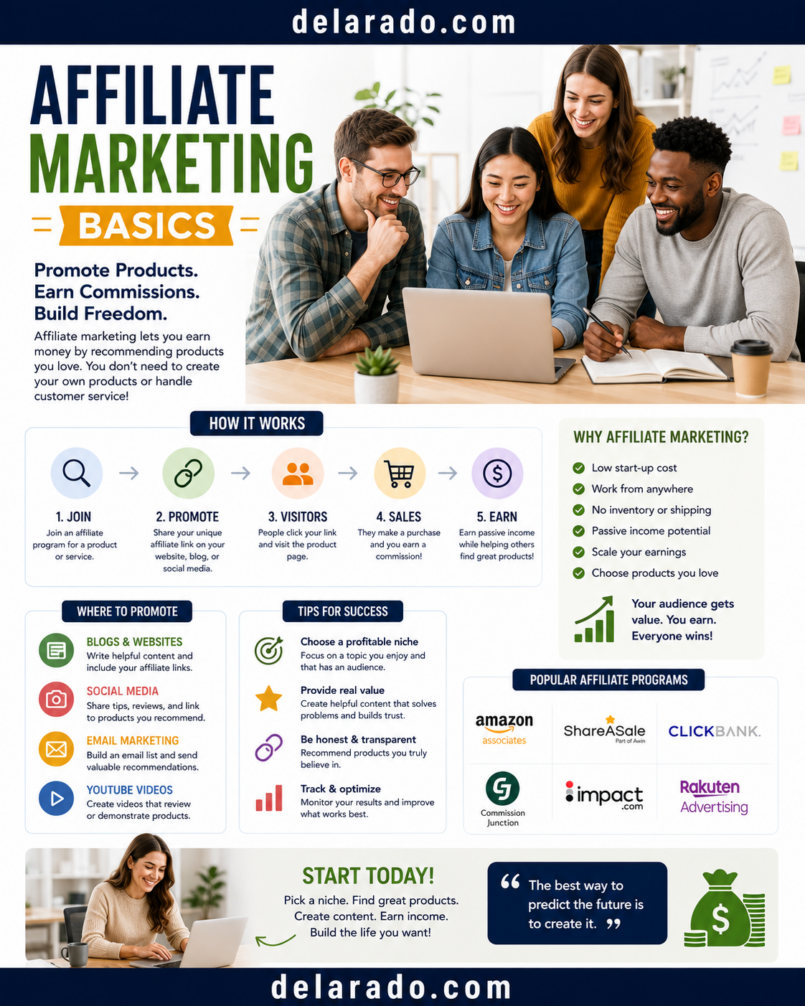
Affiliate marketing is a performance-based marketing model in which you recommend a product or service using a tracked link and may earn a commission when someone completes a qualifying action, such as making a purchase or starting a trial. It can be a legitimate way to monetize helpful content, but it works best when you provide real value, make transparent recommendations, disclose your relationship clearly, and recommend products that fit the audience’s actual needs.
Affiliate marketing is not a shortcut to automatic income. Successful affiliate content requires audience research, useful articles or videos, accurate claims, honest product comparisons, relevant traffic, disclosure practices, patience, and ongoing updates. Your reputation matters more than a commission on any one sale.
Amazon’s Associates Program, for example, requires participants to state clearly and prominently: “As an Amazon Associate I earn from qualifying purchases.” Amazon also describes commissions as applying to qualifying purchases made through eligible special links under its program terms. [186][187]
Who Is This Topic For?
This guide is for bloggers, YouTubers, social-media creators, email marketers, niche website owners, course creators, freelancers, consultants, small businesses, review-site owners, and anyone who wants to understand affiliate marketing before promoting products or services.
This Article Is Helpful If You Want To:
- Understand how affiliate marketing works
- Start affiliate marketing ethically
- Choose an affiliate niche
- Find affiliate programs
- Create product reviews and comparisons
- Promote affiliate links through content
- Build an email list for affiliate content
- Use affiliate links on YouTube or social media
- Learn disclosure basics
- Avoid common affiliate marketing mistakes
Affiliate Marketing May Be a Good Fit If You:
- Enjoy teaching, reviewing, comparing, or explaining products
- Have knowledge in a specific topic or industry
- Can create useful written, video, audio, or social content
- Want to monetize an audience over time
- Can disclose relationships clearly
- Are willing to research products and update content
- Want to help people make informed decisions
Affiliate Marketing May Not Be a Good Fit If You:
- Want immediate or guaranteed income
- Do not want to create original content
- Do not want to disclose financial relationships
- Plan to copy product descriptions or competitor reviews
- Want to promote products you know nothing about
- Want to use fake testimonials or fabricated results
- Do not have time to review program terms and update old content
What Is Affiliate Marketing?
Affiliate marketing is an arrangement in which a business gives an affiliate a unique tracking link. The affiliate shares the link in helpful content, and the business may pay a commission when a person clicks the link and completes a qualifying action.
Key People and Terms
| Term | Meaning |
|---|---|
| Merchant or advertiser | The company that sells the product or service |
| Affiliate or publisher | The person or business that promotes the product through approved marketing methods |
| Customer | The person who clicks, signs up, purchases, or completes another qualifying action |
| Affiliate link | A tracked link that identifies the affiliate who referred the customer |
| Commission | Payment an affiliate may receive for a qualifying action |
| Cookie duration | The time window in which a referral may be credited, subject to program terms |
| Conversion | The qualifying action, such as a purchase, signup, trial, or lead submission |
| Affiliate network | A platform that connects merchants with affiliates and manages tracking or payments |
Simple Example
A blogger publishes a guide called “How to Choose WordPress Hosting for a New Website.”
The guide explains what to compare, such as support, backups, performance, pricing, and room to grow.
The blogger includes a tracked affiliate link to a hosting provider that fits the audience.
If a reader clicks the link and completes a qualifying purchase under that provider’s rules, the blogger may receive a commission.
The affiliate link does not increase the price for the customer in many programs, but you should never assume that without checking the program terms. Always disclose when you may earn a commission.
How Affiliate Marketing Works
Step 1: Join an Affiliate Program
You apply to a business directly or join an affiliate network that manages multiple programs. The business reviews your application, website, audience, traffic sources, or promotional methods based on its own rules.
Step 2: Receive a Unique Tracking Link
If accepted, you receive a unique affiliate link or tracking code. That link helps the merchant identify referrals from your content.
Step 3: Create Helpful Content
You create useful content such as a review, tutorial, comparison, buyer guide, product demonstration, checklist, email, video, or social post that helps people understand the product or solve a problem.
Step 4: Disclose the Relationship
You clearly disclose that you may earn a commission if someone purchases through your link. The disclosure should be easy to notice and understand before or near the endorsement or link.
Step 5: A Visitor Clicks the Link
A reader, viewer, or subscriber clicks the tracked link and visits the merchant’s site.
Step 6: A Qualifying Action Happens
If the customer completes an eligible action under the program’s terms, such as purchasing a product or starting a trial, the merchant may record the referral.
Step 7: The Merchant Pays a Commission
The affiliate may receive a commission according to the program’s terms, payout threshold, refund rules, cookie duration, validation process, and payment schedule.
Amazon states that affiliates may receive commission income from qualifying purchases made after customers use special links, subject to its operating agreement and commission rules. [186][187]
Benefits of Affiliate Marketing
Can Monetize Helpful Content
Affiliate links can help monetize useful articles, videos, tutorials, resource pages, newsletters, and comparisons without requiring you to create your own product first.
Can Be Flexible
You can create affiliate content in many formats, including blog posts, YouTube videos, email newsletters, podcasts, social content, product comparisons, and resource libraries.
Does Not Require Inventory
In most affiliate programs, the merchant handles inventory, shipping, product fulfillment, billing, returns, and customer service for the purchased product.
Can Support Niche Expertise
If you understand a topic well, you can help people compare products and make better decisions. For example, you may create resources about website tools, outdoor equipment, home organization, software, design tools, cooking tools, or hobby supplies.
Can Be Combined With Other Revenue
Affiliate marketing can work alongside advertising, digital products, courses, consulting, services, sponsorships, memberships, and physical-product sales.
Can Provide Audience Insights
Clicks, questions, sales patterns, search queries, and comments can reveal what your audience wants help with and what products they are considering.
Can Create Long-Term Content Assets
A useful buyer guide, tutorial, or comparison article may continue helping readers over time if it remains accurate, updated, and genuinely relevant.
Risks and Limitations
Income Is Not Guaranteed
Affiliate results depend on audience trust, content quality, traffic, product fit, competition, commission rates, program rules, conversion rates, refunds, and many other factors.
Program Terms Can Change
Affiliate programs may change commission rates, payout thresholds, cookie durations, marketing rules, eligible products, payment methods, and account requirements.
Account Approval Is Not Guaranteed
A merchant may decline, suspend, or remove affiliates if they do not meet program requirements or violate rules.
Thin Affiliate Content Can Perform Poorly
Pages that simply repeat merchant descriptions, copy competitors, use generic AI text, or place links without useful analysis may provide little value to readers and may struggle in search or with audience trust.
Disclosure Is Required
You should disclose material relationships clearly. If you earn a commission, receive payment, receive free products, or have another connection that affects how people evaluate your recommendation, readers should know.
Reputation Can Be Damaged
Promoting poor-quality, irrelevant, misleading, unsafe, or untested products can harm your credibility even if you earn commissions in the short term.
Privacy Rules Matter
Affiliate tracking, cookies, email lists, retargeting, analytics, and advertising tools can involve personal data or device information. Review privacy obligations that apply to your location and audience.
Some Niches Need Extra Care
Health, legal, financial, insurance, safety, children’s products, gambling, supplements, and regulated products can involve additional compliance, platform, advertising, or professional requirements.
Affiliate Disclosure Basics
A disclosure tells people that you may earn a commission or have another material relationship with a brand or product you recommend. It should be understandable, visible, and placed where people can notice it before or near the endorsement or affiliate link.
Simple Disclosure Examples
- Disclosure: This article contains affiliate links. If you purchase through a qualifying link, I may earn a commission at no additional cost to you.
- Some links below are affiliate links, which means I may earn a commission if you make a purchase through them.
- This video includes affiliate links. I may earn a commission if you buy through a qualifying link.
- This post is sponsored by [Brand]. I received compensation for creating this content.
Amazon Associates Disclosure
Amazon’s operating agreement requires associates to clearly and prominently state: “As an Amazon Associate I earn from qualifying purchases.” [186]
Where to Put a Disclosure
- Near the beginning of an affiliate article
- Near relevant affiliate links
- In a video, through clear on-screen or spoken disclosure when appropriate
- In social content near the recommendation
- In email messages containing affiliate links
- On comparison and review pages
Disclosure Mistakes to Avoid
- Hiding disclosures in a footer
- Using vague language such as “may contain links”
- Putting disclosure only on a separate legal page
- Placing it after the affiliate links
- Using tiny or low-contrast text
- Assuming a platform label alone is enough
- Forgetting disclosure in video descriptions or emails
Amazon requires a clear and prominent Associates statement, while affiliate-marketing guidance emphasizes placing disclosures in plain language near the recommendation or link. [186][188]
Step-by-Step Process
Step 1: Choose a Niche
A niche is a focused topic area and audience. Choose a topic where you can provide useful information, understand customer questions, and create content consistently.
Good Niche Criteria
- You understand or can learn the topic responsibly
- People actively search for help
- There are legitimate products or services to recommend
- You can create original content
- You can describe product limitations honestly
- You can stay interested in the topic over time
- The topic fits your audience or business
Examples of Focused Niches
- WordPress tools for beginner website owners
- Home coffee equipment for beginners
- Productivity tools for freelancers
- Photography gear for travel creators
- Outdoor equipment for weekend hikers
- Craft supplies for beginner makers
- Email marketing tools for small businesses
- Home organization products for apartment dwellers
Weak Niche
Everything people might buy online.
Stronger Niche
Beginner-friendly WordPress tools, website setup resources, and content planning systems for first-time website owners.
Step 2: Define Your Audience
Know who your content is meant to help. The more clearly you understand your audience, the easier it is to recommend relevant products and avoid generic content.
Audience Questions
- Who is the person?
- What problem are they trying to solve?
- What is their experience level?
- What is their budget range?
- What questions do they ask before buying?
- What mistakes are they trying to avoid?
- What features matter most to them?
- What products are not a good fit for them?
Example Audience
Beginning bloggers and small-business owners who want to launch a WordPress website but need simple explanations of domains, hosting, themes, plugins, backups, email tools, and content planning.
Do not recommend expensive or advanced tools to beginners simply because they pay a higher commission. Recommend the option that fits the person’s actual needs.
Step 3: Research Affiliate Programs
Find programs that align with your niche and review the rules before applying. Merchants may run their own program or use an affiliate network.
Where to Find Programs
- Company website footer links
- Company partner or affiliate pages
- Affiliate networks
- Product dashboards
- Creator partnership pages
- Industry communities
Review Before Applying
- Commission rate or payout structure
- Cookie duration
- Qualifying actions
- Payment schedule
- Payout threshold
- Payment method
- Refund and reversal policy
- Allowed traffic sources
- Paid advertising restrictions
- Email marketing restrictions
- Trademark and keyword bidding rules
- Social-media promotion rules
- Coupon and discount-code rules
- Geographic restrictions
- Required disclosures
Important Question
Would I still be comfortable recommending this product if it paid a low commission or no commission at all?
If the answer is no, the product may not be a good fit for your audience.
Step 4: Apply to Programs
Affiliate applications may ask about your website, audience, traffic sources, content style, promotional methods, social accounts, and how you plan to use links.
Prepare Before Applying
- Professional website or relevant online presence
- Clear about page or creator profile
- Published helpful content
- Privacy policy and disclosure information where appropriate
- Accurate contact details
- Clear traffic and promotion descriptions
- Understanding of the program’s rules
Do not misrepresent your traffic, audience, past results, product use, or promotional methods to gain approval.
Step 5: Create Helpful Affiliate Content
Affiliate marketing works best when the content helps a visitor make a better decision. Use links as part of the resource—not as the entire resource.
Useful Content Types
- Product reviews
- Product comparisons
- Buyer guides
- How-to tutorials
- Setup guides
- Alternatives articles
- Pros and cons lists
- Use-case guides
- Frequently asked questions
- Resource pages
- Video demonstrations
- Email education sequences
Example Content Ideas
- How to Choose WordPress Hosting for a New Website
- Shared Hosting vs. Managed WordPress Hosting: What Is the Difference?
- Five Things to Compare Before Choosing an Email Marketing Tool
- How to Create a Simple Website Backup Process
- Best Website Planning Tools for Beginner Freelancers
- How to Choose a Project Management Tool for a Small Team
Strong Review Structure
- Who the product is for
- What problem it solves
- Key features
- Benefits
- Limitations
- Pricing or pricing considerations
- Alternatives
- Who should not buy it
- Disclosure
- Clear recommendation or next step
Do not copy product descriptions from the merchant or other affiliates. Add original explanations, examples, comparisons, demonstrations, testing, and useful context.
Step 6: Use Product Experience Honestly
If you have used a product, explain your experience accurately. If you have not used it, do not imply that you have personally tested it.
If You Have Used the Product
- Describe what you tested
- Explain your use case
- Share relevant limitations
- Use original screenshots or demonstrations where permitted
- State when your experience may not apply to everyone
If You Have Not Used the Product
- Do not claim personal experience
- Use official documentation and verified information carefully
- State that you are providing a research-based overview
- Focus on who may want to consider the product
- Encourage readers to review current terms and pricing directly
Example Honest Language
I have not personally used this tool. This overview is based on the company’s published features, pricing information, and documentation. Check the current terms and trial details before deciding.
Never create fake product testing, fake screenshots, invented customer results, or fabricated personal stories to make an affiliate recommendation more persuasive.
Step 7: Add Disclosures Clearly
Place a clear disclosure near the relevant content and link. Readers should know about your potential commission before relying on the recommendation or clicking the affiliate link.
Article Disclosure Example
Disclosure: This article may contain affiliate links. If you purchase through a qualifying link, I may earn a commission at no additional cost to you. I recommend products based on their relevance to the topic and audience.
Video Disclosure Example
Disclosure: This video contains affiliate links. If you buy through a qualifying link, I may earn a commission. Please review current product details and pricing directly before purchasing.
Email Disclosure Example
Disclosure: Some links in this email are affiliate links, which means I may earn a commission if you make a qualifying purchase.
Systeme.io’s affiliate guidance recommends disclosing affiliate relationships in plain language near the link and before a visitor clicks. [59][61]
Step 8: Use Affiliate Links Correctly
Use the link format and promotional methods allowed by the merchant. Do not alter links in ways the program prohibits or use links in restricted channels.
Link Management Tips
- Use the merchant’s approved tracking link
- Label affiliate buttons clearly
- Keep a record of which links appear on each page
- Review links periodically for errors
- Update discontinued products or expired offers
- Use appropriate link attributes where relevant
- Do not cloak or shorten links if the program prohibits it
- Check whether email, paid ads, social platforms, or coupon sites are allowed
Clear Button Examples
- Check Current Pricing
- View Product Details
- Compare Plans
- Visit the Official Website
- Start a Free Trial
Buttons to Avoid
- Get Rich Now
- Guaranteed Results
- Only One Chance
- Secret Discount
- Buy Before It Is Too Late
Use language that tells the visitor what happens next without making false or exaggerated claims.
Step 9: Build Traffic Ethically
Affiliate content needs an audience. Build traffic through useful content, search visibility, video, social media, email, partnerships, communities, and other permitted methods.
Organic Traffic Methods
- Search-focused articles
- YouTube tutorials
- Short-form educational videos
- Email newsletters
- Pinterest content
- Social-media posts
- Podcast content
- Community participation
- Guest posts where allowed
- Resource libraries
Traffic Practices to Avoid
- Spam comments
- Misleading paid ads
- Fake reviews
- Keyword stuffing
- Copied content
- Doorway pages
- Sending unsolicited promotional email
- Using prohibited trademark terms in ads
- Fake social-media accounts
- Misrepresenting affiliate links as official links
Google’s site reputation abuse policy targets third-party content published primarily to exploit a host website’s ranking signals without close oversight and with little value to users. Create content that fits your own site’s purpose and offers real value. [190]
Step 10: Build an Email List
An email list can help you continue helping people after they visit your content. Offer a relevant resource, obtain appropriate permission, and send useful follow-up messages.
Lead Magnet Ideas for Affiliate Content
- Buyer comparison checklist
- Website launch checklist
- Tool comparison worksheet
- Keyword research template
- Beginner setup guide
- Product selection quiz
- Resource library
- Mini email course
Example Funnel
Helpful article → Free buyer checklist → Email education sequence → Relevant product comparison → Affiliate recommendation with clear disclosure
Do not use a lead magnet to collect emails and then send unrelated affiliate offers. Match follow-up messages to the topic and expectation that caused someone to subscribe.
Step 11: Track Performance
Track content performance, affiliate link clicks, conversions where available, email engagement, and customer questions. Use data to improve content quality, not simply to add more links.
Useful Metrics
- Organic traffic
- Video views
- Audience retention
- Affiliate link clicks
- Click-through rate
- Conversions reported by the affiliate program
- Commission earnings
- Email signup rate
- Email opens and clicks
- Customer questions
- Refund or reversal data where available
- Content update needs
Simple Affiliate Link Click-Through Formula
\[
\text{Affiliate Link CTR} = \frac{\text{Affiliate Link Clicks}}{\text{Page Views}} \times 100
\]
Example
If 1,000 people view a comparison article and 50 click an affiliate link:
\[
\frac{50}{1{,}000} \times 100 = 5\%
\]
A click-through rate alone does not show whether the content is helpful. Review audience satisfaction, conversions, refunds, questions, and product fit as well.
Step 12: Update Content Regularly
Affiliate content can become outdated quickly when prices, features, program terms, product availability, discounts, policies, and alternatives change.
Update Checklist
- Check product pricing
- Check feature descriptions
- Check affiliate links
- Check commission and program terms
- Remove discontinued products
- Update screenshots
- Review comparisons
- Check disclosure placement
- Update publication dates where appropriate
- Add new relevant alternatives
Do not leave outdated recommendations online simply because a page once generated commissions.
Programs That Can Help
Amazon Associates
Amazon Associates is Amazon’s affiliate program. Participants may earn commission income from qualifying purchases made through eligible special links, subject to the program’s current rules. Amazon requires a clear and prominent disclosure stating: “As an Amazon Associate I earn from qualifying purchases.” [186][187]
Affiliate Networks
Affiliate networks can connect publishers with merchants and may provide tracking links, reporting, payments, program applications, and promotional resources. Examples may include networks such as Impact, CJ, ShareASale, Awin, Rakuten Advertising, and PartnerStack. Review each network and merchant’s current terms before applying.
WordPress
WordPress can help create affiliate articles, comparison pages, resource libraries, blog posts, disclosures, product reviews, landing pages, and content categories.
Google Search Console
Google Search Console can help identify search queries, impressions, clicks, pages that need updates, and content opportunities based on what people search for.
Google Analytics
Google Analytics can help measure page visits, engagement, traffic sources, outbound affiliate link activity when configured appropriately, email signups, and other content outcomes.
Canva
Canva can help create buyer checklists, comparison graphics, product guides, social visuals, lead magnets, affiliate disclosure graphics, thumbnails, and email resources.
YouTube Studio
YouTube Studio can help upload tutorials and reviews, add descriptions and disclosures, manage captions, review audience analytics, and track performance of affiliate-focused videos.
MailerLite, ConvertKit, or Brevo
Email platforms can help create signup forms, deliver lead magnets, send relevant educational sequences, manage subscriber preferences, and include appropriate affiliate disclosures in emails.
Link Management Tools
Link management tools can help organize affiliate links, check broken links, update destination URLs, and maintain a record of affiliate programs. Use only methods permitted by each affiliate program.
Common Mistakes
Choosing Products Only for High Commissions
Do not recommend unsuitable products because they pay more. Prioritize audience fit, product quality, customer value, and honest recommendations.
Not Disclosing Affiliate Relationships
Disclose when you may earn a commission. Place disclosure clearly near the recommendation or affiliate link rather than hiding it on a separate page.
Copying Merchant or Competitor Content
Do not copy product descriptions, reviews, comparison tables, videos, images, or articles. Create original explanations, examples, research, testing, visuals, and analysis.
Making Claims Without Evidence
Do not promise guaranteed income, rankings, traffic, health results, financial outcomes, business growth, product performance, or results you cannot support.
Writing Fake Reviews
Do not claim personal experience with a product you have not used. Do not create fake screenshots, fake customer stories, fake ratings, or AI-generated testimonials.
Using Irrelevant Affiliate Links
Only link to products that fit the topic and audience. A website setup guide should not contain unrelated affiliate links simply because they pay commissions.
Ignoring Program Rules
Each merchant has its own rules about email, paid advertising, social media, coupon sites, trademark bidding, link shortening, link cloaking, and promotional claims. Read the current agreement.
Sending Unwanted Affiliate Emails
Do not buy or scrape email lists. Use appropriate permission-based email marketing and disclose affiliate relationships in email content.
Publishing Outdated Comparisons
Update pricing, features, availability, screenshots, policies, links, and alternatives regularly.
Building Thin Content at Scale
Do not mass-produce generic affiliate pages with little original value. Google’s policies emphasize people-first content and can treat low-value third-party content aimed at exploiting a host site’s ranking signals as spam. [190][196]
Ignoring Customer Trust
Short-term commissions are not worth losing your audience’s trust. Explain limitations, recommend alternatives when appropriate, and make it clear when a product is not a good fit.
Frequently Asked Questions
What is affiliate marketing?
Affiliate marketing is a performance-based arrangement where you promote a product or service using a tracked link and may earn a commission when someone completes a qualifying action, such as a purchase or trial signup.
How do affiliate marketers get paid?
Payment depends on the program. Some pay a percentage of a sale, a fixed amount per purchase, a recurring commission, or payment for another qualifying action. Review the program’s commission rules, payout schedule, thresholds, reversals, and payment methods.
Do I need a website for affiliate marketing?
No, but a website can be helpful for publishing articles, reviews, comparisons, resource pages, disclosure information, and search-focused content. Some affiliates also use YouTube, social media, email, podcasts, or communities, subject to each program’s rules.
How do beginners start affiliate marketing?
Choose a focused niche, define an audience, research products you can recommend honestly, join appropriate programs, create useful content, disclose affiliate relationships, use approved links, build traffic ethically, and update your content regularly.
Can I make money with affiliate marketing?
It is possible to earn commissions, but income is not guaranteed. Results depend on content quality, audience trust, traffic, product fit, conversion rates, commission structure, competition, program rules, and consistent work.
How long does affiliate marketing take?
There is no fixed timeline. Building helpful content, earning trust, gaining traffic, and learning which products fit your audience often takes time. Avoid anyone who promises automatic or guaranteed income on a specific schedule.
Do I need to disclose affiliate links?
Yes, disclosures are important when you may earn a commission or have another material relationship with a brand. Use clear language near the recommendation or link. Amazon Associates specifically requires the statement: “As an Amazon Associate I earn from qualifying purchases.” [186]
Can I use affiliate links on YouTube?
Usually, yes, if the affiliate program and YouTube policies allow it. Include clear disclosure in the video and description where appropriate, use accurate claims, and do not use deceptive titles, thumbnails, or product promises.
Can I use affiliate links in email?
Some programs allow it and others restrict it. Check the merchant’s rules before sending affiliate links through email. Use permission-based email lists, disclose the relationship, and comply with relevant email marketing laws.
Can I promote a product I have not used?
You can provide a research-based overview if program rules allow it, but do not claim personal experience or testing that did not happen. Be transparent about the basis of your recommendation.
What makes an affiliate review trustworthy?
A trustworthy review explains who the product is for, what it does, benefits, limitations, alternatives, pricing considerations, and the reviewer’s actual experience or research basis. It also clearly discloses any affiliate relationship.
What should I avoid in affiliate marketing?
Avoid fake reviews, copied content, hidden disclosures, unsupported claims, misleading ads, spam, purchased email lists, irrelevant links, prohibited promotional methods, fake scarcity, and recommendations that do not serve your audience.