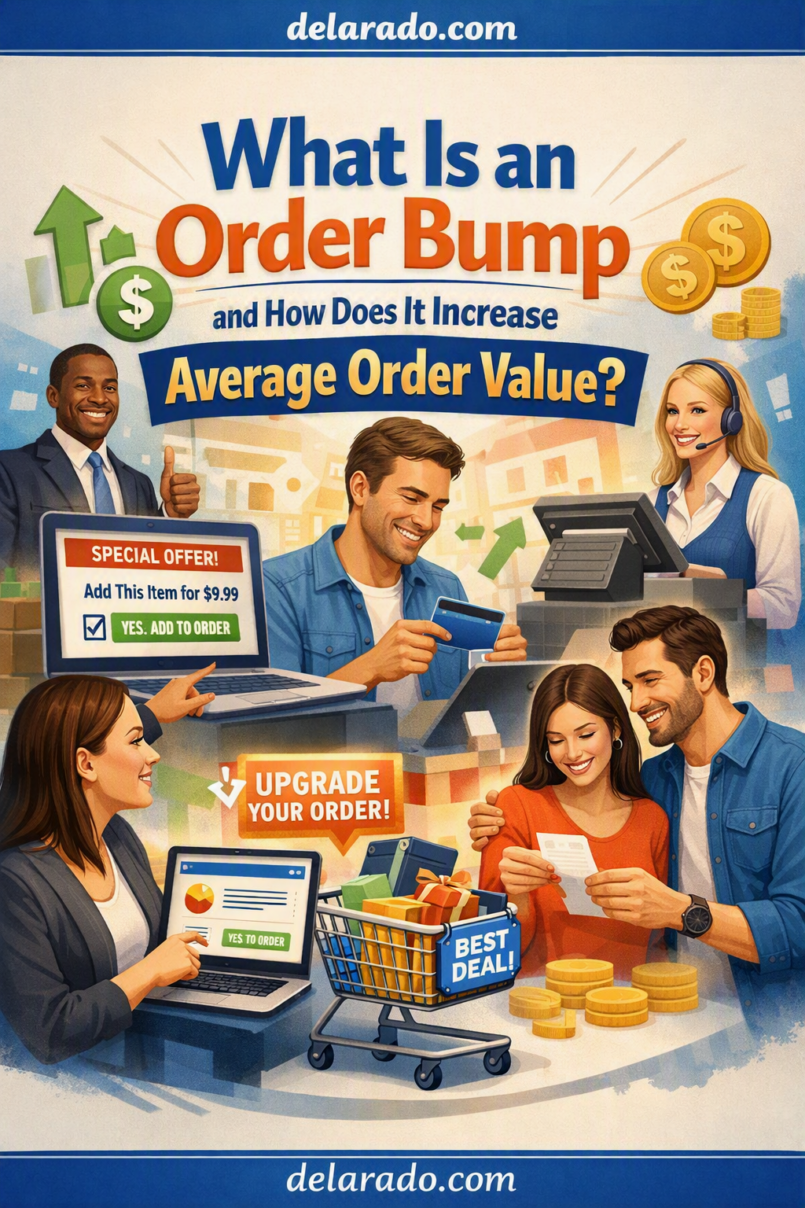
An order bump is a small, optional add-on offer shown during checkout. It gives a customer the chance to add a relevant product, upgrade, service, warranty, template, bonus, or digital resource to the order without leaving the checkout process.
Order bumps can increase average order value, or AOV, when customers choose a useful add-on that genuinely improves the product they are already buying. They should be clearly optional, accurately priced, easy to understand, and selected only through the customer’s informed choice—not through prechecked boxes, hidden fees, confusing subscription terms, or pressure tactics.
WooCommerce describes an order bump as a last-minute checkout offer designed to increase average order value. Shopify defines AOV as the average amount spent per transaction, calculated by dividing total revenue by the number of orders. [106][103]
Who Is This Topic For?
This guide is for eCommerce businesses, digital-product sellers, course creators, coaches, consultants, service providers, WooCommerce store owners, Shopify sellers, affiliates, and anyone who sells a product or service through an online checkout.
This Article Is Helpful If You Want To:
- Understand what an order bump is
- Increase average order value ethically
- Add a relevant checkout offer
- Sell complementary digital products
- Offer a product upgrade at checkout
- Improve a course or digital-product funnel
- Create a WooCommerce order bump
- Test checkout offers
- Reduce unnecessary checkout friction
- Measure checkout conversion and AOV
What Is an Order Bump?
An order bump is an optional offer displayed at or near checkout. It usually appears as a small product card, checkbox, toggle, button, or clearly labeled add-on section that lets a buyer include a related item before completing the purchase.
Simple Example
A customer buys a $29 Website Launch Checklist Bundle.
During checkout, they see an optional $9 add-on: “Add the Website Planning Worksheet Pack.”
The worksheet pack helps them apply the checklist, so it is relevant to the purchase.
If the customer actively chooses the add-on, the order total becomes $38 instead of $29. If they do not choose it, they can complete the original purchase without penalty or confusion.
Order Bump vs. Upsell
| Term | When It Appears | What It Does |
|---|---|---|
| Order bump | Usually during checkout | Offers a small, relevant add-on to the current purchase |
| Upsell | Before or after checkout | Encourages a customer to purchase a higher-priced version, upgrade, or larger offer |
| Cross-sell | Before, during, or after purchase | Suggests a complementary product or service |
| Downsell | After declining or leaving a higher-priced offer | Offers a lower-priced alternative or reduced version |
Shopify describes upselling as encouraging a buyer to purchase a more expensive item, upgrade, or add-on that genuinely enhances the customer’s experience. An order bump is commonly a smaller checkout-stage offer. [104][109]
What Is Average Order Value?
Average order value, often called AOV, is the average amount a customer spends each time they place an order.
AOV Formula
\[
\text{Average Order Value} = \frac{\text{Total Revenue}}{\text{Number of Orders}}
\]
Example Without an Order Bump
If your store earns $2,000 from 100 orders:
\[
\frac{2{,}000}{100} = 20
\]
Your average order value is $20.
Example With an Order Bump
Suppose some customers add a relevant checkout offer, increasing total revenue to $2,300 across the same 100 orders:
\[
\frac{2{,}300}{100} = 23
\]
Your average order value becomes $23.
Shopify defines AOV as the average amount spent per transaction and uses the formula total revenue divided by number of orders. [103]
How Order Bumps Can Increase AOV
An order bump can increase AOV when a customer chooses a relevant addition to something they already planned to buy. The customer has already decided to purchase, so a small, useful add-on may be easier to evaluate than a completely separate product.
Order Bumps Can Help When They:
- Complement the main product
- Save the customer time
- Help the customer use the original product
- Provide a relevant upgrade
- Offer a useful companion resource
- Reduce a common customer problem
- Are priced reasonably relative to the main purchase
- Are easy to understand at a glance
Example: Digital Course
Main product: $79 Beginner WordPress Website Setup Course
Order bump: $14 Website Planning Worksheet Pack
Why it fits: The worksheets help students plan the pages, content, and setup tasks covered in the course.
Example: Physical Product
Main product: $35 reusable water bottle
Order bump: $7 cleaning brush designed for that bottle type
Why it fits: The brush helps the customer maintain the product they are purchasing.
Example: Service Booking
Main product: $150 website consultation
Order bump: $25 pre-consultation website planning worksheet
Why it fits: The worksheet helps the client prepare goals, questions, and project information before the consultation.
An order bump should improve the original purchase. If the add-on feels random, confusing, or unrelated, it can reduce trust or distract the customer during checkout.
Benefits of Order Bumps
Can Increase Average Order Value
When a meaningful number of buyers choose an optional add-on, total revenue can increase without requiring more website visitors or more primary orders.
Can Improve Product Use
A companion template, guide, extended support option, accessory, or implementation resource can help customers get more value from their original purchase.
Can Create a More Helpful Checkout Experience
A relevant add-on can save the customer from having to search for a related item later. The offer should feel useful, not interruptive.
Can Help Bundle Related Resources
Digital-product sellers can offer worksheets, templates, bonus lessons, resource libraries, audio versions, implementation guides, or checklists that work alongside the main purchase.
Can Be Easy to Test
Many checkout platforms allow users to test an order bump with a single product, then review take rate, checkout completion, refunds, support requests, and AOV before expanding the strategy.
Does Not Require a Separate Sales Page
Because the offer appears during checkout, customers can choose it without leaving the buying flow. WooCommerce says accepted order bumps can be added to a cart during checkout to increase AOV without interrupting the purchase flow. [115]
Risks and Limitations
Too Many Offers Can Reduce Checkout Completion
If customers see several add-ons, upsells, timers, popups, and confusing choices before payment, they may feel overwhelmed and abandon the checkout.
Irrelevant Offers Can Harm Trust
A random add-on may make a business seem more focused on extracting extra money than helping the customer complete a useful purchase.
Preselected Add-Ons Can Be Deceptive
Do not precheck boxes that add a paid item, subscription, warranty, donation, or recurring charge. The customer should actively choose the offer with clear understanding of the price and terms.
Hidden Subscription Terms Create Risk
If an order bump involves a recurring charge, membership, subscription, or renewal, explain the price, billing frequency, cancellation method, and material terms clearly before payment.
Discounting Can Reduce Profit
An order bump may raise AOV but still reduce profit if the item has high fulfillment costs, support requirements, refund rates, payment fees, or customer-service burden.
Customer Experience Matters More Than AOV
Do not use order bumps to raise a metric at the expense of trust, clarity, satisfaction, retention, or repeat business.
Not Every Product Needs an Order Bump
A simple low-cost product may not need a checkout add-on. If the best possible offer feels forced, it may be better to keep checkout simple.
Ethical Order Bump Principles
An ethical order bump is optional, relevant, clearly priced, easy to decline, and honest about what the buyer receives.
Use an Order Bump When It Is:
- Relevant to the main product
- Useful to the buyer
- Clearly optional
- Accurately described
- Clearly priced
- Easy to accept or decline
- Supported by accurate terms
- Available without hidden conditions
Avoid Order Bumps That:
- Are preselected by default
- Hide a subscription or recurring charge
- Use misleading countdown timers
- Use fake scarcity messages
- Make declining difficult
- Use confusing product names
- Hide the total order cost
- Claim false savings or benefits
- Use unrelated products
- Depend on misleading customer testimonials
Consumer-protection guidance on negative-option marketing emphasizes clear disclosure of material terms, express informed consent before charges, and simple cancellation methods for applicable subscription offers. [105][108]
How to Choose an Order Bump
Start by looking at what customers commonly need before, during, or after using the main product. The best order bump often helps them use the original purchase more effectively.
Questions to Ask
- What problem does the main product solve?
- What related task may customers need help with?
- What resource would save the buyer time?
- What question do buyers commonly ask after purchase?
- What complement would improve product use?
- Is the add-on genuinely useful to most buyers?
- Can I describe the offer in one or two clear sentences?
- Can customers decline it without confusion?
- Can I support and deliver it well?
- Will it create a better customer outcome?
Order Bump Ideas for Digital Products
- Worksheet pack for a course
- Template bundle for a guide
- Audio version of an ebook
- Implementation checklist
- Bonus mini lesson
- Resource library
- Prompt pack
- Printable planner
- Editable Canva templates
- Quick-start setup guide
Order Bump Ideas for eCommerce
- Product care kit
- Matching accessory
- Gift wrapping
- Extended support or protection, where appropriate
- Refill or replacement item
- Personalization option
- Complementary bundle item
- Expedited shipping option, clearly priced
Order Bump Ideas for Services
- Pre-consultation worksheet
- Priority scheduling, where available
- Additional planning session
- Implementation checklist
- Digital resource bundle
- Recorded training session
- Additional template pack
- Follow-up support session
Step-by-Step Process
Step 1: Review Your Main Product
Start with a product or service that already has a clear purpose. Do not create an order bump to compensate for a weak or unclear main offer.
Review Questions
- What does the main product help the buyer do?
- What is included?
- What is not included?
- What do customers ask about after purchase?
- What related problem remains unsolved?
- Would an add-on improve the customer outcome?
Example
Main product: Beginner WordPress Website Setup Course
Common customer need: A structured way to plan pages, content, and launch tasks
Potential order bump: Website Planning Worksheet Pack
Step 2: Choose One Relevant Add-On
Start with one order bump. Do not add multiple optional products before you know whether buyers find the first one useful.
Good Order Bump Criteria
- Directly related to the main product
- Useful immediately
- Easy to explain
- Easy to deliver
- Clearly optional
- Reasonably priced
- Not required for the main product to work
- Supported by accurate terms
Example
Add the Website Planning Worksheet Pack for $12. It includes editable worksheets for defining website goals, planning essential pages, organizing content, and preparing a launch checklist.
The main course should still be useful without the worksheet pack. The add-on should enhance, not artificially complete, the original purchase.
Step 3: Set a Clear Price
Price the order bump based on its actual value, costs, support needs, and relationship to the main product. Do not choose a price only because it feels easy to accept impulsively.
Pricing Questions
- What is the value of the add-on?
- What costs are involved in providing it?
- Does it require ongoing support?
- Does it have refund or replacement risk?
- How does the price relate to the main product?
- Can I explain the price clearly?
- Does the buyer understand the new total?
Example
Main course: $79
Optional worksheet pack: $12
Total if selected: $91 before any applicable tax or fees
Show the add-on price clearly. If taxes, shipping, recurring billing, or other charges apply, disclose them before the customer completes payment.
Step 4: Write Clear Offer Copy
The order bump copy should explain what the buyer gets, why it is relevant, and what it costs. Keep it short and direct.
Order Bump Copy Formula
Yes, add [specific add-on] for [clear price]. It includes [what the buyer receives] and helps you [relevant use or benefit]. Optional—your main purchase works without it.
Example
Yes, add the Website Planning Worksheet Pack for $12. It includes editable worksheets for mapping your website goals, pages, content, and launch tasks. Optional—your course purchase includes all core lessons without this add-on.
Good Copy Includes:
- Clear product name
- Clear price
- What is included
- Why it complements the main product
- Optional status
- Relevant delivery or access details
Copy to Avoid
- Wait! You Will Regret This If You Skip It
- Only One Left, Act Now
- This Is Required to Succeed
- Get Rich With This Add-On
- Guaranteed Results
- Secret Bonus That Disappears Forever
Step 5: Place the Offer Clearly in Checkout
Place the order bump where the customer can see it without obscuring the checkout fields, total price, payment terms, refund information, or purchase button.
Placement Guidelines
- Keep it near the order summary or checkout details
- Show the price directly beside the offer
- Make selection optional and obvious
- Update the order total clearly when selected
- Do not cover checkout fields with popups
- Make it easy to deselect before payment
- Keep the checkout mobile-friendly
- Do not distract from the main purchase
WooCommerce says order bump offers can appear at checkout and are designed to present last-minute offers that may increase AOV. [106]
Step 6: Make Consent Explicit
The buyer should actively choose an order bump. Do not automatically add paid products or subscriptions to a cart.
Use:
- An unchecked checkbox
- A clear “Add to Order” button
- A clearly labeled toggle set to off by default
- Clear confirmation of the updated total
- Clear order summary before final payment
Do Not Use:
- Prechecked paid add-ons
- Hidden subscription enrollment
- Confusing button labels
- Small hard-to-read terms
- Forced add-ons
- Tricks that make declining harder than accepting
- Fake “No Thanks” language that shames the buyer
Consumer-protection guidance regarding negative-option marketing emphasizes clear material disclosures and express informed consent before a consumer is charged. [105][108]
Step 7: Test the Customer Experience
Before publishing the order bump, complete the checkout process yourself on desktop and mobile. Confirm that the offer, total, receipt, delivery, and customer records work correctly.
Testing Checklist
- Does the offer appear at the intended point?
- Is the add-on optional?
- Is the price visible?
- Does selecting the bump update the total accurately?
- Can the customer remove the bump easily?
- Does checkout work on mobile?
- Does the receipt show the add-on clearly?
- Is the product delivered correctly?
- Do support and refund policies apply correctly?
- Are taxes and fees displayed correctly?
- Does the order confirmation match the customer’s purchase?
Do not activate an order bump until you have tested it through a complete customer journey.
Step 8: Track the Results
Track whether the order bump improves revenue and customer experience. Do not focus only on AOV.
Useful Metrics
- Order bump offer views
- Order bump acceptance rate
- Checkout completion rate
- Average order value
- Revenue per visitor
- Refund rate
- Customer support requests
- Customer satisfaction feedback
- Repeat purchase rate
- Profit after costs and fees
Order Bump Take Rate Formula
\[
\text{Order Bump Take Rate} = \frac{\text{Orders With the Bump}}{\text{Orders Eligible to See the Bump}} \times 100
\]
Example
If 200 customers reach checkout and 30 add the optional offer:
\[
\frac{30}{200} \times 100 = 15\%
\]
A 15% take rate may or may not be useful depending on margins, refund rates, checkout abandonment, support costs, and whether the add-on improves the customer experience.
Step 9: Improve Carefully
Test one major change at a time. Do not change the bump product, price, copy, design, checkout location, and main product price all at once.
Possible Tests
- Different but relevant add-on
- Different title or description
- Different preview image
- Different price point
- Different checkout placement
- Different product bundle
- Shorter or clearer copy
- Different order of benefit points
Questions to Ask
- Does the bump help the customer?
- Does it increase AOV without reducing checkout completion?
- Does it increase refund requests or support tickets?
- Is the copy clear?
- Are customers surprised by the add-on?
- Does the offer remain relevant on mobile?
- Is the total order cost clear?
If an order bump creates customer confusion or does not provide enough value, remove it rather than trying to force it to work.
Order Bump Examples
Digital Course
| Main Product | Order Bump | Why It Fits |
|---|---|---|
| Beginner WordPress Setup Course | Website Planning Worksheet Pack | Helps students apply the course lessons |
| Social Media Content Course | 30-Day Content Calendar Template | Gives students an implementation tool |
| Beginner SEO Course | Keyword Research Worksheet | Supports the practical research process |
Digital Download
| Main Product | Order Bump | Why It Fits |
|---|---|---|
| Website Launch Checklist | Editable Website Planning Templates | Turns the checklist into an action plan |
| Budget Planner PDF | Editable Spreadsheet Version | Gives buyers another usable format |
| Social Caption Pack | Canva Graphic Template Bundle | Helps buyers turn captions into complete posts |
eCommerce Product
| Main Product | Order Bump | Why It Fits |
|---|---|---|
| Reusable water bottle | Compatible cleaning brush | Supports product maintenance |
| Camera | Compatible memory card or protective case | Helps the customer use and protect the purchase |
| Gift product | Gift wrapping or message card | Improves the gift experience |
Service Business
| Main Service | Order Bump | Why It Fits |
|---|---|---|
| Website consultation | Pre-consultation planning worksheet | Helps clients prepare for the call |
| Coaching session | Session notes template or implementation guide | Helps customers act on the session |
| Online workshop | Workshop recording and resource pack | Provides convenient review material |
Programs That Can Help
WooCommerce
WooCommerce can support product checkout and offers an Order Bump extension designed to present last-minute add-on offers during checkout. Its documentation states that the extension is intended to help increase average order value. [106]
FunnelKit
FunnelKit can help WooCommerce store owners create optimized checkout pages, order bumps, upsells, funnels, and post-purchase offers.
CheckoutWC
CheckoutWC can help WooCommerce stores create checkout offers and order bumps. Its documentation says accepted bumps can add products to the cart during checkout without interrupting the purchase flow. [115]
Shopify
Shopify can support online stores, checkout workflows, product pages, and compatible apps for upsells, cross-sells, bundles, and checkout offers. Review current Shopify plan and app limitations before adding checkout functionality.
ClickFunnels
ClickFunnels can help create funnel-based checkout pages, order forms, order bumps, upsells, digital-product delivery, and email follow-up workflows.
Systeme.io
Systeme.io can help create sales funnels, checkout pages, order bumps, one-click upsells, digital products, courses, email campaigns, and automation workflows.
Stripe and PayPal
Payment processors can help collect payment through supported checkout systems. Review current fees, payment options, policies, country availability, refunds, and subscription requirements before choosing a provider.
Google Analytics
Google Analytics can help track product views, checkout starts, purchases, revenue, and funnel drop-off. Use analytics responsibly and avoid collecting unnecessary personal information.
Common Mistakes
Offering an Unrelated Product
A random order bump can feel like a distraction. Offer something that directly complements the main purchase.
Adding Too Many Checkout Offers
One relevant add-on is often enough. Multiple popups, order bumps, upsells, downsells, and countdown timers can make checkout confusing.
Using Prechecked Boxes
Do not automatically add a paid item or subscription. The customer should make an active, informed choice.
Hiding Subscription Terms
If an offer includes recurring billing, explain the price, frequency, cancellation process, and key terms clearly before charging the customer.
Using Fake Urgency
Do not use resettable timers, false “limited stock” claims, misleading “last chance” language, or pressure tactics that do not reflect a real deadline or limitation.
Making the Add-On Required
An order bump should be optional. Do not make customers feel they must buy a separate add-on for the main product to work as described.
Not Showing the Updated Total
When a customer adds an order bump, show the revised total clearly before they pay.
Not Testing Mobile Checkout
Review the order bump, selection controls, price, order summary, forms, payment buttons, and confirmation page on a phone before launch.
Tracking Only AOV
Monitor checkout completion, refunds, support questions, customer satisfaction, repeat purchases, and profit. A higher AOV is not useful if it creates a worse customer experience.
Using Misleading Proof
Do not use fake testimonials, invented savings, false customer counts, fabricated ratings, or AI-generated reviews to push an order bump.
Frequently Asked Questions
What is an order bump?
An order bump is an optional add-on offer presented during checkout. It lets customers add a related product or service to their current order without leaving the purchase flow. [106][107]
How does an order bump increase average order value?
It can increase AOV when customers choose a relevant optional add-on, which raises total revenue across orders. AOV is calculated by dividing total revenue by the number of orders. [103]
What is the difference between an order bump and an upsell?
An order bump is usually a small add-on shown during checkout. An upsell generally encourages a buyer to upgrade to a more expensive product, higher-tier version, or expanded offer before or after checkout.
Should an order bump be preselected?
No. Customers should actively select a paid add-on. Preselected products, hidden subscriptions, and confusing checkout choices can create consumer-protection and trust problems.
What makes a good order bump?
A good order bump is relevant to the main product, clearly optional, useful to the buyer, accurately described, clearly priced, easy to accept or decline, and easy to deliver.
How much should an order bump cost?
Price it based on actual value, costs, support needs, margin, and the relationship to the main product. The buyer should understand the price and updated total clearly before completing payment.
Can I use order bumps for digital products?
Yes. Digital order bumps can include templates, worksheets, bonus lessons, prompt packs, implementation guides, resource libraries, audio versions, and additional downloads that support the main product.
Can I use order bumps for services?
Yes. Relevant examples include planning worksheets, resource packs, priority scheduling, additional support sessions, recordings, implementation guides, or related consulting resources.
Can order bumps hurt conversions?
Yes. Irrelevant offers, too many add-ons, unclear pricing, hidden terms, aggressive urgency, and complicated checkout designs can reduce trust and cause customers to abandon checkout.
How do I measure whether an order bump works?
Track offer views, acceptance rate, checkout completion, AOV, revenue per visitor, refunds, support requests, customer feedback, repeat purchases, and profit. Review these together rather than focusing only on AOV.
What should I avoid with an order bump?
Avoid prechecked boxes, hidden subscriptions, unclear total prices, unrelated products, fake scarcity, misleading testimonials, forced add-ons, deceptive “no thanks” buttons, and any design that makes it difficult for customers to decline.