To become an internet marketer, you do not need to know every platform, buy expensive software, or have a marketing degree. You need a practical set of skills that helps you understand people, communicate value, attract attention ethically, measure results, and improve based on feedback.
Internet marketing is a broad field. A blogger may focus on SEO and affiliate marketing. A freelancer may focus on client outreach, website design, and email marketing. An eCommerce business owner may focus on product pages, customer retention, paid ads, and conversion optimization. A creator may focus on video, storytelling, social media, and audience trust.
The best approach is to learn the foundations first, then choose a specialty based on your business model. You do not need to master everything at once. Start with core skills, apply them to real projects, and improve through consistent practice.
The Core Skills of Internet Marketing
Internet marketing combines communication, research, technology, creativity, strategy, customer service, and analysis. The tools may change, but the core skills remain useful across websites, email, social media, SEO, video, advertising, and online sales.
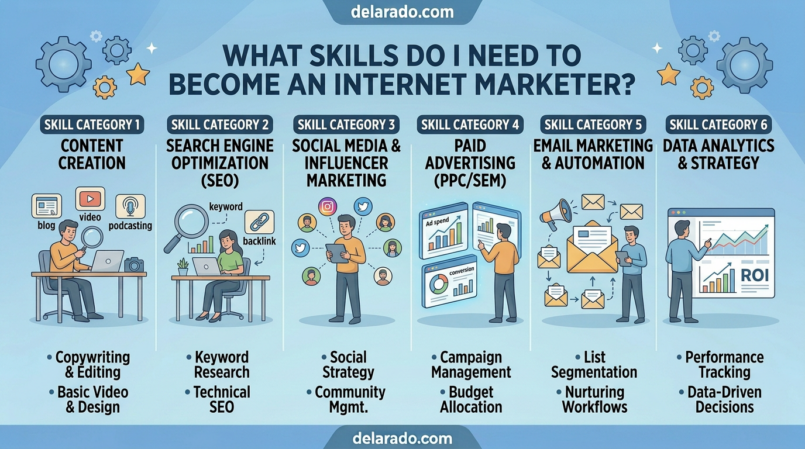
Essential Skill Areas
- Audience research.
- Content creation.
- Writing and communication.
- Search engine optimization.
- Email marketing.
- Social-media marketing.
- Website and landing-page basics.
- Offer creation and sales fundamentals.
- Analytics and performance tracking.
- Customer service and trust building.
- Project management and consistency.
- Ethical marketing and compliance awareness.
Google’s digital marketing and eCommerce certificate curriculum includes campaign management, performance measurement, SEO, customer retention, Google Ads, and social-media marketing—an example of the broad skill areas commonly used in modern marketing work. [357]
1. Audience Research
Audience research is the ability to understand who you are trying to help, what they need, what questions they ask, what problems they face, and what outcomes they want.
Without audience research, marketing becomes guesswork. You may create content nobody needs, build products people do not want, or run ads that attract the wrong visitors.
What to Learn
- How to define a target audience.
- How to identify customer problems and goals.
- How to study competitor websites and reviews.
- How to review search suggestions and customer questions.
- How to interview customers or prospects.
- How to identify objections before a purchase.
- How to understand customer language.
- How to create a practical customer persona.
Example
Suppose you want to sell WordPress website setup services. Your audience may not simply want “a website.” They may want a professional online presence, a way to get more inquiries, an easier way to update services, a mobile-friendly design, better Google visibility, or less technical frustration.
Understanding these real needs helps you write better content and create stronger service packages.
2. Writing and Communication
Writing is one of the most valuable internet marketing skills because it appears everywhere. You use it in blog posts, product descriptions, service pages, email newsletters, landing pages, video scripts, social-media captions, ads, customer support messages, and calls to action.
Good marketing writing is clear, useful, specific, and focused on the audience. It does not rely on hype, confusing jargon, fake urgency, or exaggerated promises.
Writing Skills to Practice
- Writing clear headlines.
- Explaining benefits and features.
- Creating useful blog-post outlines.
- Writing simple calls to action.
- Creating product descriptions.
- Writing email subject lines.
- Writing welcome emails.
- Writing video scripts.
- Answering frequently asked questions.
- Editing for clarity and accuracy.
A Simple Writing Framework
Problem: What is the audience struggling with?
Why it matters: What happens if the problem continues?
Solution: What useful information, product, or service can help?
Next step: What should the reader do now?
For example, instead of writing “We offer the best SEO services,” explain the outcome: “We help local service businesses improve their website pages and Google visibility so potential customers can find the services they need.”
3. Content Marketing
Content marketing is the ability to create useful material that educates, informs, helps, or guides an audience before asking them to buy. Content may include articles, videos, checklists, templates, podcasts, newsletters, product demos, reviews, webinars, social posts, and courses.
Content marketing can attract search traffic, grow an email list, build trust, support sales conversations, educate customers, and reduce common support questions.
Content Skills to Learn
- Topic research.
- Content planning.
- Blog writing.
- Video scripting.
- Creating tutorials.
- Creating comparison articles.
- Creating product reviews.
- Creating lead magnets.
- Repurposing content across platforms.
- Updating older content.
Google recommends people-first content that is helpful, reliable, and created primarily to benefit people rather than manipulate rankings. It encourages content that demonstrates genuine experience or depth of knowledge, is accurate, has a clear focus, and leaves readers feeling they have learned enough to achieve their goal. [237]
Useful Content Formats
- Beginner guides.
- Step-by-step tutorials.
- Tool reviews.
- Comparison articles.
- Case studies.
- Checklists.
- Templates.
- Frequently asked questions.
- Common mistakes articles.
- Resource pages.
- How-to videos.
- Product demonstrations.
4. Search Engine Optimization
SEO is the skill of improving a website so relevant pages can appear in search-engine results when people look for information, products, or services. SEO can help businesses attract visitors who already have a question, problem, or buying need.
SEO is not only about keywords. It involves understanding what people search for, creating the best possible answer, improving website usability, organizing content, and making it easier for search engines to discover and understand pages.
Beginner SEO Skills
- Keyword research.
- Search-intent analysis.
- Writing useful title tags and meta descriptions.
- Using headings clearly.
- Creating simple, readable URLs.
- Internal linking.
- Optimizing images and alt text.
- Improving page speed and mobile usability.
- Using Google Search Console.
- Updating content based on performance data.
SEO Tools to Learn
- Google Search Console.
- Google Analytics.
- Google Trends.
- Google Keyword Planner.
- SE Ranking.
- Ahrefs.
- Semrush.
- AnswerThePublic.
Start simple. Use Google Search Console to see which search queries and pages bring visibility. Use keyword research tools to identify topic ideas, but always write for people first.
5. Website and Landing Page Skills
A website is often the foundation of an online business. It gives you a place to publish content, explain your offer, build credibility, collect email subscribers, sell products, provide support, and control your brand presence.
You do not need to become a professional developer, but basic website skills can save time and help you make better marketing decisions.
Useful Website Skills
- Choosing a domain name.
- Setting up basic hosting.
- Using WordPress.
- Creating pages and blog posts.
- Using menus and categories.
- Installing essential plugins carefully.
- Adding contact forms.
- Creating email opt-in forms.
- Making pages mobile-friendly.
- Improving basic site speed.
- Adding Privacy Policy and Terms pages.
- Creating clear landing pages.
Essential Website Pages
- Homepage.
- About page.
- Contact page.
- Services or product pages.
- Blog or resource section.
- Privacy Policy.
- Terms of Use.
- Affiliate Disclosure, if relevant.
- Refund or return policy, if relevant.
WordPress is a flexible option for blogs, service websites, affiliate sites, content hubs, and eCommerce stores. Hosting companies such as DreamHost and SiteGround can provide WordPress-compatible hosting plans, while website builders such as Wegic may help beginners create basic sites with less technical setup.
6. Email Marketing
Email marketing is the ability to build and communicate with a list of people who have chosen to hear from you. It is valuable because it gives you a direct relationship with your audience instead of relying only on social-media algorithms or paid ads.
Email can help you welcome new subscribers, deliver lead magnets, educate customers, share useful content, promote relevant offers, provide support, recover abandoned carts, and encourage repeat purchases.
Email Skills to Learn
- Creating sign-up forms.
- Building landing pages.
- Creating lead magnets.
- Writing welcome sequences.
- Segmenting subscribers.
- Writing useful newsletters.
- Creating automations.
- Improving open rates and click-through rates.
- Following consent and unsubscribe requirements.
- Measuring conversions from email campaigns.
HubSpot’s digital marketing training includes email marketing alongside content marketing, SEO, social media, and strategy—reflecting email’s role as a core marketing skill. [335]
Beginner Email Strategy
- Create a free resource that solves a small audience problem.
- Add a sign-up form to relevant pages of your website.
- Send a welcome email immediately.
- Send two to four helpful follow-up emails.
- Continue sending useful content consistently.
- Promote relevant offers honestly and selectively.
7. Social Media and Video Marketing
Social media and video can help people discover your brand, learn from you, see your personality, ask questions, and engage with your content. You do not need to be active everywhere. Choose the platform that best matches your audience and your preferred content format.
Useful Social-Media Skills
- Choosing the right platform.
- Creating a content calendar.
- Writing captions and hooks.
- Creating short-form videos.
- Creating carousels and graphic posts.
- Responding to comments professionally.
- Using calls to action.
- Repurposing content.
- Tracking engagement and traffic.
- Building community without spam.
Video Skills to Learn
- Writing simple video scripts.
- Recording screen tutorials.
- Editing video clips.
- Adding captions.
- Creating thumbnails.
- Using voiceovers.
- Creating product demonstrations.
- Repurposing long videos into short clips.
Tools such as Canva, CapCut, InVideo.io, Synthesia.io, ElevenLabs, Kling.ai, and Instadoodle can help create graphics, edit video, generate voiceovers, produce AI-assisted videos, and create visual explainers. Tools can speed up production, but they cannot replace useful ideas, audience knowledge, accuracy, or trust.
8. Offer Creation and Sales Skills
Marketing brings people to an offer. Sales skills help them understand why the offer may be useful and what they should do next. You do not need aggressive sales tactics. Ethical selling means clearly explaining value, answering questions honestly, and helping people make informed decisions.
Offer Creation Skills
- Defining the customer problem.
- Explaining the desired outcome.
- Packaging products or services clearly.
- Setting prices.
- Writing sales pages.
- Creating calls to action.
- Handling common objections.
- Creating guarantees carefully and honestly.
- Designing simple sales funnels.
- Following up with interested leads.
Simple Offer Formula
I help [specific audience] achieve [desired outcome] through [product, service, process, or method].
For example: “I help local service businesses create simple, mobile-friendly WordPress websites with service pages and contact forms so potential customers can find and contact them online.”
Strong offers are specific. They make it clear who the offer is for, what the customer receives, what problem it helps solve, how much it costs, and how to begin.
9. Analytics and Performance Measurement
Analytics helps you replace guesses with evidence. You can use data to understand where visitors come from, what content performs well, which pages generate leads, which emails create clicks, and what offers produce sales.
You do not need to become a data scientist. Start with a few meaningful numbers tied to your business goals.
Metrics Worth Tracking
- Website traffic.
- Search impressions and clicks.
- Top-performing pages.
- Email subscribers.
- Email open rates and click-through rates.
- Lead magnet downloads.
- Contact-form inquiries.
- Sales conversations.
- Conversion rate.
- Average order value.
- Customer acquisition cost.
- Refund rate.
- Customer retention.
- Profit.
Tools to Learn
- Google Analytics.
- Google Search Console.
- Email marketing platform reports.
- Social-media analytics.
- Advertising platform dashboards.
- CRM reporting tools.
- Spreadsheet tracking.
For beginners, Google Analytics and Google Search Console are strong starting points. Google’s marketing training also highlights performance measurement as a key skill area, because successful campaigns need to be measured and improved over time. [357]
10. Customer Service and Trust Building
Internet marketing is not only about attracting attention. It is also about keeping promises after someone becomes a customer. Great customer service can lead to repeat purchases, referrals, positive reviews, testimonials, and a stronger reputation.
Trust-Building Skills
- Communicating clearly.
- Responding professionally to questions.
- Setting realistic expectations.
- Handling complaints respectfully.
- Creating clear policies.
- Using honest testimonials.
- Disclosing affiliate relationships.
- Protecting customer information.
- Delivering work on time.
- Asking for feedback and improving.
Trust is especially important online because people cannot always meet you in person before deciding whether to buy. Use a real About page, clear contact details, transparent pricing, accurate content, customer-support information, and appropriate disclosures.
11. Ethical Marketing and Compliance Awareness
Ethical marketing protects your audience and your business. Do not make claims that you cannot support. Do not use fake reviews, fake scarcity, copied content, misleading before-and-after examples, or hidden affiliate relationships.
Important Ethical Practices
- Use clear affiliate disclosures.
- Do not make guaranteed income claims.
- Do not use misleading health or financial claims.
- Use honest testimonials from real customers.
- Respect email consent and unsubscribe requests.
- Protect customer data.
- Use copyrighted images, video, music, and content legally.
- Be transparent about pricing, refunds, and subscriptions.
- Review AI-generated content for accuracy before publishing.
Google’s helpful-content documentation encourages creators to consider whether their content is trustworthy, has clear sourcing, reflects relevant expertise, and avoids easily verifiable factual errors. [237]
12. Project Management and Consistency
Internet marketing has many moving parts. You may need to plan content, publish articles, respond to emails, update pages, create videos, review data, talk with customers, and manage tools. Project management helps you keep making progress without becoming overwhelmed.
Useful Organization Skills
- Setting weekly priorities.
- Creating content calendars.
- Tracking tasks.
- Creating repeatable checklists.
- Documenting processes.
- Setting realistic deadlines.
- Batching similar tasks.
- Reviewing results monthly.
- Deciding what not to do.
Simple tools such as Google Sheets, Notion, Trello, Asana, ClickUp, and a basic calendar can help organize work. The best system is the one you will actually use consistently.
Skills to Learn First
Trying to learn every internet marketing skill at once can lead to frustration. For most beginners, the best path is to develop foundational skills first and add advanced skills when needed.
Recommended Learning Order
- Audience research and niche selection.
- Basic writing and communication.
- Website setup and landing-page basics.
- Content creation.
- Basic SEO and keyword research.
- Email list building.
- One social-media or video platform.
- Offer creation and simple sales fundamentals.
- Analytics and conversion tracking.
- Automation and paid advertising.
Paid advertising should generally come later because it can cost money quickly. Learn how to define your audience, create a useful offer, build a landing page, and track conversions before investing heavily in ads.
How to Practice Internet Marketing Skills
Reading and watching courses can help, but practical work builds confidence faster. Create a small project where you can practice multiple skills at the same time.
Beginner Practice Project
- Choose a topic or niche you understand or want to learn.
- Build a simple WordPress website.
- Create a homepage, About page, and Contact page.
- Publish five helpful articles or tutorials.
- Set up Google Search Console and Google Analytics.
- Create a small lead magnet.
- Add an email sign-up form.
- Write a three-email welcome sequence.
- Create five social-media posts or short videos.
- Review results after 30 to 60 days and improve one area.
Even if the project does not earn money immediately, it can become a portfolio piece that demonstrates your skills to clients, employers, partners, or future customers.
Final Thoughts
The most important skills for internet marketers are audience research, communication, content creation, SEO, website basics, email marketing, analytics, offer creation, customer service, and ethical decision-making.
You do not need to become an expert in every area before you start. Learn the foundations, choose one business model, practice on real projects, and build deeper skills based on what your business needs next.
Strong internet marketers do not rely only on tools or trends. They understand people, create useful value, build trust, measure results, and improve consistently.
Frequently Asked Questions
Do I need a degree to become an internet marketer?
No. A degree can be useful, but it is not required. Practical skills, portfolio work, customer understanding, measurable results, and consistent learning are often more important.
What is the most important skill in internet marketing?
Understanding your audience is one of the most important skills because it influences your content, offers, website, emails, ads, and customer experience. Clear communication and useful content are also essential.
Can I learn internet marketing for free?
Yes. You can learn many basics through free resources, documentation, YouTube tutorials, Google Search Console, Google Analytics, and practical website projects. Paid courses and tools may help later, but they are not required to begin.
Should I learn SEO or social media first?
Both are useful, but SEO is often valuable for long-term website traffic while social media can provide faster feedback and interaction. Start with the channel that best matches your audience and content style.
Do I need to know how to code?
No. Basic technical knowledge can help, but most beginners can build websites, create content, set up email forms, and manage campaigns with no-code tools and WordPress.
Can AI replace internet marketing skills?
AI can help with research, outlining, drafts, content ideas, video scripts, analysis, and automation. It cannot replace customer understanding, strategic judgment, first-hand experience, ethical decisions, quality control, or trust building.
How long does it take to learn internet marketing?
You can learn basic concepts in weeks, but real skill develops through ongoing practice. The best way to improve is to build projects, publish content, review data, listen to customers, and refine your approach over time.