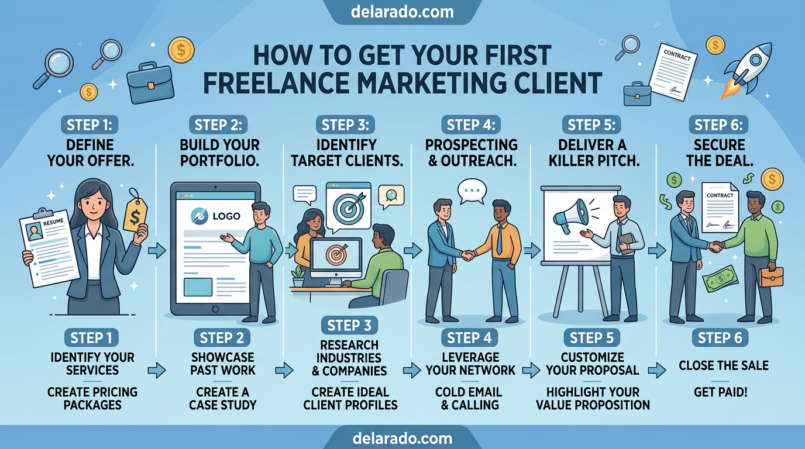
Getting your first freelance marketing client is less about having a perfect website, expensive software, or thousands of social-media followers. It is about offering a clear service that solves a real problem for a specific type of customer, showing enough evidence that you can help, and starting conversations professionally.
Many new freelancers make the mistake of offering “all digital marketing services” to everyone. That makes it hard for a potential client to understand what they are buying. A focused offer—such as WordPress website setup for local service businesses, social-media content for fitness coaches, or email welcome sequences for online stores—is easier to explain, price, and deliver.
Your first client does not need to be your biggest client. The goal is to gain practical experience, deliver a strong result, learn what clients need, collect honest feedback, and improve your offer over time.
What Is Freelance Marketing?
Freelance marketing means providing marketing-related services independently to businesses, creators, organizations, or individuals. You may work on one-time projects, monthly retainers, consulting engagements, or ongoing support.
Freelance Marketing Service Examples
- WordPress website setup.
- Website maintenance.
- Blog writing and editing.
- SEO audits.
- Keyword research.
- Local SEO support.
- Google Business Profile optimization.
- Email marketing setup.
- Welcome email sequences.
- Social-media content creation.
- Short-form video editing.
- Canva graphic design.
- Content calendar planning.
- Landing-page writing.
- Product description writing.
- Lead magnet creation.
- Analytics reporting.
You do not need to offer all of these services. Starting with one specific service can make it easier to learn, build a portfolio, find prospects, and create a repeatable process.
Choose One Clear Service
Your first service should solve a problem that businesses understand and are willing to pay to solve. It should also match your current skills or a skill you can learn and practice responsibly.
Weak Offer
I help businesses with digital marketing.
Stronger Offers
- I create simple WordPress websites for local service businesses that need more online inquiries.
- I write SEO-focused blog articles for small software companies.
- I create 12 branded Instagram posts and captions each month for local fitness coaches.
- I set up lead magnets and welcome email sequences for online course creators.
- I help local businesses improve their Google Business Profile information and customer review process.
- I edit short educational videos for creators and small business owners.
Use This Service Formula
I help [specific audience] achieve [specific outcome] through [specific marketing service].
Examples
- I help local contractors get more service inquiries through mobile-friendly WordPress websites.
- I help beginner online coaches build email welcome sequences that educate new subscribers.
- I help small eCommerce brands create product descriptions that explain benefits clearly.
- I help content creators turn long videos into short captioned clips for social media.
A focused offer makes your outreach more relevant because potential clients can quickly see whether you solve a problem they have.
Choose a Target Client
You are more likely to get your first client if you focus on a specific type of business. A target client can be defined by industry, location, company size, business model, platform, or problem.
Target Client Examples
- Local home-service businesses.
- Fitness coaches.
- Real estate agents.
- Independent consultants.
- Small eCommerce stores.
- Online course creators.
- Therapists and wellness professionals.
- Local restaurants.
- Wedding photographers.
- Freelance designers.
- Small software companies.
- Nonprofit organizations.
Questions to Help You Choose
- Which type of business do I understand?
- Which businesses have a visible marketing problem?
- Which businesses can afford my service?
- Where can I find potential clients?
- What service could make a noticeable difference for them?
- Can I create a portfolio example for this type of client?
- Would I enjoy working with this audience?
Market and competitive research can help you understand what competitors offer, how they price services, and how they attract customers. It can also help you identify gaps where a focused service may provide a clearer value proposition. [239]
Research Client Problems
Before contacting businesses, understand the problems they may be facing. Do not assume every business needs the same service. Look for visible gaps and listen to what business owners say they need.
Common Marketing Problems
- An outdated or missing website.
- No clear contact form or booking process.
- Poor mobile website experience.
- Few customer reviews.
- Inconsistent social-media content.
- No email list or follow-up process.
- Weak or missing service pages.
- Unclear product descriptions.
- No helpful blog content.
- Slow website performance.
- Incomplete Google Business Profile information.
- Few conversion-focused calls to action.
How to Research Potential Clients
- Review their website.
- Search for their business on Google.
- Review their Google Business Profile.
- Look at social-media activity.
- Read recent customer reviews.
- Review service pages or product pages.
- Check whether their contact forms work.
- Look for broken links or outdated information.
- Review their email signup process.
- Search for competitors in the same industry.
The goal is not to criticize a business. The goal is to identify one specific way you may be able to help.
Build a Small Portfolio
Clients want evidence that you can deliver. If you have not worked with paying clients yet, create sample work that demonstrates your skills honestly.
Do not pretend that sample work was completed for a real client. Label it clearly as a sample, mock project, demonstration, or personal project.
Portfolio Ideas by Service
| Service | Portfolio Example |
|---|---|
| WordPress web design | Create a sample website for a fictional local plumber, fitness coach, or landscaping company. |
| Blog writing | Write three sample articles for one defined industry. |
| SEO | Create a sample website audit and keyword research document. |
| Social media | Create a 10-post content calendar and branded visual samples. |
| Email marketing | Create a lead magnet landing page and a five-email welcome sequence. |
| Video editing | Edit short sample videos using footage you own or are allowed to use. |
| Canva design | Create branded social posts, lead magnet covers, or simple ad creatives. |
What to Include in a Portfolio Case Study
- The business type or sample scenario.
- The problem you aimed to solve.
- The work you created.
- Your process.
- The tools you used.
- What you would measure in a real project.
- A clear label if the project is a sample.
Three focused examples are usually more useful than 20 unrelated pieces of work.
Create a Simple Freelance Website
You do not need an elaborate website before looking for clients. A simple WordPress website, portfolio page, or professional landing page can be enough to explain your service and show examples.
Essential Portfolio Website Pages
- Homepage.
- About page.
- Services page.
- Portfolio or case studies page.
- Contact page.
- Privacy Policy.
- Terms of Use.
- Testimonials page when you have genuine client feedback.
Homepage Structure
- Clear headline explaining who you help.
- Short description of your main service.
- Relevant portfolio examples.
- Brief explanation of your process.
- Clear call to action.
- Contact or consultation link.
Example Homepage Headline
I Build Simple WordPress Websites for Local Service Businesses That Need More Online Inquiries.
Example Call to Action
Request a free 15-minute website consultation to discuss your current website and online goals.
Your website does not need to claim that you are an expert if you are new. Be honest about your experience, show your work, and explain the practical value you provide.
Create a Simple Service Package
A service package defines what a client receives, how long delivery takes, what the price includes, and what is outside the scope. Clear packages make it easier for clients to say yes and protect you from unclear expectations.
Service Package Elements
- Service name.
- Target client.
- Problem solved.
- What is included.
- What is not included.
- Project timeline.
- Number of revisions.
- Price or starting price.
- Payment terms.
- Client responsibilities.
- Support period after delivery.
Example: WordPress Website Setup Package
Service: Basic WordPress Website Setup for Local Service Businesses.
Includes:
- Five-page mobile-friendly WordPress website.
- Homepage, About page, Service pages, and Contact page.
- Contact form setup.
- Basic on-page SEO setup.
- Basic Privacy Policy and Terms page placeholders for legal review.
- One round of revisions.
- Client handoff guide.
Does not include: Custom software development, advanced SEO campaign management, paid advertising, ongoing content writing, legal advice, or hosting fees unless separately agreed.
Use a written agreement for paid client work. Consult a qualified legal professional for contracts suited to your location and services.
Price Your First Service
Pricing can feel difficult when you are new. Avoid pricing only by guessing what competitors charge or offering unlimited work for a very low fee. Consider the value provided, time required, tools, taxes, project complexity, revisions, communication, support, and desired profit.
Pricing Questions
- How much time will this project realistically take?
- What software, contractors, or expenses are involved?
- How many revisions are included?
- What result or problem does the service address?
- What are comparable services priced at in the market?
- What is the client’s budget and business size?
- What support is included after delivery?
- How will payment be collected?
Pricing Models
- Fixed project price.
- Hourly rate.
- Monthly retainer.
- Productized service package.
- Consultation fee.
- Performance-based fee, used carefully with clear agreements.
For beginners, a fixed-price package is often easier to explain and manage than an open-ended hourly arrangement. Make sure the scope is clear so the project does not grow beyond what you priced.
Find Potential Clients
Your first client may come from people you already know, local businesses, professional communities, freelance marketplaces, referrals, social media, content marketing, or direct outreach.
Potential Client Sources
- Friends, family, and professional contacts.
- Former coworkers.
- Local business directories.
- Google Maps and Google Search.
- LinkedIn.
- Facebook and local community groups.
- Industry communities.
- Freelance marketplaces.
- Local networking events.
- Chambers of commerce.
- Referrals from other freelancers.
- Partnerships with web designers, photographers, or consultants.
- Content that demonstrates your expertise.
Start With People Who Already Know You
You do not need to ask friends or family to hire you if they are not a fit. But you can let your network know what service you are offering and who you help.
Example Message
Hi [Name], I’m now offering simple WordPress website setup for local service businesses that need a clearer online presence and an easier way for customers to contact them. If you know a business owner who may need help with an outdated or missing website, I would appreciate an introduction.
Keep the message professional and specific. Do not pressure people or mass-message everyone with a generic sales pitch.
Use Direct Outreach Professionally
Direct outreach means contacting a potential client directly through email, LinkedIn, a contact form, or another appropriate business channel. It can work when you are respectful, relevant, and focused on a real opportunity to help.
Good Outreach Principles
- Research the business before writing.
- Use the person’s or business’s name correctly.
- Mention one specific observation.
- Offer one practical idea.
- Keep the message brief.
- Do not make exaggerated promises.
- Do not criticize or shame the business.
- Use a simple call to action.
- Respect a “no” or no response.
- Follow email and privacy rules that apply to your outreach.
Simple Outreach Email Template
Subject: Quick idea for [Business Name]’s website
Hi [Name],
I came across [Business Name] while looking at local [industry] businesses in [location]. I noticed that [specific, respectful observation, such as a missing mobile call-to-action, outdated service page, or unclear contact option].
I help [type of business] improve [specific outcome] through [specific service]. One simple improvement could be [brief relevant suggestion].
If you are interested, I would be happy to send a short, no-obligation overview of what I would improve first.
Best,
Your Name
Your Website
Your Contact Information
Do not send the same generic message to hundreds of businesses. Personalized outreach is more respectful and more likely to start a useful conversation.
Offer a Small, Useful First Step
Potential clients may not be ready to buy a large project from someone they do not know. A small, clear first step can reduce risk and show how you work.
Starter Offer Ideas
- Website homepage audit.
- Google Business Profile review.
- SEO content audit.
- 15-minute consultation.
- Sample social-media content calendar.
- Email welcome sequence review.
- Basic keyword research document.
- Short video editing sample.
- Landing page feedback session.
Example Website Audit Offer
I will review your homepage, service pages, mobile usability, contact process, and basic calls to action. You will receive a short document with three practical improvements you can make, whether or not you choose to work with me.
Be clear about what is free and what is paid. Do not provide unlimited unpaid consulting in hopes that a prospect might hire you later.
Use Google Business Profile for Local Clients
If you serve local businesses or operate a local freelance service, a Google Business Profile may help potential customers find your business through Google Search and Maps.
Google says a Business Profile lets you share business details, define service areas and specialties, and signal what you do and where you work—even if you operate without a physical storefront. [536]
Local Profile Basics
- Use your real business name.
- Select accurate business categories.
- Describe your services clearly.
- Add your real service area if applicable.
- Use accurate contact information.
- Link to your website.
- Add genuine photos or portfolio examples.
- Keep business hours current.
- Ask for honest reviews after completing work.
Do not create misleading location listings or pretend to have offices where you do not operate. Keep profile details accurate and aligned with Google’s current guidelines.
Use Content Marketing to Attract Clients
Direct outreach can create conversations quickly, but content marketing can build long-term trust. Publish helpful content for the type of clients you want to serve.
Content Ideas for Freelance Marketers
- Five Website Mistakes Local Contractors Make.
- How to Improve a Small Business Contact Page.
- What Should a Local Service Website Include?
- How to Create a Welcome Email Sequence for New Leads.
- How to Use Google Business Profile for a Service Area Business.
- Beginner SEO Checklist for Small Businesses.
- How to Turn One Long Video Into Five Short Social Clips.
- Small Business Website Audit Checklist.
Helpful content can demonstrate your knowledge, create search visibility, give prospects a reason to trust you, and provide a natural way to offer a consultation or service package.
Run a Good Discovery Call
A discovery call is a conversation to understand whether a client’s needs match your service. It should focus on listening, not pushing a sale.
Discovery Call Questions
- What are you trying to improve right now?
- How do new customers currently find you?
- What is working well with your current marketing?
- What is frustrating or not working?
- What result would make this project worthwhile?
- What timeline are you working with?
- Who will provide content, images, approvals, or access?
- What budget range have you set aside?
- What have you tried before?
- What questions do you have about my process?
What to Avoid
- Promising results you cannot guarantee.
- Talking more than the client.
- Offering a solution before understanding the problem.
- Using confusing marketing jargon.
- Pressuring someone to decide immediately.
- Agreeing to work outside your skills or capacity.
If the client is not a good fit, it is better to say so respectfully than to accept a project you cannot deliver well.
Write a Clear Proposal
A proposal explains the project scope, deliverables, price, timeline, responsibilities, and next steps. It helps prevent misunderstandings before work begins.
Proposal Sections
- Client name and business name.
- Summary of the client’s goals.
- Recommended service or package.
- Specific deliverables.
- Project timeline.
- Client responsibilities.
- Price and payment schedule.
- Revision limits.
- What is not included.
- Assumptions or dependencies.
- Next steps to approve the project.
Simple Proposal Statement
Based on our conversation, I recommend a five-page WordPress website setup designed to make it easier for potential customers to understand your services and contact your business. The project includes [deliverables], will be completed within [timeline] after required materials are received, and costs [price].
Use a contract or service agreement before starting paid work. A proposal alone may not provide the legal protection or terms needed for a professional client relationship.
Deliver Excellent Work
Your first client can become a source of learning, feedback, referrals, and a future case study. Deliver what you promised, communicate clearly, meet reasonable deadlines, and handle issues professionally.
Client Delivery Checklist
- Confirm the project scope before starting.
- Create a timeline with milestones.
- Request needed materials early.
- Communicate progress at agreed intervals.
- Track revisions clearly.
- Test deliverables before handoff.
- Provide simple instructions or training.
- Send final files and access details securely.
- Explain ongoing support terms.
- Ask for feedback after delivery.
Good communication is often as important as technical skill. Clients want to know what is happening, what you need from them, and when the work will be complete.
Ask for an Honest Testimonial
After you deliver quality work, ask the client for honest feedback. A genuine testimonial can help future prospects understand what it is like to work with you.
Testimonial Request Example
Hi [Client Name], I appreciate the opportunity to work with you. If you are comfortable sharing feedback, I would be grateful for a short honest testimonial about your experience, the problem you wanted to solve, and what you found most helpful. Your feedback will also help me improve my service.
Use testimonials honestly. The FTC’s guidance states that endorsements and testimonials should be truthful, should reflect the endorser’s real experience, and should not be presented out of context or distorted. [391]
Do Not:
- Write fake testimonials.
- Offer payment only for positive reviews.
- Edit a testimonial in a misleading way.
- Use a client’s name, logo, or photo without permission.
- Claim that every client will get the same result.
Turn One Client Into More Opportunities
Your first client can lead to more than one project. If you do good work and communicate well, you may receive repeat work, referrals, a case study, or an opportunity to expand your service.
After Completing a Project
- Ask for feedback.
- Request a testimonial with permission.
- Ask whether they know another business that may need help.
- Offer a relevant maintenance or follow-up service.
- Create a case study if the client agrees.
- Stay in touch through occasional helpful updates.
- Document your process for future projects.
Example Follow-Up Offer
Now that the website is live, I also offer a monthly care plan that includes plugin updates, backups, security checks, uptime monitoring, and a limited number of page edits. Let me know if you would like details.
Only offer services that genuinely help the client. Do not turn every completed project into pressure for additional purchases.
Common Mistakes New Freelancers Make
- Offering too many unrelated services.
- Trying to work with every type of client.
- Using vague service descriptions.
- Starting projects without a clear scope.
- Underpricing without understanding time and costs.
- Promising outcomes you cannot guarantee.
- Working without a written agreement.
- Accepting projects outside your skills or capacity.
- Sending generic mass outreach messages.
- Criticizing prospects instead of offering useful ideas.
- Using fake portfolio work or fake testimonials.
- Failing to communicate during projects.
- Not asking for feedback, referrals, or case study permission.
A 30-Day First Client Plan
Week 1: Choose Your Offer
- Choose one marketing service.
- Choose one target client type.
- Research common client problems.
- Create a clear service statement.
- Outline your service package and delivery process.
Week 2: Build Your Proof
- Create two or three honest portfolio examples.
- Build a simple website or portfolio page.
- Write a short About page and service page.
- Create a basic consultation or contact form.
- Prepare a simple proposal template.
Week 3: Start Conversations
- Tell your network what service you offer.
- Identify 20 to 30 relevant potential clients.
- Research each prospect briefly.
- Send a small number of personalized outreach messages.
- Offer a useful first step, audit, or consultation.
- Track responses in a spreadsheet or CRM.
Week 4: Improve and Follow Up
- Follow up professionally with interested prospects.
- Review which messages received replies.
- Improve your offer based on prospect questions.
- Practice discovery calls.
- Send clear proposals to qualified prospects.
- Continue publishing helpful content for your niche.
The purpose of the first 30 days is to build a focused offer, create proof, start conversations, and learn what potential clients need. There is no guaranteed number of clients or timeline.
Final Thoughts
Getting your first freelance marketing client starts with clarity. Choose one service, one audience, and one problem you can solve. Build a small but honest portfolio, create a clear package, and reach out to potential clients professionally.
Focus on being useful rather than sounding impressive. Research businesses before contacting them, offer relevant ideas, listen during discovery calls, use clear agreements, and deliver high-quality work.
Your first client can become the foundation for better skills, stronger case studies, testimonials, referrals, and a more sustainable freelance marketing business.
Frequently Asked Questions
Can I get freelance marketing clients with no experience?
Yes. Start by learning one practical skill, creating honest sample work, offering a clear service, and reaching out to businesses that may need help. Do not misrepresent sample work as paid client work.
What marketing service is easiest to sell as a beginner?
Beginner-friendly services can include WordPress setup, social-media content creation, blog writing, video editing, basic SEO research, email setup, Canva design, and website updates. The best choice depends on your skills and the needs of your target clients.
Should I work for free to get my first client?
You can create portfolio samples or offer a limited free audit, but avoid doing large amounts of unpaid client work. If you choose to do a discounted or pro bono project, define the scope, timeline, and expectations clearly.
How do I find local freelance clients?
You can use Google Maps, Google Business Profile, local directories, chambers of commerce, networking events, referrals, LinkedIn, community groups, and personalized outreach. Focus on businesses that match your service and target audience.
How much should I charge for freelance marketing services?
Pricing depends on scope, time, skills, market, expenses, client budget, revisions, and value provided. A fixed-price package is often easier for beginners than open-ended pricing. Track your time and costs so you can improve pricing over time.
Do I need a contract for freelance work?
Written agreements are strongly recommended for paid client work. They should clarify scope, payment, timeline, revisions, responsibilities, ownership, confidentiality, and cancellation terms. Consult a qualified legal professional for an agreement suited to your situation.
How long does it take to get a freelance client?
There is no guaranteed timeline. It depends on your service, target market, portfolio, outreach quality, pricing, demand, and consistency. Focus on building proof, starting relevant conversations, and improving based on feedback.